Hormones
Testosterone Bloodwork Interpretation: A Clinical Blueprint for Optimization
By Samir Levin · August 22, 2026 · 16 min read
Disclaimer
This article is for informational and educational purposes only. It does not constitute medical advice, diagnosis, or treatment. Always consult a qualified healthcare provider before starting any new supplement, peptide, or protocol. Keys to Health and Samir Levin are not responsible for any actions taken based on this content.
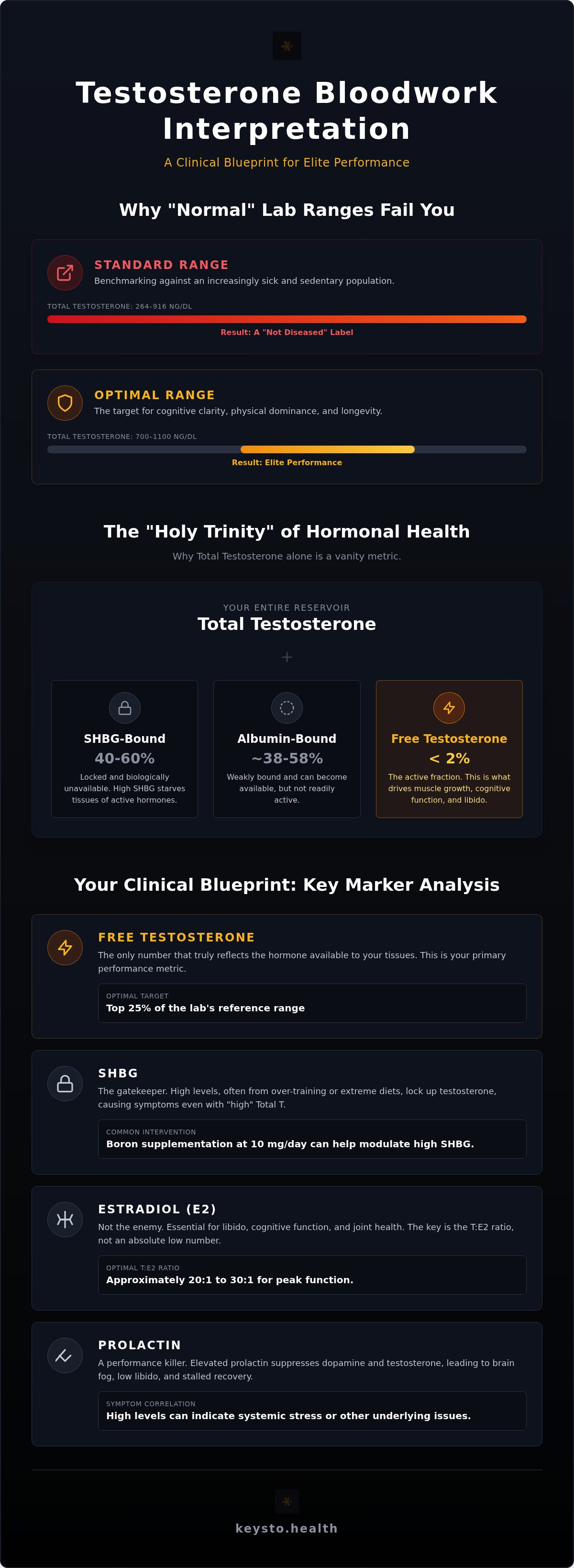
Standard reference ranges are a statistical average of an increasingly sick and sedentary population. If your clinician tells you that your levels are "normal" because they fall within a bracket designed to include 95% of the general public, they are benchmarking you against mediocrity. Mastering testosterone bloodwork interpretation requires looking past these outdated scales that ignore clinical symptoms. A 2017 study in the Journal of Clinical Endocrinology and Metabolism established a harmonized reference range of 264 to 916 ng/dL for healthy men, yet you deserve better than a "not diseased" label.
I understand the frustration of seeing a 310 ng/dL result flagged as healthy while you struggle with brain fog and stalled recovery. This guide provides a clinical blueprint for moving from basic data points to a high-performance protocol. We will analyze the "Holy Trinity" of hormonal health: Total Testosterone, Free Testosterone, and Sex Hormone-Binding Globulin (SHBG).
You will learn to identify your specific biological bottlenecks and understand how Estradiol and Prolactin impact your results. We are going to transform your raw lab data into actionable intelligence for longevity and elite performance.
Key Takeaways
- Understand why standard laboratory reference ranges represent a statistical average of a declining population rather than a target for elite health.
- Master the interplay between Total Testosterone, Free Testosterone, and SHBG to identify your actual bioavailable hormone levels.
- Utilize a systematic clinical blueprint for testosterone bloodwork interpretation to differentiate between primary and secondary hypogonadism.
- Analyze critical secondary markers like Estradiol and Prolactin to resolve common performance bottlenecks like brain fog and stalled recovery.
- Leverage precision tools like the HRT Bloodwork Analyzer to convert laboratory data into a high-performance optimization protocol.
Table of Contents
- Why Standard Reference Ranges Fail the Elite Performer
- The Holy Trinity of Testosterone Labs: Total, Free, and SHBG
- Beyond the T-Score: Interpreting Estrogen, Prolactin, and LH/FSH
- Step-by-Step Interpretation: Identifying Your Biological Bottleneck
- Implementing the Protocol: From Data to Biological Execution
Why Standard Reference Ranges Fail the Elite Performer
Standard laboratory reference ranges are not a target for excellence. They act as a statistical safety net designed to identify overt clinical disease, not to facilitate elite performance or longevity. When you receive a lab report, the "normal" range represents the middle 95% of the population that recently visited that specific lab. In 2026, that population is increasingly sedentary, obese, and metabolically dysfunctional. Benchmarking your biology against a declining average is a recipe for mediocrity.
I have consulted with numerous clients who presented with a total testosterone of 800 ng/dL but suffered from every classic symptom of hypogonadism. Their primary care physicians dismissed their concerns because their numbers sat comfortably within the standard bracket. In reality, their Sex Hormone-Binding Globulin (SHBG) was so high that their bioavailable testosterone was equivalent to that of an eighty year old man. This is why testosterone bloodwork interpretation requires a nuanced understanding of hormonal interplay rather than a simple glance at a single value.
The Decline of the "Average" Male
Average testosterone levels in young men dropped by approximately 25% between 1999 and 2016. This systemic decline means that a 30 year old man today often has the hormonal profile that his grandfather had at age 60. Environmental disruptors, including microplastics and endocrine-disrupting chemicals, have fundamentally altered the male endocrine system. You can find a comprehensive overview of testosterone synthesis and its biological effects to understand how these external factors interfere with the hypothalamic-pituitary-testicular axis (HPTA).
Reference ranges have shifted downward to accommodate this new, lower average. A level of 300 ng/dL might be "statistically normal" in 2026, but it is biologically disastrous for a man seeking cognitive clarity and physical dominance. We must reject these sliding scales and focus on functional optimization.
Optimal vs. Normal: The Biohacker’s Brackets
For the elite performer, the goal is an optimal range, which typically sits between 700 and 1100 ng/dL for total testosterone. However, numbers are secondary to clinical symptoms. If you have "perfect" labs but suffer from low libido and poor recovery, your protocol is failing. We use the HRT Bloodwork Analyzer to identify these discrepancies before they manifest as systemic burnout. Establishing a personal baseline while you are asymptomatic is critical. This data allows us to identify your specific biological bottlenecks when performance eventually dips.
The Holy Trinity of Testosterone Labs: Total, Free, and SHBG
Total testosterone alone is a vanity metric. True testosterone bloodwork interpretation requires a deep dive into the three variables that dictate your hormonal reality. Total Testosterone represents the entire reservoir in your system, but it tells us nothing about how much of that hormone actually reaches the target tissue.
The liver produces Sex Hormone-Binding Globulin (SHBG), a transport glycoprotein that acts as a regulatory buffer. This protein binds to testosterone with high affinity, effectively locking it away from androgen receptors. SHBG holds roughly 40% to 60% of your total T; another large portion binds weakly to albumin. Only the unbound fraction, known as Free Testosterone, can cross cell membranes to initiate gene transcription for muscle protein synthesis and cognitive function.
The SHBG Mechanism: The Gatekeeper of Performance
SHBG has a significantly higher binding affinity for testosterone than for estrogen. When SHBG levels climb, they disproportionately strip your system of active androgens while leaving estrogens more available. I frequently see high SHBG in clients who over-train or follow excessively low-carb diets. This state creates a starvation effect where tissues cannot access the circulating hormone. We can modulate SHBG through specific interventions like boron supplementation at 10 mg/day or by optimizing insulin sensitivity. MedlinePlus offers a basic Testosterone Levels Test summary, but it lacks the clinical depth needed to manage these SHBG fluctuations.
Calculating the Free Testosterone Index (FTI)
The ratio of Total T to SHBG determines your Free Testosterone Index. We target a Free T percentage of 2% to 3% for peak physiological function. If your total T is 900 ng/dL but your Free T is only 1%, you will feel symptomatic. We use the same precision logic in our Peptide Calculator to ensure dosing adjustments reflect individual biological clearance rates. Once you identify these ratios, you can apply our testosterone optimization protocols to fix the bottleneck. Analyzing these markers together prevents the common mistake of treating a number rather than a biological system.
Beyond the T-Score: Interpreting Estrogen, Prolactin, and LH/FSH
Focusing exclusively on testosterone levels is a common diagnostic failure. A sophisticated testosterone bloodwork interpretation must evaluate the feedback loops and signaling hormones that dictate your physiological state. We begin by analyzing Luteinizing Hormone (LH) and Follicle-Stimulating Hormone (FSH) to identify the site of endocrine dysfunction. High levels of these gonadotropins paired with low testosterone indicate primary hypogonadism, suggesting the testes are failing to respond to signals. Conversely, low or "normal" LH and FSH in the presence of low testosterone point toward secondary hypogonadism, where the pituitary or hypothalamus fails to signal production.
We also evaluate prolactin and estradiol to ensure the androgenic environment remains stable. These markers often act as the hidden brakes on your performance. Understanding the potential benefits and risks of optimization requires looking at how these hormones interact with your total androgen load. If these secondary markers are skewed, even the most aggressive testosterone protocol will fail to produce results.
The Estradiol Paradox in Optimization
Estradiol (E2) is frequently misunderstood as a "female hormone" that men should eliminate. In reality, E2 is critical for bone mineral density, lipid metabolism, and neuroprotection. It is produced through the aromatization of testosterone via the aromatase enzyme. We prioritize the T:E2 ratio, typically targeting a range between 20:1 and 30:1, rather than chasing an absolute number. Crushing estrogen with aromatase inhibitors (AIs) can lead to joint degradation and severe mood instability; we only use them when symptoms like significant water retention or sensitive breast tissue manifest.
Prolactin and the Dopamine Connection
High prolactin levels suppress the release of Gonadotropin-Releasing Hormone (GnRH), which effectively shuts down endogenous testosterone production. This hormone also shares an inverse relationship with dopamine. When prolactin climbs, dopamine drops, leading to brain fog and an extended refractory period. I often recommend Pyridoxal-5-Phosphate (P5P), the active form of Vitamin B6, at 50 to 100 mg twice daily to manage mild elevations. P5P works by increasing dopaminergic activity, which naturally inhibits prolactin secretion. For precise data on how these markers affect your specific biology, utilize our HRT Bloodwork Analyzer to map your hormonal bottlenecks.
Step-by-Step Interpretation: Identifying Your Biological Bottleneck
Data without a systematic framework is merely noise. To execute a precise testosterone bloodwork interpretation, you must follow a logical sequence that isolates where the endocrine chain is breaking. We begin at the top of the signaling pathway and move down to the peripheral tissues where the hormone actually functions.
- Analyze the LH/FSH: Determine if the issue is signaling (brain) or production (testes).
- Compare Total T against Free T: Quantify the impact of SHBG on your bioavailable reservoir.
- Evaluate E2 and Prolactin: Identify potential inhibitors that may cause side effects or suppress production.
- Cross-reference with clinical symptoms: Validate the numbers against your actual state of libido, energy, and recovery.
Primary vs. Secondary Hypogonadism
The relationship between gonadotropins and testosterone levels reveals the root cause of deficiency. Primary Hypogonadism occurs when LH and FSH are high but testosterone remains low. This indicates testicular failure; the brain is screaming for more production, but the testes cannot respond. In this scenario, exogenous replacement is typically the only viable path.
Secondary Hypogonadism manifests as low or "low-normal" LH and FSH alongside low testosterone. This suggests a signaling failure within the hypothalamus or pituitary gland. We often address this with a "restart" protocol using selective estrogen receptor modulators (SERMs) or human chorionic gonadotropin (hCG) to restore the natural pulse. Identifying this distinction dictates whether you commit to lifelong replacement or a temporary corrective protocol.
The Biohacker’s Troubleshooting Checklist
Before jumping to pharmacological interventions, we must rule out systemic interference. A Micronutrient Deficiency in zinc, magnesium, or vitamin D can bottleneck the entire steroidogenesis process. We also assess metabolic health markers like A1c and fasting insulin using our Metabolic Protocol. Insulin resistance is a primary driver of low SHBG and increased aromatization.
- Zinc/Magnesium: Essential cofactors for the enzymes involved in testosterone synthesis.
- Vitamin D: Acts as a pro-hormone that modulates androgen receptor sensitivity.
- Sleep Quality: Disruptions in REM sleep directly blunt the Morning LH Pulse, leading to lower daily baselines.
Access our full suite of biological optimization protocols
Interpretation is only the first half of the equation. Once you identify the bottleneck, you must apply a structured execution plan to restore physiological dominance. We use these steps to ensure our community moves beyond "normal" and into the elite brackets required for high-stakes performance.
Implementing the Protocol: From Data to Biological Execution
Hormonal data serves no purpose if it remains static on a lab report. A refined testosterone bloodwork interpretation must culminate in a deployment strategy that addresses the specific bottlenecks identified in your profile. We use the HRT Bloodwork Analyzer to automate this transition from raw metrics to a tactical roadmap. This tool removes human bias and ensures that every adjustment to your Testosterone Protocol reflects your unique biological clearance rates.
We apply a strict 6-week rule for all protocol adjustments. This duration allows the endocrine system to reach a steady-state and provides sufficient time for androgen receptor saturation. Testing earlier often leads to knee-jerk reactions based on transient hormonal fluctuations rather than stable physiological shifts. Once we achieve stability, we can layer in synergistic compounds to maximize the androgenic environment.
Synergistic Stacks for Hormonal Health
I often pair BPC-157 with TRT to exploit synergistic effects on tissue recovery. While testosterone enhances nitrogen retention and muscle protein synthesis, BPC-157 upregulates Vascular Endothelial Growth Factor (VEGF) receptors to accelerate angiogenesis. This combination is a core component of our Regenerative Protocol, specifically for resolving chronic connective tissue injuries that high androgen levels alone cannot fix.
We also utilize micronutrients to modulate the bioavailability of the hormones already in circulation. Boron at a dosage of 10 mg/day has demonstrated the ability to reduce SHBG levels by approximately 25% in human trials over a seven-day period. Pairing this with Zinc ensures that the enzymes responsible for testosterone synthesis have the necessary cofactors to maintain peak output.
The Role of AI in Modern Longevity
The complexity of modern blood panels often exceeds the pattern-recognition capabilities of the human brain. Our AI Bloodwork Analyzer identifies performance gaps by cross-referencing hundreds of data points simultaneously. This predictive scaling allows us to forecast future longevity markers and intervene before sub-optimal levels manifest as clinical symptoms. We prioritize data-driven precision over the "guess and check" methodology prevalent in mainstream wellness. This methodology ensures that your biology remains an asset rather than a liability in high-stakes environments.
Mastering Your Biological Blueprint
I've spent 25 years refining the clinical metrics required for elite hormonal health. Relying on standard lab ranges is a strategy for decline. By mastering testosterone bloodwork interpretation, you transition from a passive observer to an architect of your own biology. We prioritize the free hormone fraction and signaling markers to ensure your protocol remains as precise as your performance demands.
Key Takeaways
- Reject standard laboratory reference ranges in favor of age-adjusted optimal brackets that correlate with clinical symptoms.
- Focus on the ratio of Total Testosterone to SHBG to determine your actual bioavailable androgen load.
- Monitor secondary markers like Estradiol and Prolactin to prevent neurological and vascular side effects.
- Update bloodwork every 6 weeks during protocol adjustments to ensure steady-state accuracy before making further changes.
Take command of your endocrine system and eliminate the biological bottlenecks holding you back. Your peak performance is within reach.
Frequently Asked Questions
What is the most important marker in testosterone bloodwork?
Free Testosterone is the most critical marker because it represents the biologically active portion of the hormone. Total testosterone includes hormone bound to Sex Hormone-Binding Globulin (SHBG) and albumin; these fractions are largely unavailable to your tissues. For precise testosterone bloodwork interpretation, we focus on the free fraction to assess actual androgenic activity at the cellular level. Without this metric, you are essentially guessing your actual physiological status.
Can I interpret my own testosterone labs without a doctor?
You can certainly perform a preliminary testosterone bloodwork interpretation using precision tools like our HRT Bloodwork Analyzer. This AI-driven system identifies biological bottlenecks and cross-references your data with established optimization brackets. While a clinician must confirm any medical diagnosis, understanding your own biomarkers allows you to take an active role in protocol design. We prioritize data-driven self-mastery over the passive patient model found in mainstream healthcare.
Why is my free testosterone low when my total testosterone is high?
This discrepancy usually indicates elevated levels of Sex Hormone-Binding Globulin (SHBG). SHBG acts as a transport protein that binds to testosterone with high affinity, preventing it from interacting with androgen receptors. I often see this in clients who practice long-term calorie restriction or excessive endurance training. To resolve this, we investigate liver health and insulin sensitivity, as these factors directly regulate SHBG production and dictate your bioavailable hormone reservoir.
How does SHBG affect my testosterone bloodwork interpretation?
Sex Hormone-Binding Globulin (SHBG) functions as the primary gatekeeper of your hormonal bioavailability. High SHBG levels effectively lock away your testosterone, leading to symptoms of deficiency even if your total numbers look impressive. Conversely, excessively low SHBG can lead to rapid hormonal clearance and increased aromatization into estrogen. We analyze SHBG to determine the appropriate dosing frequency in our testosterone protocol for stable serum concentrations.
What is the optimal T:E2 ratio for men on TRT?
We target a T:E2 ratio between 20:1 and 30:1 for men on testosterone replacement therapy. This balance ensures you maintain enough estradiol for neuroprotection and bone density without suffering from high-estrogen side effects like water retention. Rather than using aromatase inhibitors to crush estrogen, we prefer adjusting injection frequency to minimize the aromatization peaks. This approach maintains vascular health and mood stability while optimizing the androgenic environment.
How often should I get bloodwork done for hormone optimization?
You should get bloodwork done every 6 weeks when initiating or adjusting a protocol. This timeframe allows the endocrine system to reach a steady-state and ensures that markers like hematocrit and estradiol have stabilized. Once you achieve your optimal brackets, a maintenance schedule of every 6 months is usually sufficient for long-term monitoring. Frequent testing prevents minor imbalances from evolving into systemic performance failures that could stall your progress.
Does high prolactin always mean I have a pituitary tumor?
High prolactin does not automatically indicate a prolactinoma or pituitary tumor. Minor elevations often stem from high stress, poor sleep, or the use of certain medications that inhibit dopamine. We first investigate lifestyle factors and consider using Pyridoxal-5-Phosphate (P5P) at 50 to 100 mg twice daily to lower levels via dopaminergic signaling. If levels remain chronically and significantly elevated, a clinical imaging scan may then be necessary to rule out pathology.
What is the difference between bioavailable and free testosterone?
Free testosterone refers to the 1% to 3% of the hormone that is completely unbound in the blood. Bioavailable testosterone includes this free fraction plus the portion weakly bound to albumin. While both are theoretically accessible to tissues, free testosterone is the most potent driver of androgen receptor activity. We use both markers to gain a comprehensive view of your hormonal economy and to identify specific transport issues within the system.

Article by
Samir Levin
Samir Levin is a biohacker and longevity researcher with 25 years of personal experimentation across peptides, hormonal optimization, and regenerative medicine. He is the founder of Keys to Health — a platform combining a 112-compound research encyclopedia, AI-powered bloodwork analyzer, peptide protocol builder, and evidence-based PDF protocols used by thousands of biohackers worldwide.
Samir's work is grounded in first-person experimentation, not theory. He personally reversed 10+ years of AAS-induced gynecomastia without surgery using an enzymatic stack he developed and documented. His protocols are built from clinical literature, N=1 data, and feedback from the Keys to Health community.
He covers peptides, TRT/HRT, GLP-1 agents, senolytics, longevity stacks, cognitive enhancement, and animal longevity protocols for dogs, cats, and horses.
testosteronebloodworkhormone optimizationmen's healthbiohackingSHBGfree testosteroneestradiollongevity