Peptides
TB-500 Mechanism of Action: The Clinical Blueprint for Cellular Migration and Tissue Repair
By Samir Levin · August 28, 2026 · 16 min read
Disclaimer
This article is for informational and educational purposes only. It does not constitute medical advice, diagnosis, or treatment. Always consult a qualified healthcare provider before starting any new supplement, peptide, or protocol. Keys to Health and Samir Levin are not responsible for any actions taken based on this content.
Most researchers view TB-500 as a simple repair agent, but what if I told you it functions more like a molecular architect that reprogrammes cellular motility through actin sequestration? You've likely waded through conflicting forum threads and surface-level "top 10" lists only to find yourself more confused about the distinction between Thymosin Beta-4 and its synthetic fragment. I understand the frustration of seeking high-level data in an industry often saturated with vague promises and anecdotal noise.
This article provides the clinical blueprint for the TB-500 mechanism of action, stripping away the fluff to focus on how this peptide actually interacts with the cytoskeleton. We'll master the biological pathways behind G-actin binding and systemic angiogenesis to move your recovery from maintenance to optimization. By the end of this guide, you'll have the technical depth to utilize our Peptide Calculator with precision and integrate TB-500 into an elite-level regenerative protocol that yields measurable outcomes.
Key Takeaways
- Master the TB-500 mechanism of action by understanding how G-actin sequestration controls the cellular cytoskeleton to drive rapid tissue repair.
- Identify the critical distinction between the synthetic 17-23 amino acid fragment and the full-length Thymosin Beta-4 protein for protocol accuracy.
- Analyze the shift from M1 to M2 macrophage polarization and the role of VEGF in promoting systemic angiogenesis.
- Establish precise research protocols using a 2.5-5.0 mg bi-weekly dose divided into strategic loading and maintenance phases.
- Integrate TB-500 into broader longevity frameworks to mitigate vascular aging and preserve long-term structural tissue elasticity.
Table of Contents
What is TB-500? The Molecular Architecture of Thymosin Beta-4
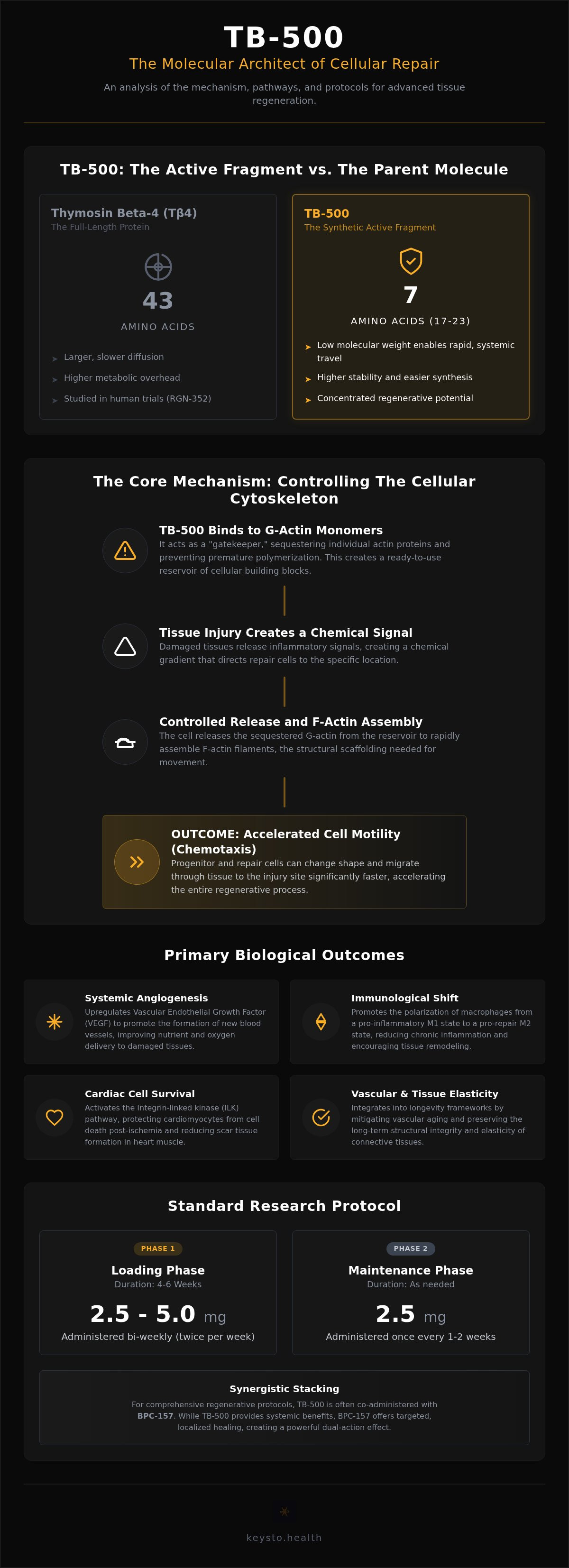
Most researchers think they're using the full protein when they order TB-500. They're wrong. TB-500 is a synthetic peptide fragment representing the most potent region of Thymosin Beta-4 (Tβ4). While the parent protein contains 43 amino acids, the TB-500 mechanism of action is concentrated within a specific 17-23 amino acid sequence. This 7-amino acid chain is the primary "active site" responsible for binding to cellular proteins and driving the regenerative process.
The Fragment vs. The Parent Molecule
The distinction between the full 43-amino acid Tβ4 protein and the 7-amino acid TB-500 fragment is critical for protocol accuracy. I've found that the fragment is significantly easier to synthesize and maintains higher stability during storage than the parent molecule. While Tβ4 has undergone human clinical trials under names like RGN-352 for cardiac and ophthalmic repair, TB-500 remains the standard for high-performance research. It retains the essential actin-binding properties of the parent protein without the metabolic "overhead" of the larger structure.
Systemic Diffusion: The "Traveler" Peptide
Size matters in molecular biology. The low molecular weight of TB-500 allows it to diffuse rapidly through tissues and cross biological barriers that stop larger proteins. This is why we categorize it as a systemic traveler. You don't have to pin the exact site of a tear or strain to initiate repair. Once introduced, it enters the systemic circulation and migrates toward injury sites where inflammatory signals are highest. This systemic travel is a defining feature of the TB-500 mechanism of action, as the fragment's small size allows it to navigate the interstitial space with minimal resistance.
Nature designed Tβ4 to be stored in platelets and released into wound fluid during trauma to act as an immediate responder. By utilizing the 17-23 fragment, we're essentially hijacking this natural emergency system to accelerate recovery across the entire body. If you want to compare this profile to other healing compounds, check our Compound Encyclopedia for a full breakdown of molecular weights and binding affinities. This systemic flexibility makes it a cornerstone of any advanced Regenerative Protocol.
To understand the TB-500 mechanism of action, we must first analyze the internal scaffolding of the cell. Actin serves as the primary component of the cytoskeleton, providing the structural tension necessary for a cell to maintain its shape and, more importantly, to move. TB-500 acts as a molecular gatekeeper for this system by binding to G-actin, the monomeric form of the protein. By sequestering these monomers, the peptide prevents them from polymerizing prematurely into F-actin filaments, creating a ready-to-use reservoir of building blocks for rapid cellular reconfiguration. This ensures that the cell remains fluid and capable of responding to repair signals instantly.
G-Actin vs. F-Actin: The Mechanics of Movement
This sequestering effect creates a critical buffer of actin monomers within the cytoplasm. When a tissue injury occurs, the cell utilizes this pool to drive a process known as treadmilling. During treadmilling, the cell rapidly assembles monomers at the leading edge of a filament while simultaneously disassembling them at the trailing edge. This constant recycling allows the cell to change its morphology and migrate through dense extracellular matrices. We define chemotaxis as the directed movement of cells toward a chemical gradient of injury. This accelerated motility is why TB-500 is a core component of our Regenerative Protocol, as it allows progenitor cells to reach the wound site faster than they would under normal physiological conditions.
The ILK Pathway and Cardiac Survival
Beyond simple movement, the TB-500 mechanism of action involves deep-seated survival signaling through the Integrin-linked kinase (ILK) pathway. A landmark study published in Nature involving mammalian cardiac models demonstrated that Thymosin Beta-4 activates ILK to promote the survival of cardiomyocytes. This is particularly vital following ischemic events where oxygen deprivation typically leads to mass cell death. By upregulating ILK and the subsequent phosphorylation of Akt, the peptide helps maintain heart muscle integrity and significantly reduces the formation of non-functional scar tissue. Research outcomes have shown that this pathway improves contractile function and increases capillary density in the border zones of damaged heart tissue. This suggests that the peptide doesn't just patch a wound; it preserves the actual biological machinery of the organ, making it an essential tool for cardiovascular optimization.
Angiogenesis and the Immunological Flip: M1 to M2
I've analyzed hundreds of recovery protocols, and the most common failure point in tissue repair is the lack of micro-vascularization. The TB-500 mechanism of action solves this by inducing Angiogenesis, the formation of new blood vessels from pre-existing ones. This process is driven by the upregulation of VEGF (Vascular Endothelial Growth Factor), a signal protein that stimulates the growth of the circulatory network. Without this new blood supply, migrating cells lack the oxygen and nutrients required to complete the remodeling phase of repair.
Vascular Repair via Endothelial Migration
Endothelial cells respond to TB-500 by migrating toward the injury to construct new capillary networks. This is a game-changer for "white zone" injuries, such as tears in tendons or ligaments, which naturally possess a poor blood supply. By forcing re-vascularization in these avascular regions, the peptide transforms a slow-healing environment into a highly metabolic repair zone. If you're looking to optimize your systemic circulatory health alongside localized repair, our Cardiovascular Protocol provides the necessary framework for total vascular maintenance.
The peptide's small molecular size allows it to penetrate these dense, low-flow tissues more effectively than larger growth factors. Once in situ, it organizes endothelial cell attachment and promotes the basement membrane degradation necessary for new vessel sprouts. This isn't just about healing an acute injury; it's about improving the long-term structural integrity of the tissue by ensuring it remains well-perfused.
Dampening the Cytokine Storm
The most overlooked aspect of this peptide is the "immunological flip." It facilitates Macrophage Polarization, shifting the immune environment from a pro-inflammatory M1 state to a pro-regenerative M2 state. M1 macrophages are necessary for early-stage debris clearance, but if they persist, they cause chronic inflammation and tissue degradation. TB-500 signals the transition to M2 macrophages, which act as the primary rebuilding crew by depositing extracellular matrix components and organizing new tissue fibers.
We see a measurable decrease in pro-inflammatory cytokines like TNF-α and IL-1β when this shift occurs. By downregulating these signals, the peptide prevents excessive secondary damage and reduces oxidative stress in the cellular microenvironment. This dual capacity to build new blood vessels while simultaneously silencing the inflammatory fire is central to the TB-500 mechanism of action. It ensures that the body's immune response works for the repair process rather than against it.
Research Protocols: Reconstitution, Dosing, and Synergistic Stacking
Translating the TB-500 mechanism of action from molecular theory to a research protocol requires a disciplined dosing schedule. I've found that a two-phase approach is the most effective way to maximize the peptide's systemic diffusion and actin-binding potential. We establish a baseline research dose of 2.5-5.0 mg administered twice weekly. This frequency maintains a steady-state concentration in the blood, ensuring that repair signals remain constant throughout the healing cycle.
The Loading Phase typically spans the first 4 weeks of the protocol. During this window, the goal is to saturate the target tissues and establish an ample pool of G-actin monomers to facilitate rapid cellular motility. From week 5 onward, we transition to a Maintenance Phase. This usually involves reducing the dosage or frequency to once weekly, depending on the severity of the tissue damage being addressed. This structured shift prevents receptor desensitization and ensures long-term efficacy during extended research cycles.
The "Wolverine Stack": TB-500 + BPC-157
Pairing TB-500 and BPC-157 creates the gold standard for connective tissue repair. I refer to this as the "Wolverine Stack" because the mechanistic synergy is unparalleled in the longevity space. While the TB-500 mechanism of action drives cellular migration and angiogenesis, BPC-157 focuses on structural growth through collagen synthesis and growth factor expression. One peptide moves the cellular repair crew to the site of injury, while the other provides the bricks and mortar to rebuild the tissue. You can read our deep dive on BPC-157 Peptide Mechanisms to see how it bridges the gap between migration and structural healing.
Precision Reconstitution Standards
Research integrity depends entirely on your handling of the compound. You must have bacteriostatic water, sterile insulin syringes, and alcohol swabs ready before you begin. Never shake the vial once you've added the diluent. Peptides are fragile amino acid chains; mechanical agitation will shear the bonds and degrade the compound, rendering the research useless. Gently swirl the vial if necessary, but allow the powder to dissolve on its own. Precise math is non-negotiable for anyone serious about biological optimization. Use our Peptide Reconstitution Calculator to ensure your concentrations are exact every time.
Explore the full Regenerative Protocol
The Elite Perspective: Integrating TB-500 into Longevity Frameworks
Elite-level optimization requires a shift in perspective from reactive repair to proactive Bio-Maintenance. While most users wait for a catastrophic tendon rupture to research the TB-500 mechanism of action, successful practitioners utilize it to preserve structural integrity before failure occurs. We don't just use these compounds to fix what's broken; we use them to fortify the biological architecture against the wear of high-performance lifestyles. This involves maintaining the fluidity of cellular processes even when no acute trauma is present.
Vascular Aging and Systemic Longevity
Age-related decline is often a direct result of micro-vascular rarefaction, where capillary density decreases across vital organs and connective tissues. By leveraging the angiogenic properties of TB-500, we can mitigate this decline and maintain the nutrient delivery systems essential for cellular health. Maintaining endothelial health is the foundation of biological youth. Integrating this peptide into our Longevity Protocol ensures that your tissues remain elastic and well-perfused, effectively slowing the progression of vascular aging.
- Preserves capillary density in skeletal muscle and cardiac tissue.
- Enhances the elasticity of the extracellular matrix through continuous remodeling.
- Promotes systemic endothelial cell migration for constant micro-repair.
The Keys to Health Regenerative Framework
A mechanism-first approach is the only way to achieve elite optimization. We don't guess; we use data from the HRT Bloodwork Analyzer to identify systemic inflammatory markers and hormonal imbalances that might impede recovery. This data-driven foundation allows us to build precise stacks that address your specific biological needs. You can utilize our AI Peptide Protocol Builder to customize your stack based on these clinical markers. This tool removes the guesswork by aligning your blood chemistry with the most effective research compounds available today.
The Regenerative Protocol serves as the ultimate recovery blueprint, combining compounds like TB-500 with synergistic agents to create a comprehensive healing environment. Understanding the TB-500 mechanism of action is just the first step in mastering your biology. While mammalian studies have demonstrated profound cardiac survival benefits, we focus on the human application of these systemic mechanisms for long-term health. By moving beyond simple injury repair, you can establish a maintenance schedule that preserves your performance peak for decades. We've spent 25 years refining these strategies to ensure they deliver measurable results.
Ready to move beyond basic maintenance? Explore our full range of Keys to Health Protocols to begin your biological upgrade.
Master Your Biological Architecture
Mastering the TB-500 mechanism of action represents the difference between basic maintenance and elite biological optimization. We've analyzed how G-actin sequestration drives cellular motility and how the strategic shift to M2 macrophage polarization silences chronic inflammation to accelerate remodeling. By integrating this peptide into a structured framework, you move beyond the reactive "fix it when it breaks" mentality that dominates the mainstream wellness industry.
We utilize 25 years of human optimization experience and AI-powered research tools to ensure your protocols are built on clinical data rather than forum hearsay. These evidence-based longevity blueprints allow you to maintain peak performance and structural integrity regardless of the demands you've placed on your body. Establishing a protocol that prioritizes systemic angiogenesis and tissue elasticity is the most effective way to preserve your functional youth.
I've spent my career refining these strategies to ensure they deliver measurable results for the most demanding practitioners. You've now got the blueprint to take control of your own cellular repair and long-term vitality.
Frequently Asked Questions
Is TB-500 the same as Thymosin Beta-4?
No. TB-500 is a synthetic fragment representing the 17-23 amino acid sequence of the full 43-amino acid Thymosin Beta-4 protein. This specific fragment is the active site responsible for G-actin binding and cellular migration. While the parent protein occurs naturally in all nucleated cells, the fragment is preferred in research settings for its superior stability and higher diffusion rate across biological barriers.
Does TB-500 need to be injected at the site of the injury?
Localized injection is unnecessary because the TB-500 mechanism of action is systemic. The peptide's low molecular weight allows it to diffuse rapidly through the circulatory system and migrate to injury sites where inflammatory signals are highest. You can administer it subcutaneously at any convenient site. Once in the bloodstream, the peptide identifies damaged tissue via chemotaxis, ensuring that the repair signals reach the target area regardless of the entry point.
What is the typical half-life of the TB-500 fragment?
The plasma half-life of the TB-500 fragment is relatively short, typically estimated at around 2 hours. However, its biological effects persist much longer because the peptide binds to actin within the cellular cytoskeleton. This intracellular binding allows it to influence cellular motility and tissue remodeling for several days. This is why our protocols favor twice-weekly dosing rather than daily administration; it maintains a steady state of regenerative activity without overwhelming the system.
Can I stack TB-500 with BPC-157 for better results?
Stacking these compounds is the most effective way to address complex connective tissue injuries. While TB-500 drives the migration of progenitor cells and stimulates angiogenesis, BPC-157 accelerates the actual structural synthesis of collagen. This combination ensures that the necessary repair crew arrives at the site and has the materials needed to rebuild. We frequently integrate this pairing into our regenerative recovery frameworks to maximize the rate of functional tissue return.
Are there any known side effects of TB-500 in research?
Research indicates that TB-500 is generally well-tolerated in mammalian models with few documented adverse events. Some researchers report localized redness or minor irritation at the injection site, while others mention transient lethargy following high doses. It's important to distinguish between the isolated fragment and the full protein, as most safety data comes from Thymosin Beta-4 trials. We recommend monitoring systemic inflammatory markers to ensure the microenvironment remains optimized for repair during any research cycle.
How long does it take for TB-500 to start working?
Molecular activity begins within hours of administration, but structural tissue repair typically requires a 2 to 4-week window to become measurable. The TB-500 mechanism of action involves complex shifts in macrophage polarization and the upregulation of VEGF for new blood vessel growth. These biological processes take time to manifest as improved joint mobility or reduced pain. Most research protocols utilize a loading phase of at least one month to establish significant regenerative momentum.
Is TB-500 detectable in drug testing for athletes?
Athletes should be aware that TB-500 is a prohibited substance under WADA and most professional sporting bodies. It falls under the category of peptide hormones and metabolic modulators. Modern anti-doping laboratories use high-resolution mass spectrometry to detect the synthetic fragment in urine and blood samples. Even though the peptide mimics a natural sequence, the synthetic version possesses distinct markers that make it easily identifiable during routine drug screenings.
How should TB-500 be stored after reconstitution?
You must store reconstituted TB-500 in a refrigerator at temperatures between 2°C and 8°C. Exposure to direct sunlight or room temperature for extended periods will cause the peptide bonds to degrade, reducing its efficacy. Once you've added bacteriostatic water, the compound remains stable for approximately 30 days if handled correctly. Always keep the vial upright and avoid any mechanical agitation, such as shaking, which can shear the delicate amino acid chain.

Article by
Samir Levin
Samir Levin is a biohacker and longevity researcher with 25 years of personal experimentation across peptides, hormonal optimization, and regenerative medicine. He is the founder of Keys to Health — a platform combining a 112-compound research encyclopedia, AI-powered bloodwork analyzer, peptide protocol builder, and evidence-based PDF protocols used by thousands of biohackers worldwide.
Samir's work is grounded in first-person experimentation, not theory. He personally reversed 10+ years of AAS-induced gynecomastia without surgery using an enzymatic stack he developed and documented. His protocols are built from clinical literature, N=1 data, and feedback from the Keys to Health community.
He covers peptides, TRT/HRT, GLP-1 agents, senolytics, longevity stacks, cognitive enhancement, and animal longevity protocols for dogs, cats, and horses.
TB-500Thymosin Beta-4PeptidesBiohackingLongevityTissue RepairRecoveryAngiogenesis