Longevity
Senior Dog Longevity Science: A Clinical Framework for Biological Optimization
By Samir Levin · September 1, 2026 · 17 min read
Disclaimer
This article is for informational and educational purposes only. It does not constitute medical advice, diagnosis, or treatment. Always consult a qualified healthcare provider before starting any new supplement, peptide, or protocol. Keys to Health and Samir Levin are not responsible for any actions taken based on this content.
Most pet owners accept the "inevitable decline" of their senior dogs as a natural byproduct of time. I don't. Aging isn't a destiny; it's a regulated biological program that we can now manipulate with clinical precision. This shift toward senior dog longevity science marks the end of reactive veterinary care and the beginning of proactive biological optimization.
I know the frustration of watching a high-performance animal lose mobility while traditional supplements like glucosamine fail to move the needle. We've spent 25 years at the intersection of human and animal performance science to solve this exact problem. You're looking for data-driven protocols, not vague wellness advice or emotive hand-holding.
We'll move straight into the mechanisms of action for advanced bioregulatory peptides. I'll detail specific dosing ranges, such as 250 mcg to 500 mcg daily for BPC-157, based on current canine research and our clinical frameworks. We're going to restore cognitive function and physical resilience by targeting the cellular roots of aging through systemic regeneration.
Key Takeaways
- Shift your perspective from reactive geriatric care to proactive biological optimization by treating aging as a modifiable risk factor.
- Identify how cellular senescence and "inflammaging" drive systemic decline and learn the technical pathways to neutralize these inflammatory signals.
- Master the application of senior dog longevity science through evidence-based peptide protocols, including the synergistic pairing of BPC-157 and TB-500.
- Implement precise dosing strategies using our clinical tools to ensure safety and measurable restoration of mobility and cognitive function.
- Replace outdated NSAID-heavy regimens with advanced bioregulatory signaling molecules that promote genuine tissue regeneration at the source.
Table of Contents
Aging as a Modifiable Risk Factor: The New Canine Longevity Paradigm
Aging is not an accident. It is a biological program that we can manipulate. I have spent 25 years optimizing elite human performance, and the cellular requirements for a canine athlete are identical. Dogs are biological machines that require high-level maintenance to prevent the systemic breakdown that most owners accept as inevitable.
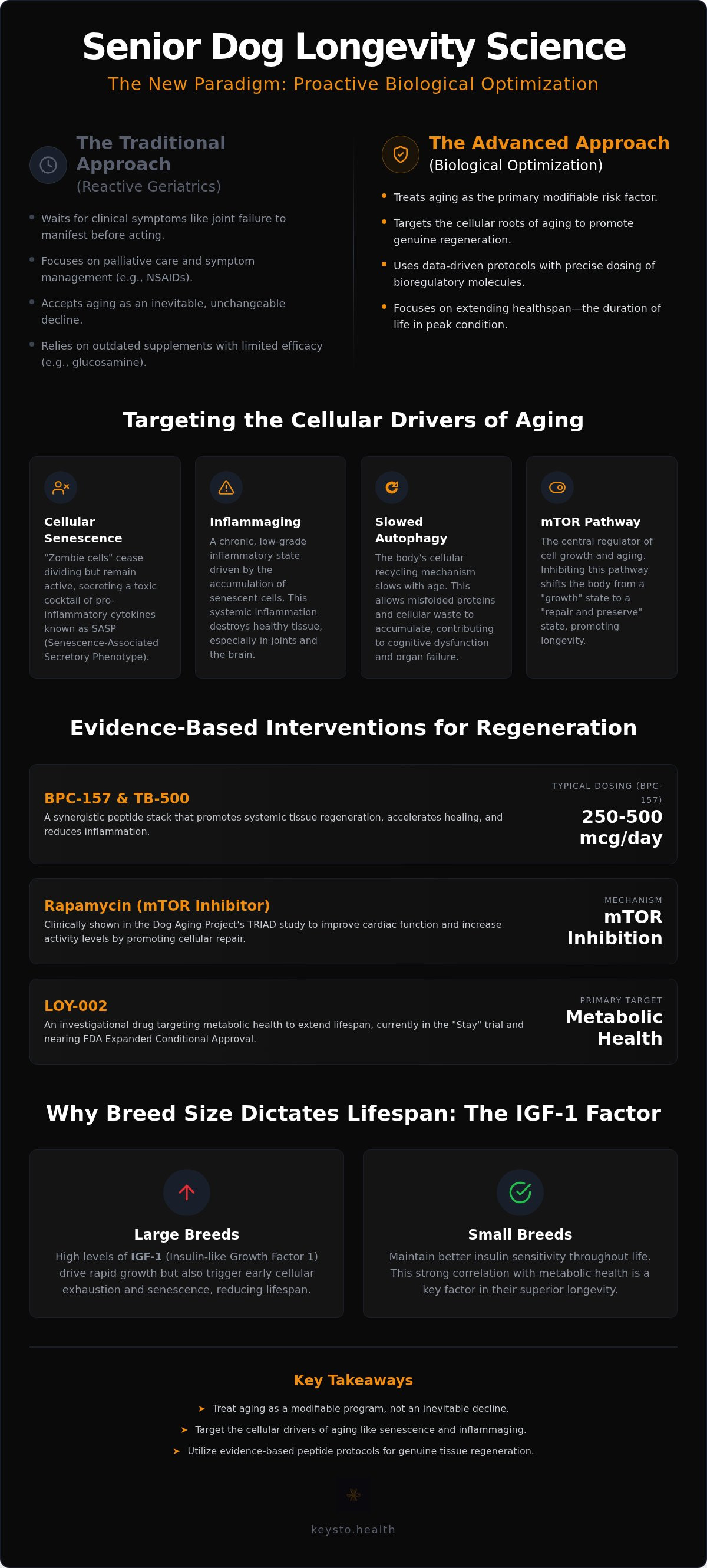
Traditional veterinary medicine is fundamentally reactive. It waits for the physical manifestation of decay, such as joint failure or cognitive decline, before intervening with palliative care. This is a failure of strategy. We view aging as the primary modifiable risk factor rather than an unchangeable fate.
We define longevity as healthspan. It is the duration of life spent in peak physical and cognitive condition. The Dog Aging Project and current clinical trials for LOY-002, known as the "Stay" trial, validate this approach. These trials focus on metabolic health as the primary driver of lifespan extension. LOY-002 has already achieved two of three major technical sections for FDA Expanded Conditional Approval as of January 2026, proving that targeting metabolic pathways is the most effective route for senior dog longevity science.
The Shift from Geriatrics to Biological Optimization
Waiting for "senior" symptoms to appear before acting is a tactical error. Large breed dogs face a biological disadvantage due to high levels of IGF-1 (Insulin-like Growth Factor 1). While IGF-1 promotes rapid growth, it also triggers early cellular exhaustion and senescence. Small breeds maintain better insulin sensitivity, which correlates directly with their superior lifespans. We use metabolic health as a proxy for biological age. If your dog exhibits signs of insulin resistance or muscle wasting, their biological age has surpassed their chronological age. Optimization must begin long before the first gray hairs appear.
The Keys to Health Clinical Framework
We apply the same rigor to canine physiology that we use in professional human athletics. Integrating the Canine Longevity Protocol into daily care allows us to move away from "wait and see" diagnostics toward data-driven intervention. We prioritize baseline data, such as tracking muscle density and inflammatory markers, to identify biological shifts before they become clinical pathologies. Using our Peptide Calculator for precise dosing ensures that we are providing the exact signaling molecules needed for regeneration. This framework ensures we are optimizing the biological program rather than just managing a decline.
The Science of Canine Senescence: Targeting the Hallmarks of Aging
Senescence is the biological state where cells cease division but remain metabolically active, refusing to undergo apoptosis. These "zombie cells" secrete a toxic cocktail of pro-inflammatory cytokines known as the Senescence-Associated Secretory Phenotype (SASP). In senior dog longevity science, we recognize that the accumulation of these cells is the primary driver of inflammaging, a chronic, low-grade inflammatory state. This systemic fire destroys healthy tissue, specifically targeting the synovial fluid in joints and neural pathways in the brain. Understanding the physiological markers of aging in dogs is essential for mapping how these inflammatory signals disrupt immune function and gut health.
Autophagy is the body's mechanism for recycling cellular waste. In senior dogs, this process slows down, allowing misfolded proteins to accumulate in the brain and vital organs. This buildup is a primary hallmark of canine cognitive dysfunction, mirroring human neurodegenerative conditions. By prioritizing compounds that reactivate these cleanup pathways, we move beyond simple symptom management. We're cleaning the biological slate to prevent protein aggregation and subsequent organ failure.
MTOR and the Rapamycin Frontier
mTOR is the central regulator of cell growth and aging in mammals. When we inhibit this pathway, we shift the body from a state of constant growth to a state of cellular repair and preservation. The Dog Aging Project's TRIAD study (Test of Rapamycin in Aging Dogs) has demonstrated that low-dose Rapamycin can improve cardiac function and increase spontaneous activity levels in senior dogs. Initial results from the trial's early cohorts showed significant improvements in left ventricular diastolic function. By modulating mTOR, we trigger the autophagy required to remove aggregated proteins before they cause permanent damage. You can find specific frameworks for these interventions in our advanced longevity protocols.
Mitochondrial Bioenergetics in Senior Dogs
Mitochondria are the cellular power plants responsible for producing ATP. As dogs age, mitochondrial efficiency plummets, often due to the depletion of NAD+ (Nicotinamide Adenine Dinucleotide). This bioenergetic failure is the root cause of sarcopenia, the progressive loss of skeletal muscle mass that leads to lethargy and frailty. To combat this, we utilize a synergistic stack of CoQ10 and PQQ to support mitochondrial biogenesis and ATP production.
- CoQ10 (Ubiquinol): Facilitates electron transport within the mitochondrial membrane to optimize energy output.
- PQQ (Pyrroloquinoline quinone): Promotes the growth of new mitochondria in aging cells, directly countering mitochondrial decay.
- NAD+ Precursors: Restore the metabolic efficiency required for cellular repair and DNA maintenance.
Traditional vs. Advanced Longevity Interventions
Traditional geriatric care is a strategy of managed decline. It relies heavily on NSAIDs like carprofen to mask pain, which often leads to hepatic and renal stress over time. I view this as a failure of biological architecture. We don't just want to suppress the pain signal; we want to repair the tissue that generates it. This is the core of senior dog longevity science.
Advanced interventions move beyond palliative care by using bioregulatory signaling molecules. Instead of just managing symptoms, we use these compounds to trigger the body's innate repair mechanisms. We prioritize the integration of our Regenerative Recovery Protocols to provide a clinical advantage that standard veterinary care cannot match. This approach treats the underlying biological program of aging rather than its late-stage manifestations.
Why Glucosamine is Not a Strategy
Most oral joint supplements like glucosamine and chondroitin have clinical efficacy rates barely exceeding placebo in canine research. The primary issue is limited bioavailability and the lack of a signaling mechanism. Glucosamine provides "building blocks" for cartilage, but it doesn't tell the body to use them. Systemic signaling via peptides like BPC-157 is far more effective because it modulates growth factors and promotes angiogenesis (the formation of new blood vessels). Injectable research protocols bypass the GI tract entirely, ensuring that 100% of the compound reaches the systemic circulation to initiate repair.
Metabolic Optimization: The LOY-002 Approach
Caloric restriction is the most validated method for extending mammalian life, but it's difficult to implement without causing muscle wasting in seniors. We prioritize metabolic flux and insulin sensitivity over simple caloric deprivation. Visceral fat in senior dogs functions as an active endocrine organ, secreting pro-inflammatory cytokines that drive systemic decay. Improving insulin sensitivity through our Metabolic Protocol mimics the longevity benefits of fasting while preserving critical lean muscle mass. This methodology aligns with the clinical goals of the LOY-002 trials, which target metabolic health as the primary lever for life extension. We focus on maintaining high insulin sensitivity to reduce the "inflammaging" that accelerates joint and organ failure.
Peptide Protocols for Canine Regeneration and Longevity
Peptides represent the most significant advancement in senior dog longevity science since the advent of modern diagnostics. These short chains of amino acids function as precise signaling molecules. They don't just provide raw materials for tissue; they command the body to initiate specific biological repairs. This methodology allows us to bypass the systemic waste and poor bioavailability associated with oral supplements.
I've used these protocols for decades to accelerate recovery in high-stakes environments. For senior dogs with mobility issues, I recommend the synergistic pairing of BPC-157 and TB-500. This combination, often called the Wolverine Stack, targets both localized structural repair and systemic recovery. It's the gold standard for restoring a dog's ability to move without the side effects of chronic NSAID use.
BPC-157 (Body Protective Compound) works by upregulating growth factor receptors, specifically those related to angiogenesis and collagen synthesis. It's particularly effective for accelerating tendon and ligament repair by modulating the expression of early growth response 1 (EGR1). TB-500 (Thymosin Beta-4) complements this by promoting cell migration and systemic tissue recovery. It sequesters G-actin, allowing cells to move more efficiently to sites of injury to build new blood vessels and repair muscle fibers.
The BPC-157 + TB-500 Protocol
A standard research dosing range for a 50lb dog is 250–500 mcg of BPC-157 daily. We typically run this for 6 to 8 weeks to maximize the regenerative effect on connective tissue. TB-500 requires a loading phase of 0.1 mg/kg administered twice weekly for four weeks, followed by a maintenance dose of 0.05 mg/kg once weekly. This tiered approach ensures the system is saturated with the signaling molecule before moving to a preservation phase.
Precision is non-negotiable when dealing with these compounds. You must use our Peptide Calculator to ensure accuracy during the reconstitution process. Improper dosing can lead to sub-clinical results, wasting both time and resources in your optimization efforts. We prioritize exact measurements to mirror the clinical rigor of human biohacking.
Epitalon and the Telomere Hypothesis
Epitalon targets the very foundation of aging by upregulating telomerase. This enzyme protects the telomeres at the ends of chromosomes, preserving DNA integrity in aging cells. Research by Vladimir Khavinson has demonstrated that Epitalon can extend lifespan and restore circadian rhythms by stimulating melatonin production in the pineal gland. This is critical for senior dogs who often experience disrupted sleep-wake cycles.
For senior dogs, a practical dosing framework involves 1–2 mg/day administered for 10-day cycles, repeated twice yearly. This approach focuses on cellular longevity rather than immediate physical repair. It's a long-term strategy for maintaining biological youth at the chromosomal level, ensuring that cellular division remains stable as the animal ages and reducing the risk of oncogenic mutations.
Implementing the Canine Longevity Blueprint
Optimization is a systemic discipline. I've seen countless owners fail because they treat longevity as a collection of random supplements rather than a clinical framework. Real progress in senior dog longevity science depends on the intersection of metabolic health, circadian alignment, and precision compound stacking. We begin by establishing a baseline using hard data: activity tracking, muscle mass measurements, and serum inflammatory markers like C-reactive protein.
The Canine Longevity Protocol serves as the operational manual for this transition. It moves the dog from a state of reactive maintenance to a state of biological optimization. Consistency is the primary variable. A protocol only works if the signaling molecules are delivered with the same regularity we demand in elite human athletics.
Step 1: Metabolic and Circadian Alignment
Metabolic health starts with feeding windows. We utilize time-restricted feeding to induce periodic autophagy and improve insulin sensitivity. Senior dogs often suffer from anabolic resistance, meaning they require higher concentrations of high-quality protein to maintain muscle mass. I prioritize a high-leucine protein profile to trigger muscle protein synthesis even in aging tissues.
Circadian rhythm is the second pillar. A disrupted sleep-wake cycle suppresses natural growth hormone secretion and accelerates cognitive decline. We use environmental controls and light management to anchor the dog's internal clock. You can reference our Sleep Protocol for specific strategies on optimizing the rest environment to support systemic recovery.
Step 2: Targeted Compound Stacking
Stacking is about sequencing. We don't introduce every compound at once. We typically start with regenerative peptides like BPC-157 to address structural integrity before introducing senolytics to clear out "zombie cells." This ensures the body has the regenerative capacity to handle the turnover of senescent tissues. We monitor the dog's response to each new variable for 14 days before adjusting the stack.
I recommend analyzing the mechanism of action for every intervention. Our Compound Reference provides detailed data on 112+ research compounds, allowing you to build a stack based on your dog's specific biological needs. We prioritize evidence-based dosing over anecdotal suggestions. This methodical approach ensures that every milligram of a compound is serving a specific clinical purpose in the longevity blueprint.
Mastering the Biological Program of Aging
The decline of a senior dog isn't an inevitable fate. It is a series of targeted biological failures that we can now address with clinical precision. By neutralizing cellular senescence and optimizing mitochondrial bioenergetics, we move from the standard model of geriatric management into the high-performance realm of senior dog longevity science.
We prioritize clinical-grade dosing guides and precise mechanisms of action to ensure every intervention produces a measurable result. Restoring mobility with the BPC-157 and TB-500 stack or protecting DNA integrity with Epitalon are no longer experimental theories. These protocols represent the new standard for our expert-led pet biohacking community, providing the tools necessary to extend healthspan and restore peak function.
You now have the framework and the data to rewrite your dog's biological trajectory. Proactive optimization is the only logical path for owners who demand elite-level results for their animals. It's time to implement the blueprint and start the optimization process today.
Frequently Asked Questions
What is the most effective peptide for a senior dog with arthritis?
BPC-157 is the most effective bioregulatory peptide for canine arthritis due to its ability to modulate the healing response in connective tissues. I recommend pairing it with TB-500 to leverage their synergistic effects on angiogenesis and cellular migration. While BPC-157 focuses on structural repair of tendons and ligaments, TB-500 provides systemic regenerative support. This combination addresses the root causes of joint degradation more effectively than standard oral supplements.
Is BPC-157 safe for long-term use in dogs?
Current research suggests BPC-157 has a high safety profile with no documented systemic toxicity in canine models. We typically utilize 6 to 8 week cycles followed by a washout period to maintain receptor sensitivity and prevent biological adaptation. This cyclic approach mirrors the protocols used in elite human performance to ensure long-term efficacy. Monitoring inflammatory markers provides the data necessary to determine when to reintroduce the compound into your dog's regimen.
How do I calculate the correct peptide dosage for my small breed dog?
Peptide dosing must be weight-based to ensure clinical precision. For a small breed dog under 25 lbs, a standard research dose is 250 mcg of BPC-157 daily. You should use our Peptide Reconstitution Calculator to determine the exact volume of bacteriostatic water required for your specific vial size. Precision is critical in senior dog longevity science to avoid sub-therapeutic results or unnecessary metabolic waste during the optimization process.
Can I use human-grade Rapamycin for my dog’s longevity protocol?
Rapamycin (Sirolimus) is a single molecule, and human-grade versions are frequently used off-label in canine longevity protocols. The TRIAD study utilized low-dose Rapamycin to successfully improve cardiac function in senior dogs without significant adverse events. It works by inhibiting the mTOR pathway, which triggers cellular cleanup and repair. You must prioritize precise weekly dosing, as the half-life in dogs differs from humans, requiring a protocol tailored specifically to canine metabolic rates.
What are the first signs that a longevity protocol is working?
The earliest indicators of a successful protocol include increased spontaneous activity and a restoration of the natural sleep-wake cycle. You'll likely observe your dog initiating play more frequently or navigating stairs with less hesitation. These behavioral shifts reflect a reduction in systemic inflammaging and improved mitochondrial bioenergetics. We also track physical markers like improved muscle density and a visible reduction in joint swelling to validate that the signaling molecules are reaching their targets.
Should I combine peptides with traditional veterinary medications?
Peptides can be integrated with traditional medications, but they often allow for a significant reduction in the dosage of chronic NSAIDs. Compounds like BPC-157 provide a protective effect on the gastric mucosa, which can mitigate some of the side effects associated with long-term carprofen use. We recommend establishing a baseline of stability on your current medications before introducing new bioregulatory compounds. This allows you to isolate the effects of each intervention and adjust your stack based on measurable data.
What is the role of NAD+ boosters in canine aging?
NAD+ boosters are essential for restoring mitochondrial efficiency and preventing the sarcopenia associated with senior dog longevity science. As NAD+ levels decline, the cellular power plants fail to produce sufficient ATP, leading to muscle wasting and lethargy. By utilizing precursors like NMN or NR, we provide the fuel necessary for DNA repair and metabolic health. This intervention is particularly critical for large breed dogs who face accelerated cellular exhaustion due to their higher metabolic demands.
How often should I cycle longevity compounds for my pet?
Most regenerative peptides follow a cycle of 8 weeks on followed by a 4-week washout period. This prevents the downregulation of growth factor receptors and ensures the body continues to respond to the signaling molecules. Senolytic compounds require even less frequent administration, often following a "hit and run" protocol of once every few months to clear out accumulated senescent cells. Consistent cycling allows you to maintain peak biological optimization without overwhelming the dog's metabolic pathways.

Article by
Samir Levin
Samir Levin is a biohacker and longevity researcher with 25 years of personal experimentation across peptides, hormonal optimization, and regenerative medicine. He is the founder of Keys to Health — a platform combining a 112-compound research encyclopedia, AI-powered bloodwork analyzer, peptide protocol builder, and evidence-based PDF protocols used by thousands of biohackers worldwide.
Samir's work is grounded in first-person experimentation, not theory. He personally reversed 10+ years of AAS-induced gynecomastia without surgery using an enzymatic stack he developed and documented. His protocols are built from clinical literature, N=1 data, and feedback from the Keys to Health community.
He covers peptides, TRT/HRT, GLP-1 agents, senolytics, longevity stacks, cognitive enhancement, and animal longevity protocols for dogs, cats, and horses.
senior dogdog healthlongevitypeptidesBPC-157TB-500canine healthbiohackingregenerative medicine