Peptides
Peptide Reconstitution Mistakes: Why Your Protocol Fails Before the First Dose
By Samir Levin · August 17, 2026 · 17 min read
Disclaimer
This article is for informational and educational purposes only. It does not constitute medical advice, diagnosis, or treatment. Always consult a qualified healthcare provider before starting any new supplement, peptide, or protocol. Keys to Health and Samir Levin are not responsible for any actions taken based on this content.
Your 5mg vial of BPC-157 is likely biologically dead before the needle even touches the rubber stopper. Most researchers treat mixing as a casual step, but in the world of high-stakes performance, reconstitution is a high-precision chemical event. If you've ever felt the frustration of a protocol failing despite sourcing the right compounds, you're likely a victim of common peptide reconstitution mistakes that degrade the fragile amino acid chains before they ever reach your system.
I understand the anxiety of staring at a syringe while trying to calculate micrograms versus milliliters. You've invested significant capital into your longevity; seeing those results neutralized by a simple math error or a turbulent pour is unacceptable. We've spent 25 years refining these protocols to eliminate the guesswork that often leads to wasted research and inconsistent biological data.
In this guide, I'll provide the exact clinical standards required to ensure structural integrity, sterility, and dosing precision. We'll cover everything from solvent selection to the mechanical physics of the gentle swirl so you can achieve predictable outcomes and maximize the shelf-life of your research assets.
Key Takeaways
- Identify the mechanical physics of denaturation to prevent breaking fragile amino acid chains during the mixing process.
- Differentiate between bacteriostatic and sterile water to maintain a sterile environment and prevent rapid microbial growth in multi-dose vials.
- Eliminate peptide reconstitution mistakes by mastering the dosing math that separates total vial volume from precise microgram concentrations.
- Protect your compounds from UV exposure and the "freeze-thaw" trap to maintain maximum biological stability after reconstitution.
- Leverage synergistic stacks like BPC-157 and TB-500 to drive predictable results in both human and animal regenerative protocols.
Table of Contents
- The Fragility Myth: Why Mechanical Stress Destroys Peptide Integrity
- Solvent Sabotage: The Critical Difference Between BAC and Sterile Water
- The 10x Dosing Disaster: Eliminating Arithmetic Errors
- Storage and Stability Protocols for Longevity Compounds
- The Keys to Health Standard: Reconstitution for Humans and Animals
The Fragility Myth: Why Mechanical Stress Destroys Peptide Integrity
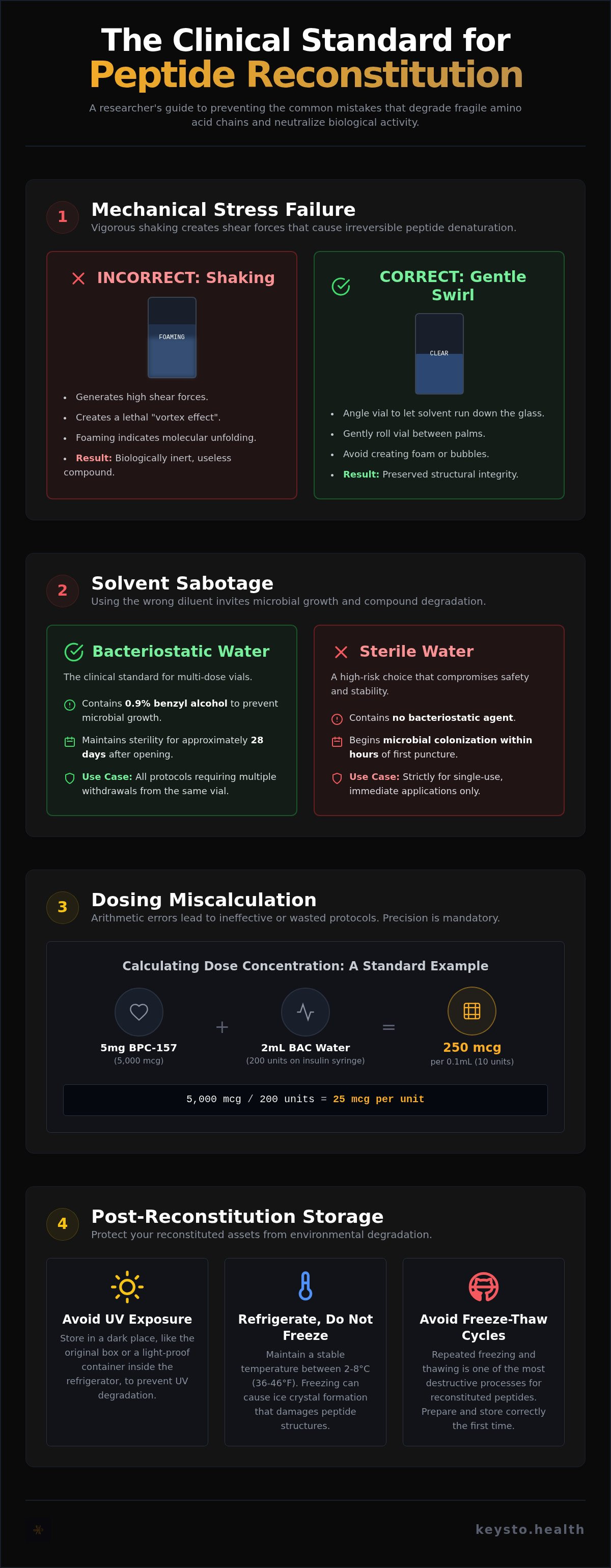
Peptides are not robust proteins; they are delicate strings of amino acids held together by fragile hydrogen bonds. I've watched countless researchers ruin expensive batches simply because they "shook" a vial to speed up dissolution. This is one of the most frequent peptide reconstitution mistakes. The powder you receive has undergone the lyophilization process to remove moisture for shelf stability. This state is excellent for storage but leaves the peptide structurally vulnerable to any form of mechanical kinetic energy.
The primary failure mechanism is denaturation. This occurs when kinetic energy breaks the complex 3D folding of the amino acid chains. A peptide's biological activity is entirely dependent on its shape. Once that shape is lost, the compound becomes inert. While smaller, more stable chains like BPC-157 can survive minor mishandling, larger molecules like IGF-1 LR3 or hGH are hyper-fragile. They require clinical-grade care.
The Physics of the "Swirl vs. Shake" Rule
Vigorous shaking creates a "vortex effect" that is lethal to long-chain peptides. This rapid movement generates high shear forces at the molecular level. If your solution starts to foam, you've likely already compromised the batch. Foaming indicates that the peptide's surface-active properties have been triggered by air-liquid interfaces, causing the molecules to unfold.
We use the "gentle tilt-and-roll" protocol to ensure a homogenous solution without structural damage:
- Angle the vial so the solvent hits the glass wall rather than the powder cake.
- Allow the liquid to slide down the side slowly.
- Rotate the vial between your palms with a steady, horizontal motion.
- Wait for the solution to turn clear naturally before proceeding.
Surface Adsorption: The Silent Content Killer
Peptides possess a high affinity for glass surfaces. They often stick to the walls of the vial through surface adsorption, which can significantly reduce the concentration of your final dose. The first 30 seconds of the reconstitution event are critical. A "rapid fire" solvent injection creates a high-pressure stream that causes molecular shearing upon impact.
This mechanical stress literally tears the molecules apart before they can dissolve. I always cross-reference the Compound Reference for specific stability data before starting a new protocol. Ensuring the solvent is added at a controlled pace prevents these losses and maintains the potency you expect from your research.
Solvent Sabotage: The Critical Difference Between BAC and Sterile Water
Choosing the wrong diluent is a catastrophic error that guarantees protocol failure. I prioritize Bacteriostatic Water, which contains 0.9% benzyl alcohol, as the only acceptable clinical standard for multi-dose vials. Many researchers fall into the "Sterile Water Trap," assuming that sterile water is safer because it lacks additives. This is one of the most dangerous peptide reconstitution mistakes you can make.
Sterile water is strictly for single-use applications. Once you pierce the rubber stopper, you've introduced atmospheric contaminants. Without a bacteriostatic agent, microbial colonization begins within hours. We use benzyl alcohol because it maintains sterility over a 28-day research window, protecting the structural integrity of the compound and the health of the subject. I recommend reviewing our clinical protocols to ensure your specific compound is paired with the correct solvent environment.
Microbial Proliferation in Peptide Solutions
The mechanism of action for benzyl alcohol involves disrupting the bacterial cell membrane, effectively halting reproduction. If you use plain saline for long-term storage, you're inviting two distinct failure points. First, saline lacks preservative qualities. Second, the sodium chloride can cause significant pH shifts and crystallization during refrigeration. These shifts often trigger immediate peptide precipitation, where the compound falls out of solution and becomes biologically unavailable. Re-using a single-use sterile water ampule is a high-risk failure point that I've seen lead to systemic infections in poorly managed research environments.
Solvent Temperature and Solubility
Temperature plays a vital role in the kinetic energy of the mixing phase. I've observed that using ice-cold solvent often leads to "clumping" and incomplete dissolution. This occurs because the reduced thermal energy prevents the solvent molecules from efficiently surrounding the lyophilized peptide chains. We utilize a "room temperature equilibration" protocol for all solvents before reconstitution begins.
- Remove the solvent from refrigeration 30 minutes prior to use.
- Ensure the vial reaches approximately 20 to 22 degrees Celsius.
- Verify the Compound Reference for specific solubility requirements.
Equilibrating your solvent ensures that the peptide dissolves smoothly without requiring the mechanical agitation that causes denaturation. This step is non-negotiable for maintaining the precise concentration required for high-performance data. You can find specific solubility data for over 100 research chemicals in our Compound Encyclopedia.
The 10x Dosing Disaster: Eliminating Arithmetic Errors
Arithmetic failure is the single most common cause of research termination. I've seen experienced practitioners accidentally administer ten times the intended dose simply by confusing milligrams (mg) with micrograms (mcg). A 5mg vial contains 5,000mcg. If your target dose is 250mcg, you possess exactly 20 doses, regardless of the volume of water you add. Confusing these units is one of the most catastrophic peptide reconstitution mistakes a researcher can make.
Many researchers mistakenly believe that adding more diluent increases the total dose. It doesn't. It only reduces the concentration. To eliminate these errors, I recommend using a dedicated Peptide Reconstitution Calculator to remove human error from the equation entirely. Precision is the only way to ensure your data remains valid and your results remain predictable.
Standardizing Your Diluent Volume
We utilize 1ml or 2ml as the "Gold Standard" for diluent volume because it simplifies the resulting math. Higher volumes, such as 2ml, are often superior for reducing "dead space" loss. This refers to the residual solution that remains in the syringe tip and needle after the plunger is fully depressed. If your concentration is too high, even a tiny amount of dead space represents a significant loss of active compound.
- 1ml diluent in a 5mg vial = 500mcg per 10 units (0.1ml).
- 2ml diluent in a 5mg vial = 250mcg per 10 units (0.1ml).
- Check the Compound Reference for specific volume recommendations.
Lower concentrations generally improve injection comfort. If you're running a high-frequency protocol, such as daily BPC-157 administration, using more diluent reduces localized tissue irritation. This is particularly important when managing long-term recovery cycles where site rotation is limited.
Protocol for Variable Vial Sizes
Handling a 2mg vial one week and a 10mg vial the next is a recipe for disaster if you rely on memory. The "mental math" approach fails under fatigue or routine. I've established a 3-step verification process for every new vial reconstitution to maintain clinical standards:
- Physical Label Check: Confirm the total mg on the vial before piercing the seal.
- Calculator Input: Run the numbers through the Peptide Reconstitution Calculator for every new batch.
- Syringe Mapping: Explicitly identify the unit tick on the syringe that corresponds to your mcg target.
Confusing insulin syringe units with volume is another frequent failure point. On a standard U-100 syringe, 10 units equals exactly 0.1ml. Never guess your volume based on visual estimation. If you're managing complex stacks, such as pairing BPC-157 with TB-500, keeping your concentrations standardized across all vials prevents dosing confusion during administration.
Storage and Stability Protocols for Longevity Compounds
Reconstitution is only half the battle. Once a peptide is in liquid form, the biological clock starts ticking with aggressive speed. One of the most common peptide reconstitution mistakes is returning a liquid vial to the freezer. This "Freeze-Thaw Trap" is lethal to molecular integrity. The formation of ice crystals creates mechanical shearing that tears the delicate amino acid chains apart. If it's liquid, it stays in the refrigerator until the vial is exhausted.
Thermal degradation and light sensitivity are the next primary threats. Leaving a vial on a warm counter for as little as 15 minutes can reduce potency by as much as 20%. We also prioritize opaque storage containers to prevent photo-degradation. UV exposure triggers peptide bond cleavage, particularly in sensitive stacks like CJC-1295. I've seen entire research cycles fail because a vial was left under a desk lamp during a dosing session.
The 2–8°C Clinical Window
Consistency is the priority for long-term stability. I always store my research compounds at the back of the refrigerator shelf rather than the door. Door storage subjects the vial to constant temperature fluctuations every time the seal is broken. These micro-shifts in temperature accelerate the degradation of the compound's 3D folding. Most compounds maintain peak stability for 14 to 28 days under these conditions.
You must perform a visual inspection before every draw. Look for these signs of degradation:
- Cloudiness or a "milky" appearance.
- Visible particulates or "floaters" that don't dissolve with a gentle roll.
- Any change in color from the original clear solution.
Handling Loss and Dead Space
Precision requires accounting for "hub loss." Standard syringes often leave 0.05ml to 0.1ml of solution in the tip after the plunger is fully depressed. In a high-concentration vial, this represents a significant loss of active compound. We prefer fixed-needle insulin syringes for peptide research because they virtually eliminate this dead space waste. This ensures the subject receives the exact microgram dose calculated.
If you've prepared a large batch intended for use beyond 30 days, utilize an aliquoting protocol. Divide the solution into smaller, single-use sterile vials immediately after reconstitution. This limits the number of times the primary seal is punctured and prevents the repeated atmospheric exposure that invites microbial growth. For more data on specific compound stability, I recommend cross-referencing our Compound Reference.
The Keys to Health Standard: Reconstitution for Humans and Animals
Biological optimization isn't exclusive to the human system. We apply the same clinical rigor to our Canine Joint Recovery Protocols and equine performance programs. Whether you're managing a senior cat's kidney health or a horse's tendon repair, peptide reconstitution mistakes in sterile technique can lead to localized abscesses or systemic infection. Animals can't communicate site irritation. Your precision must be absolute from the first draw.
BPC-157 and TB-500: The Regenerative Powerhouse
We often utilize the "Wolverine Stack" for accelerated tissue repair in both humans and animals. This pairing relies on two distinct mechanisms of action. BPC-157 functions by upregulating growth factor receptors, specifically VEGFR2, to promote angiogenesis. In contrast, TB-500 (Thymosin Beta-4) utilizes actin-sequestering to promote cell migration to the injury site. Clinical data from animal models suggests that this combination significantly outperforms monotherapy for ligament and tendon healing.
Reconstitution for this stack requires careful management of concentration. I typically recommend a BPC-157 dosing range of 250–500 mcg/day. Elite athletes may require the higher end of this range during acute injury phases. Sedentary individuals focused on longevity often find success at the lower end. You can find stability data for these and 112 other compounds in our Compound Encyclopedia.
Systematic Protocol Building
Manual tracking is an invitation for error. We've developed the AI Protocol Builder to automate your scheduling and dosing math. This tool integrates with our HRT Analyzer to ensure your compound choices are justified by your current bloodwork data. This data-driven approach eliminates the "guess and check" methodology that characterizes most amateur research. It ensures that your peptide reconstitution mistakes are zeroed out before you ever touch a syringe.
Before you pierce your next vial, follow this final checklist to maintain the Keys to Health standard:
- Verify the total vial weight in milligrams against your target dose in micrograms.
- Equilibrate your bacteriostatic water to room temperature for 30 minutes.
- Inject the solvent slowly against the glass wall to prevent molecular shearing.
- Inspect the solution for particulates or cloudiness under direct light.
- Label the vial with the reconstitution date and the exact concentration per unit.
Bottom Line
- Mechanical stress and temperature fluctuations are the primary drivers of peptide denaturation and protocol failure.
- Always utilize bacteriostatic water for multi-dose vials to prevent rapid microbial colonization and infection.
- Standardize your diluent volumes to 1ml or 2ml to eliminate the arithmetic errors that lead to dangerous 10x dosing disasters.
- Leverage tools like the Peptide Reconstitution Calculator to ensure clinical precision in every research protocol.
Standardizing Your Biological Optimization
Mastering these clinical standards ensures that your research assets remain biologically active from the first draw to the final dose. We've established these protocols over 25 years in elite performance to eliminate the common peptide reconstitution mistakes that drain budgets and invalidate data. By prioritizing mechanical care, solvent sterility, and precise arithmetic, you secure the structural integrity of your compounds.
Our community utilizes these expert-led protocols developed by Samir Levin to manage over 112+ research compounds with clinical-grade precision. Whether you're optimizing human longevity or animal recovery, the blueprint for success starts with a zero-error preparation phase. You've done the work to source high-quality compounds; don't let a mixing error neutralize your progress.
Secure your results and protect your investment by adopting a professional-grade reconstitution standard today. You're now equipped to move from guesswork to clinical certainty.
Frequently Asked Questions
Can I use tap water or bottled water to reconstitute peptides?
You must never use tap or bottled water for reconstitution. These sources contain minerals, chlorine, and microbial life that compromise the compound and your health. We only use bacteriostatic water with 0.9% benzyl alcohol to ensure sterility over a multi-week research window. Using unverified water sources is one of the most common peptide reconstitution mistakes. Always verify your solvent requirements using the Peptide Calculator before beginning.
What happens if I accidentally shake my peptide vial?
Shaking a vial introduces excessive kinetic energy that can lead to denaturation. This process breaks the delicate hydrogen bonds maintaining the peptide's 3D structure, rendering it biologically inert. If you see foaming after shaking, the peptide has likely unfolded. We prioritize a gentle tilt and roll method to preserve molecular integrity. While some smaller chains are resilient, larger molecules like hGH will be destroyed by vigorous agitation.
How long do peptides stay stable after they are mixed?
Most reconstituted peptides remain stable for 14 to 28 days when stored at a consistent 2 to 8 degrees Celsius. Stability varies significantly between compounds. For example, BPC-157 is relatively robust while IGF-1 LR3 degrades much faster. I recommend checking our Compound Reference for specific shelf-life data. Always store vials at the back of the refrigerator to avoid the temperature fluctuations found in the door.
Is it possible to "over-dilute" a peptide?
You cannot technically "over-dilute" a peptide in terms of destroying its activity. Adding more diluent simply reduces the concentration per unit. This can actually be beneficial for reducing "dead space" loss in the syringe hub. However, very high volumes may cause localized discomfort during injection. We generally standardize to 1ml or 2ml of bacteriostatic water to keep the dosing math simple and the injection volume manageable for the subject.
Do I need to store my peptides in the freezer after reconstitution?
Never store reconstituted peptides in the freezer. Once you've added a solvent, the compound is in a liquid state. Freezing creates ice crystals that cause mechanical shearing of the amino acid chains. This process destroys the peptide's structural integrity. I've seen researchers ruin entire batches by attempting to extend shelf-life through freezing. Keep your reconstituted vials in an opaque container in the refrigerator to protect them from both heat and light.
Why did my peptide solution turn cloudy after adding the water?
A cloudy solution usually indicates that the peptide has precipitated out of the solvent or that microbial contamination has occurred. This often happens due to extreme temperature shock or a significant pH shift in the diluent. If the solution doesn't turn clear after a few minutes of resting at room temperature, the batch is likely compromised. I don't recommend using any solution that isn't perfectly transparent as it indicates a failure in integrity.
Can I mix two different peptides in the same vial?
We don't recommend mixing two different peptides in the same vial for long-term storage. Different compounds often require different pH levels for stability, and cross-reactions can occur over time. This is a common source of peptide reconstitution mistakes that leads to degraded assets. If your protocol requires a synergistic stack like BPC-157 and TB-500, you can draw both into the same syringe immediately before administration to ensure each remains stable.
How do I know if my peptide has been denatured?
You can identify denaturation through visual indicators or a lack of biological response. Signs like persistent foaming, particulates, or cloudiness suggest the molecular structure is compromised. However, denaturation isn't always visible. If a previously effective protocol suddenly yields zero results, the peptide has likely lost its 3D folding due to heat or mechanical stress. I rely on strict adherence to our clinical protocols to prevent these invisible failures.

Article by
Samir Levin
Samir Levin is a biohacker and longevity researcher with 25 years of personal experimentation across peptides, hormonal optimization, and regenerative medicine. He is the founder of Keys to Health — a platform combining a 112-compound research encyclopedia, AI-powered bloodwork analyzer, peptide protocol builder, and evidence-based PDF protocols used by thousands of biohackers worldwide.
Samir's work is grounded in first-person experimentation, not theory. He personally reversed 10+ years of AAS-induced gynecomastia without surgery using an enzymatic stack he developed and documented. His protocols are built from clinical literature, N=1 data, and feedback from the Keys to Health community.
He covers peptides, TRT/HRT, GLP-1 agents, senolytics, longevity stacks, cognitive enhancement, and animal longevity protocols for dogs, cats, and horses.
peptidesreconstitutionBPC-157TB-500biohackinglongevitypeptide protocolbacteriostatic water