Peptides
Peptide Reconstitution Math: A Practitioner’s Guide to Precision Dosing
By Samir Levin · August 18, 2026 · 17 min read
Disclaimer
This article is for informational and educational purposes only. It does not constitute medical advice, diagnosis, or treatment. Always consult a qualified healthcare provider before starting any new supplement, peptide, or protocol. Keys to Health and Samir Levin are not responsible for any actions taken based on this content.
Relying on a digital calculator without understanding the underlying logic is the fastest way to compromise a $500 research protocol. Most practitioners treat peptide reconstitution math as a guessing game, shifting decimals between milligrams and micrograms until the numbers look right. This lack of precision leads to inconsistent serum levels and expensive wasted compounds. I've spent two decades refining these protocols to ensure that every unit drawn into a syringe matches the intended biological outcome.
I've seen many researchers struggle with the transition from milligrams to micrograms, often fearing they've ruined a vial before the first draw. You want the certainty that your dosing is clinically accurate, not just a rough estimate. In this guide, I'll provide the exact formulas required to master reconstitution variables and verify your results manually. We'll cover everything from dilution ratios to syringe unit conversions using the keysto.health/peptide-calculator/ as a reference point so you can integrate new entries from our keysto.health/compounds/ database into your protocols with total confidence.
Key Takeaways
- Master the "Concentration First" method to convert lyophilized mass into precise liquid dosages with clinical-grade accuracy.
- Distinguish between volume and mass by understanding that syringe units measure liquid displacement rather than the actual weight of the compound.
- Apply precise peptide reconstitution math to manage synergistic stacks like BPC-157 and TB-500 within a single delivery protocol.
- Implement practitioner-level techniques for equalizing vial pressure and accounting for needle hub dead space to prevent compound loss.
Table of Contents
The Three Variables of Peptide Reconstitution Math
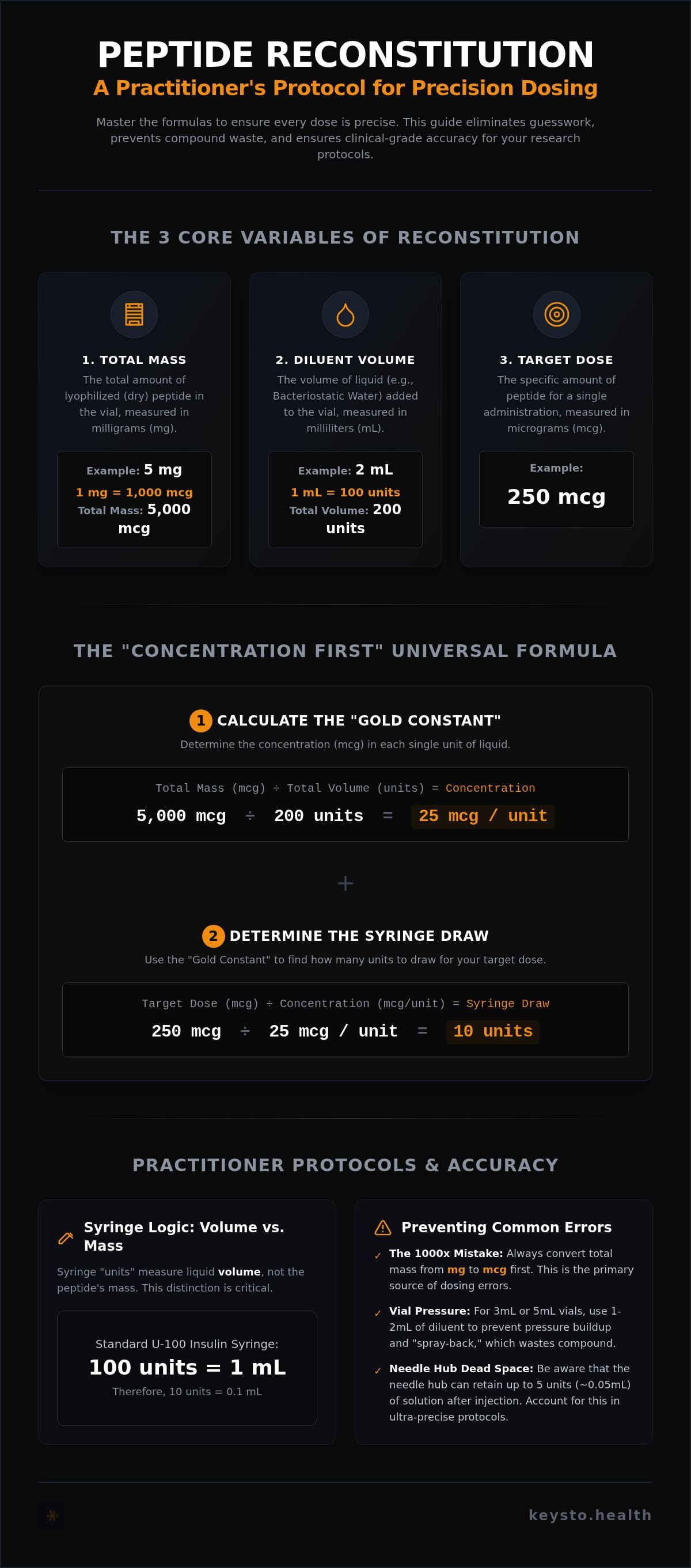
Precision in peptide reconstitution math requires isolating three distinct variables: the total mass of the compound, the volume of the diluent, and the intended dosage. Most practitioners fail because they treat these as arbitrary inputs rather than a fixed ratio. You must identify the Lyophilized mass in the vial first. This is the total amount of active peptide before any liquid is added, usually expressed in milligrams. This mass remains constant regardless of how much liquid you add later.
The second variable is the diluent volume, measured in milliliters (mL). This is the liquid that turns the powder into a solution. The third variable is your target dose, which is almost always measured in micrograms (mcg). Mastering the interplay between these three numbers allows you to verify any protocol manually, ensuring you never waste expensive research compounds due to a decimal point error.
Mass vs. Volume: The Mg to Mcg Conversion
We measure vial sizes in milligrams, but we dose in micrograms. This 1000x scale is the primary source of calculation errors. One milligram equals exactly 1000 micrograms. If you have a 5mg vial of a compound, you are handling 5000mcg of raw material. Standard research vials typically arrive in 2mg, 5mg, or 10mg formats. I cross-reference the vial label with the Compound Reference to ensure the mass matches the expected concentration for that specific peptide.
The Role of the Diluent
The diluent serves as the delivery vehicle. Bacteriostatic Water, which contains 0.9% benzyl alcohol, is the clinical standard because it inhibits bacterial growth for up to 28 days after the vial is punctured. The volume of water you add dictates the concentration, not the potency. Adding more water doesn't make the peptide "weaker" in a biological sense; it simply requires a larger injection volume to reach the same dose. For example, a 5mg vial reconstituted with 2mL of water has a concentration of 2.5mg/mL. If you use 1mL of water, the concentration doubles to 5mg/mL.
You must also manage internal vial pressure. Adding 5mL of water to a small research vial creates a vacuum imbalance that can lead to "spray back" or compromise the stopper seal. I generally suggest keeping volumes between 1mL and 2mL for most standard 3mL or 5mL research vials. This range provides enough volume for accurate measurement on a syringe without creating excessive pressure. Use the Peptide Calculator to model these ratios before beginning the physical reconstitution process.
The Universal Formula for Manual Calculation
I always teach my clients the Concentration First method. It's a three-step mental framework that eliminates the guesswork often associated with peptide reconstitution math. While digital tools provide speed, manual proficiency ensures you catch errors before they reach the syringe. If you can't verify the logic on a napkin, you shouldn't be handling the compound.
This method focuses on establishing a "Gold Constant" for every vial you prepare. Once you determine how many micrograms exist in a single unit of liquid, the rest of the protocol becomes a simple division exercise. You can use our Peptide Calculator for instant verification, but you must master the following steps to ensure clinical-grade accuracy in a lab setting.
Calculating Concentration (C)
The first step is establishing the concentration per unit of volume. Use the formula: C = Total Mass (mcg) / Total Volume (units). Let's look at a standard 5mg vial. Since 1mg equals 1000mcg, your total mass is 5000mcg. If you reconstitute this with 2mL of Bacteriostatic Water, you have 200 units of volume on a standard U-100 syringe.
Dividing 5000mcg by 200 units gives you a concentration of 25mcg per unit. This number is your constant. It remains unchanged for the life of that vial. This step is where most errors occur, usually due to a misplaced decimal point. Always double-check your total microgram count before proceeding to the draw calculation.
Determining the Syringe Draw
Once you know the concentration, finding the draw is straightforward. The formula is: Draw (Units) = Target Dose (mcg) / Concentration (mcg/unit). If your research protocol calls for a 250mcg dose, and your concentration is 25mcg/unit, you divide 250 by 25. The result is exactly 10 units on the syringe barrel.
This logic applies regardless of the compound or vial size. Whether you're preparing a 2mg vial or a 10mg vial, the "Concentration First" approach prevents the common 10x dosing error. For those integrating these calculations into a broader biological optimization strategy, I recommend reviewing our standardized performance protocols for specific dosing frequency and timing. Mastering this math ensures that your data remains clean and your results remain repeatable.
Syringe Dynamics: U-100 vs. U-40 and Unit Logic
Syringe markings are not suggestions; they are precise volumetric measurements. The most common error I see in peptide reconstitution math is the assumption that a "unit" is a fixed dose of medicine. It is not. A unit is a measure of liquid displacement. In nearly all research contexts, we use the U-100 Insulin Syringe, where 100 units equals exactly 1.0mL of volume. If you mistakenly use a U-40 syringe, which is common in veterinary medicine, your dose will be 2.5 times higher than intended because 40 units equals 1.0mL in that format.
Understanding this volumetric logic is critical when transitioning from a 5mg vial to a 10mg vial. While the liquid volume in the syringe might look identical, the mass of the peptide contained within that volume changes based on your reconstitution ratio. I always recommend using 0.5mL or 0.3mL syringes for protocols requiring less than 30 units to ensure the highest degree of visual accuracy.
The Unit-to-Volume Conversion Table
To maintain precision, you must be able to translate syringe units into milliliters instantly. This prevents errors when calculating the total amount of Bacteriostatic Water needed for a specific concentration. Use this standard conversion for U-100 syringes:
- 1 unit = 0.01mL
- 10 units = 0.1mL
- 50 units = 0.5mL
- 100 units = 1.0mL
Why Syringe Size Doesn't Change the Math
The concentration of your solution is locked the moment you add the diluent to the vial. Whether you draw that solution into a 0.3mL, 0.5mL, or 1.0mL syringe, the micrograms per unit remain the same. I prefer 0.3mL syringes for micro-dosing because the hash marks are further apart, allowing for better identification of single-unit increments. On a 1.0mL syringe, the lines are often crowded, increasing the margin for human error.
You must also account for air bubbles and the displacement effect. A single air bubble can displace 1 to 2 units of volume, which might represent 50mcg or more of a compound like BPC-157. We teach researchers to "flick" the barrel and over-draw the syringe before pushing the plunger back to the target mark. This ensures the entire volume consists of the reconstituted solution rather than trapped air. For those managing complex stacks, verifying your draw with the Peptide Calculator ensures your volumetric measurements align with your intended mass-based dose.
Stacking Math: Calculating Synergistic Peptide Blends
Stacking multiple compounds in a single syringe is a standard practice for researchers targeting complex physiological outcomes. It reduces injection frequency and leverages the synergistic properties of different peptide classes. This requires advanced peptide reconstitution math because you're often managing two distinct concentrations within the same volumetric draw. Accuracy is paramount; a calculation error in a stack doesn't just affect one compound, it compromises the entire protocol's ratio.
The Additive Volume Method
I teach researchers to use the additive volume method to ensure precision. You must calculate the required units for each compound independently using their specific reconstitution constants. For example, if Peptide A requires 10 units and Peptide B requires 15 units, your total draw will be 25 units. You don't mix the lyophilized powders in a single vial. Instead, you reconstitute them separately to maintain the integrity of each peptide's molecular structure.
Let's look at a practical scenario. You have BPC-157 at a concentration of 25mcg per unit and TB-500 at 50mcg per unit. To reach a target dose of 250mcg for the first and 500mcg for the second, you'll draw 10 units of the first and 10 units of the second. The total volume remains 20 units. This approach ensures that the specific mass of each compound is delivered without the need for complex pre-mixing math.
Stacking BPC-157 and TB-500
The combination of BPC-157 and TB-500 is the gold standard for tissue repair. BPC-157 works by upregulating growth factor receptors, specifically VEGFR2, which accelerates angiogenesis. TB-500 promotes actin polymerization and cell migration, allowing new cells to reach the site of injury more efficiently. We often see a 1:1 or 1:2 ratio used in research settings depending on the severity of the tissue damage. You can find detailed stacking ratios in our Regenerative Protocol.
Maintaining sterility is the biggest challenge when stacking. You must equalize the pressure in both vials by injecting air before drawing any liquid. I recommend drawing the compound with the smaller volume first to minimize the risk of cross-contamination. If the total volume of your stack exceeds 50 units on a U-100 syringe, consider increasing the concentration of your reconstitution (using less Bacteriostatic Water) to keep the injection volume manageable. High-volume injections can cause localized tissue pressure that may interfere with absorption rates.
Practitioner Protocols for Maximum Accuracy
Managing the physical environment of the vial is just as vital as the peptide reconstitution math itself. Most researchers ignore the internal vacuum of a fresh vial. If you don't equalize this pressure, the diluent will rush in too quickly, damaging the fragile amino acid chains through mechanical stress. I always inject a volume of air equal to the intended diluent volume into the vial before beginning the transfer to ensure a controlled flow.
This pressure management prevents "spray back" when you remove the needle. It also ensures that the vacuum doesn't pull the plunger down prematurely, which would compromise your volumetric precision. These small physical adjustments are what guarantee that your calculated dose actually reaches the syringe barrel in the intended concentration.
Pressure Equalization and Reconstitution Flow
I utilize the "Wall Drip" technique to preserve compound integrity during the mixing phase. Instead of aiming the needle directly at the lyophilized powder, I direct the stream against the glass wall of the vial. This allows the diluent to slide down slowly, preventing peptide shearing. You should never shake a vial of signaling peptides; a gentle swirling motion is sufficient to achieve a clear solution without denaturing the proteins.
If the solution remains cloudy after swirling, let it sit in the refrigerator for 15 to 20 minutes. Some complex sequences take longer to fully enter the solution. Forcing the process through vigorous agitation will only result in a degraded, less effective compound. Patience in the reconstitution phase is a prerequisite for clinical-grade results.
Accuracy Pro-Tips
You must account for the "Dead Space" variable in your syringe. This is the residual volume that remains in the needle hub and tip after the plunger is fully depressed. In standard syringes, this can range from 0.03mL to 0.08mL, which can result in significant cumulative loss of expensive compounds. Using low-dead-space syringes or accounting for this volume in your draw ensures you don't run short on the final doses of your vial.
Reconstitution triggers the clock on peptide degradation. While Bacteriostatic Water prevents microbial growth, the chemical stability of the peptide begins to decline immediately upon entering a liquid state. I keep all reconstituted vials in a stable environment at 2-8°C. This temperature math is critical for maintaining potency over the 28-day lifespan of the solution.
Precision dosing is a hallmark of elite performance architecture. Before you commit to a draw, always verify your manual calculations with the Keysto.health Peptide Calculator. This final check eliminates the risk of human error and ensures your research remains data-driven and repeatable. Consistency in these practitioner protocols separates the hobbyist from the expert.
Mastering Precision in Biological Optimization
Mastering peptide reconstitution math is the definitive barrier between amateur guesswork and clinical-grade results. You now possess the formulas to verify every draw and the practitioner protocols required to protect compound stability. By treating every vial with the technical rigor of a laboratory professional, you ensure your research data remains clean and your biological outcomes are repeatable.
I've spent 25 years refining these variables to ensure that every microgram counts toward measurable performance gains. We've validated these specific methodologies against the 112+ research compounds found in our Compound Encyclopedia. These tools support the high-stakes optimization goals of elite athletes and dedicated longevity practitioners who cannot afford dosing errors. Consistency in these technical details is what separates a strategist from a hobbyist.
Apply these protocols to your next research cycle to eliminate variables and maximize performance. Total confidence in your dosing logic is the foundation of every successful longevity strategy.
Frequently Asked Questions
How many units is 250mcg of BPC-157?
The answer depends entirely on your reconstitution volume. If you have a 5mg vial of BPC-157 and add 2mL of Bacteriostatic Water, you have a concentration of 25mcg per unit. In this specific scenario, 250mcg equals exactly 10 units on a U-100 syringe. Always verify your concentration constant before drawing to ensure you aren't under-dosing. Different vial sizes or diluent volumes will change this result completely.
Can I use sterile water instead of bacteriostatic water for reconstitution?
I do not recommend using plain sterile water for multi-dose vials. Sterile water lacks the 0.9% benzyl alcohol found in Bacteriostatic Water, which is necessary to inhibit bacterial growth after the stopper is punctured. While sterile water is acceptable for immediate, single-use applications, any peptide intended for multi-day storage requires the preservative properties of a bacteriostatic agent to remain viable and safe for the duration of the protocol.
What happens if I add too much water to my peptide vial?
Adding excessive water doesn't change the potency of the peptide, but it significantly alters your peptide reconstitution math. A higher volume of diluent results in a lower concentration per unit, meaning you must inject a larger volume of liquid to reach your target dose. This can lead to localized tissue irritation and may exceed the physical capacity of small research vials, causing pressure-related leakage or spray-back during the draw process.
How do I calculate the dose if my syringe is 0.5mL instead of 1mL?
The calculation remains identical because both 0.5mL and 1mL syringes are typically calibrated to the U-100 standard. A unit represents the same volume (0.01mL) regardless of the barrel's total capacity. If your protocol calls for 10 units, you draw to the 10-unit mark on either syringe. I prefer the 0.5mL barrel for smaller doses because the markings are spaced further apart, which improves visual accuracy and reduces human error.
Does the math change if I'm using a U-40 syringe instead of U-100?
Yes, the math changes significantly because a U-40 syringe is calibrated for a different concentration. In a U-40 syringe, 40 units equals 1mL, whereas 100 units equals 1mL in a U-100 syringe. If you use a U-40 syringe with a U-100 calculation, you'll inject 2.5 times more volume than intended. I strongly advise against using U-40 syringes for research compounds to avoid catastrophic dosing errors during your protocol.
How long are peptides stable after I've done the reconstitution math and mixing?
Stability varies by compound, but most reconstituted peptides remain viable for 21 to 28 days when stored at 2-8°C. Bacteriostatic Water prevents microbial contamination, but the chemical structure of the peptide eventually begins to degrade in liquid form. I recommend labeling every vial with the date of reconstitution. If a solution becomes cloudy or develops particulates before the 28-day mark, you should discard the vial immediately as the compound is compromised.
Is there a difference in math for nasal spray vs. injectable peptides?
The logic remains similar, but you must account for the specific volume of the nasal spray pump. Most metered nasal sprayers deliver 0.1mL per spray. If your 10mL bottle contains 50mg of a compound, each 0.1mL spray delivers 500mcg. You must verify the pump's metered volume before performing your peptide reconstitution math to ensure the dosage matches your intended protocol. Nasal absorption rates also differ from subcutaneous injection data.
How do I convert mg to units on a standard insulin syringe?
You cannot convert milligrams directly to units without knowing the total volume of diluent added. First, convert your milligrams to micrograms. Then, divide that total by the number of units of water added to the vial. This gives you the micrograms per unit. Once you have this constant, you can determine exactly how many units are required to reach your specific microgram dose. This multi-step approach is the only way to ensure accuracy.

Article by
Samir Levin
Samir Levin is a biohacker and longevity researcher with 25 years of personal experimentation across peptides, hormonal optimization, and regenerative medicine. He is the founder of Keys to Health — a platform combining a 112-compound research encyclopedia, AI-powered bloodwork analyzer, peptide protocol builder, and evidence-based PDF protocols used by thousands of biohackers worldwide.
Samir's work is grounded in first-person experimentation, not theory. He personally reversed 10+ years of AAS-induced gynecomastia without surgery using an enzymatic stack he developed and documented. His protocols are built from clinical literature, N=1 data, and feedback from the Keys to Health community.
He covers peptides, TRT/HRT, GLP-1 agents, senolytics, longevity stacks, cognitive enhancement, and animal longevity protocols for dogs, cats, and horses.
peptidespeptide reconstitutionpeptide dosingbiohackingBPC-157TB-500peptide calculatorlongevity