Peptides
Peptide Reconstitution Calculator: Precision Math for Clinical Research
By Samir Levin · August 16, 2026 · 16 min read
Disclaimer
This article is for informational and educational purposes only. It does not constitute medical advice, diagnosis, or treatment. Always consult a qualified healthcare provider before starting any new supplement, peptide, or protocol. Keys to Health and Samir Levin are not responsible for any actions taken based on this content.
A single decimal point error in your peptide math isn't just a technical oversight; it's the difference between a therapeutic breakthrough and a complete waste of high-grade research material. I've spent 25 years in the performance optimization space, and I've seen more protocols fail due to incorrect mixing than poor storage. Precise reconstitution is the foundational bridge between raw research compounds and optimized biological outcomes.
You've likely felt that moment of hesitation while staring at a 5mg vial, wondering if your syringe math actually translates to a 250mcg dose. It's frustrating to invest in elite compounds only to doubt their potency because the conversion from milligrams to micrograms feels like a high-stakes math test. We agree that clinical research shouldn't be hampered by math anxiety or the fear of wasting expensive assets.
This guide introduces our professional-grade peptide reconstitution calculator, a tool designed to provide the clinical precision required for advanced protocols. We'll master the exact math of peptide mixing to ensure dosing accuracy and compound stability. I'll provide a clear framework for understanding syringe markings and volume variables so you can proceed with total confidence in your protocol.
Key Takeaways
- Precision math is the only way to ensure your research compounds actually reach the biological targets you're aiming for.
- Our professional-grade peptide reconstitution calculator eliminates math anxiety by instantly converting vial milligrams and diluent milliliters into precise microgram doses.
- Learn why venting your vial and equalizing pressure is a critical step to prevent compound degradation during the mixing process.
- Discover standardized dosing ratios for tissue repair and vascular health, including synergistic protocols for BPC-157 and TB-500.
- Master the manual-style architecture of syringe markings to ensure every unit corresponds exactly to your target dosing schedule.
Table of Contents
Clinical Precision in Peptide Reconstitution
Reconstitution is the biochemical process of restoring a lyophilized (freeze-dried) peptide to its liquid state for administration. In my 25 years of performance optimization, I've found that precision math is the single most overlooked variable in successful research. Biological optimization requires exactitude. If your math is off by even a few microliters, you risk sub-therapeutic dosing or, conversely, over-saturating receptors and wasting expensive compounds.
Precision math is the bridge between a theoretical protocol and measurable biological data. When I work with elite athletes or researchers, the first thing we standardize is the reconstitution methodology. A common mistake involves confusing total vial volume with the concentration per unit. This is why a reliable peptide reconstitution calculator is a mandatory tool in any serious lab. It removes the cognitive load of decimal point conversions, allowing you to focus on the actual mechanism of action.
Incorrect dilution does more than just mess up your dose. It impacts the compound's shelf-life and can accelerate peptide degradation. When you use our peptide reconstitution calculator, you're not just solving a math problem; you're ensuring the structural integrity of the peptide chain remains intact for the duration of its use. While human research standards demand ultra-precise microgram (mcg) accuracy, veterinary application protocols often involve larger volumes, yet the underlying math remains identical.
The Role of Lyophilization in Compound Stability
Lyophilization preserves a peptide's primary structure by removing water through sublimation under a vacuum. This state allows for long-term storage at stable temperatures. However, the peptide chain becomes highly vulnerable once you introduce a solvent. Mechanical stress from aggressive shaking or rapid temperature fluctuations can shear the delicate bonds. I always emphasize that temperature control is just as critical as the math found in our Compound Encyclopedia for maintaining peak potency.
Solvents: Bacteriostatic Water vs. Sterile Water
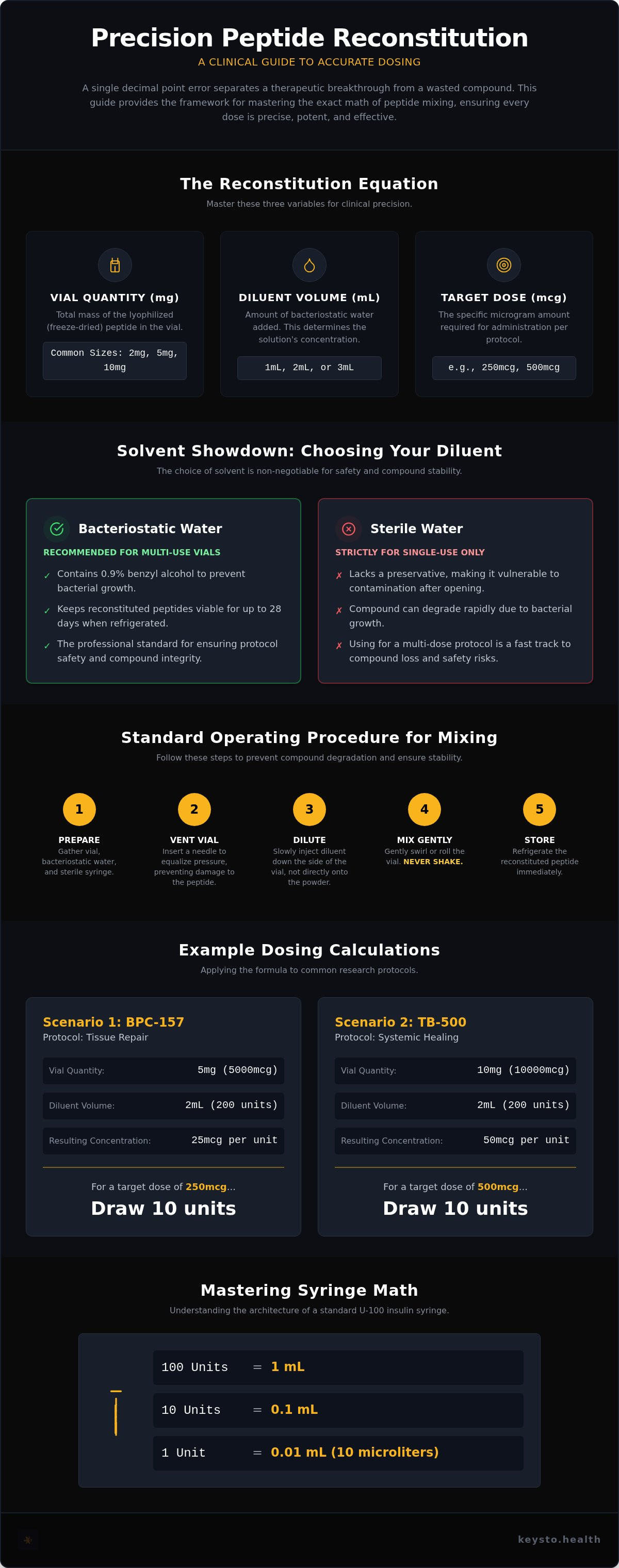
Choosing the correct diluent is non-negotiable for multi-use vials. Bacteriostatic water contains 0.9% benzyl alcohol, which acts as an antimicrobial preservative. This allows a reconstituted vial to remain viable for up to 28 days when refrigerated. Sterile water lacks this preservative and is strictly for single-use applications. Using sterile water for a multi-dose protocol is a fast track to bacterial contamination and compound loss. In high-performance settings like our Regenerative Recovery protocol, we exclusively utilize bacteriostatic water to ensure safety and stability.
The Variables of the Reconstitution Equation
To achieve clinical results, you must master the interplay between three primary variables: Vial Quantity, Diluent Volume, and Target Dose. Vial quantity is the total mass of the peptide in milligrams (mg). In the research space, we typically see standardized vials of 2mg, 5mg, or 10mg. Diluent volume refers to the amount of bacteriostatic water in milliliters (mL) you introduce to the vial. The target dose is your specific administration amount, always measured in micrograms (mcg) for high-precision compounds.
I often see researchers overcomplicate the relationship between these numbers. Adding more water doesn't change the total amount of peptide in the vial. It simply changes the concentration. A 5mg vial contains 5000mcg whether you add 1mL or 3mL of water. Using less water creates a more concentrated solution, while more water makes small doses easier to measure. This volume logic is the core reason why using a peptide reconstitution calculator is superior to mental math. It ensures your syringe volume matches your intended biological outcome every time.
Syringe math requires converting units into microliters. On a standard U-100 syringe, 100 units equal 1mL. Therefore, 1 unit is exactly 10 microliters. If your math is off, you aren't just missing a dose; you're potentially causing receptor downregulation or failing to reach a therapeutic threshold. Precision is the difference between a successful metabolic optimization protocol and a wasted investment.
The Mathematical Formula for Dosing
Manual calculation follows a specific ratio: (Target Dose / Total mg) x Total mL = Injection Volume. You must apply a 1000x multiplier to convert milligrams to micrograms before starting this equation. Even a minor rounding error can lead to a 10% variance in actual blood serum levels. This variance is often the hidden cause of inconsistent research results. I recommend double-checking every manual calculation against a digital peptide reconstitution calculator to eliminate human error.
Syringe Calibration: U-100 vs. U-40 Standards
The industry standard for peptide administration is the 1mL U-100 insulin syringe. However, for micro-dosing, 0.3mL and 0.5mL syringes are often more practical because the markings are spaced further apart. This increases visual accuracy when pulling 5 or 10 units. You must also identify the dead space in your specific syringe. Dead space is the residual liquid left in the needle hub after the plunger is fully depressed. Over a 30 day cycle, this can result in the loss of several hundred micrograms of high-cost compounds.
Standard Operating Procedure for Mixing Compounds
While the peptide reconstitution calculator provides the mathematical blueprint for your protocol, your physical execution determines the final potency of the compound. I have seen countless research cycles fail because the practitioner treated the mixing process with the same aggression they use for a protein shake. Peptides are delicate chains of amino acids held together by fragile bonds. Proper handling is the difference between a high-potency solution and a vial of expensive, degraded waste.
Sanitation is your first line of defense. I always begin by wiping the workspace and both vial stoppers with 70% isopropyl alcohol. Most research vials arrive vacuum-sealed. If you insert the needle and allow the vacuum to "suck" the diluent in, the high-pressure impact will likely shear the peptide chains. You must equalize the pressure by drawing a volume of air into your syringe equal to your diluent volume and injecting it into the bacteriostatic water vial first. This ensures a controlled, manual transfer.
I utilize the "Slow Drip" method for every compound in our Compound Encyclopedia. Instead of injecting the solvent directly onto the lyophilized powder, angle the needle so the liquid trickles down the interior glass wall. This prevents foaming and mechanical stress. Once the solvent is in, remember the golden rule: swirl, don't shake. Gently rotate the vial between your palms until the solution is completely transparent.
Step-by-Step Reconstitution Protocol
- Draw the exact volume of bacteriostatic water indicated by the peptide reconstitution calculator into your syringe.
- Angle the needle against the interior glass wall of the peptide vial, avoiding direct contact with the powder.
- Slowly release the solvent to prevent structural shearing and air bubble formation.
- Inspect the vial for clarity. If the solution remains cloudy after 15 minutes, the peptide has likely precipitated or degraded and should be discarded.
Storage and Handling for Maximum Potency
Post-reconstitution stability is highly temperature-dependent. You must maintain a refrigeration range of 2°C to 8°C to prevent thermal degradation. Light sensitivity is another critical variable. Many peptides are photo-sensitive and require storage in amber vials or dark boxes to maintain their primary structure. I also advise against storing vials in the refrigerator door. The constant vibration and temperature fluctuations from opening the door can compromise peptide integrity over a 30 day cycle.
Optimized Ratios for BPC-157, TB-500, and NAD+
BPC-157 is the cornerstone of tissue repair protocols. It works by upregulating growth factor receptors and promoting angiogenesis, which is the formation of new blood vessels. In my 25 years of practice, I've found that a daily range of 250 to 500 mcg is the clinical standard for systemic recovery. If you're working with a 5mg vial, using a peptide reconstitution calculator to determine a 2mL dilution results in exactly 250mcg per 10 units on a U-100 syringe.
TB-500, or Thymosin Beta-4, operates through actin sequestration to promote cellular migration and vascular health. We typically manage protocols ranging from 2mg to 5mg per week for ligament and tendon recovery. NAD+ presents a different challenge because it often comes in 500mg vials for metabolic support. Reconstituting NAD+ requires a higher diluent volume, often 5mL or more, to avoid acidity and injection site irritation. I recommend double-checking your stack math with a peptide reconstitution calculator to maintain these specific concentrations.
Stacking logic is about synergy, not just adding compounds together. When you pair BPC-157 with TB-500, you're creating a dual-action environment where BPC-157 upregulates the receptors while TB-500 provides the cellular building blocks. I prefer to keep these in separate vials to maintain the specific stability of each peptide chain. This prevents the risk of cross-compound degradation before administration.
The Regenerative Recovery Stack
The synergy between BPC-157 and TB-500 is the gold standard for healing. For a combined stack involving 5mg vials of each, adding 2mL of bacteriostatic water to each vial creates a standardized 2500mcg/mL concentration. This allows for a simplified 1:1 dosing ratio where 10 units of each compound provides a powerful regenerative punch. You can find advanced timing strategies and synergistic combinations in our Regenerative Recovery Protocol.
Dosing for Animal Longevity Research
Scaling human data for animal longevity requires precise weight-based adjustments. In canine and equine recovery, the margin for error is slim because incorrect concentrations can cause significant irritation. I always reference the Canine Longevity Protocol when calculating doses for non-human subjects. Precision in dilution is mandatory here to ensure the compound remains bioavailable without inducing an inflammatory response at the site of injection.
Utilizing the Keys to Health Peptide Calculator
Biohacking at an elite level requires tools that match your clinical intent. I've seen too many researchers rely on generic web tools cluttered with ads and questionable logic. Our peptide reconstitution calculator serves as the clinical standard because it prioritizes data integrity. It specifically targets the elimination of the "decimal point error." This error occurs most frequently during the 1000x conversion between milligrams and micrograms, leading to potentially dangerous over-dosing or sub-therapeutic results.
The interface is fully mobile-optimized for real-time use in the lab or at home. You can run complex calculations while handling your vials without breaking your sanitation workflow. This tool features direct integration with our Compound Encyclopedia. This means you have instant access to mechanism of action data and dosing references for 112+ peptides, ensuring your math aligns with established research standards for biological optimization.
Advanced Features for Elite Researchers
Consistency across different batches is a common struggle for long-term protocols. Our calculator includes multi-vial tracking to help you maintain a steady concentration when moving from a 2mg vial to a 5mg vial. Precision also depends on your hardware. We've integrated custom syringe inputs to accommodate 0.3mL and 0.5mL barrels. These smaller syringes are often superior for micro-dosing because they provide better visual resolution for small unit increments. Once your math is finalized, you can link it to the Protocol Builder to translate your dosing into an actionable 30 day schedule.
The Bottom Line on Reconstitution
Accuracy is the foundation of biological efficacy. If your math is flawed, your entire protocol is compromised. You're not just wasting capital; you're skewing your research data. I recommend using the Peptide Reconstitution Calculator before every new vial reconstitution. To truly close the loop on your performance, you must cross-reference your dosing with actual physiological changes. We use the HRT Bloodwork Analyzer to track clinical markers and ensure the compounds are delivering the expected metabolic or regenerative outcomes. Precision is not optional when the goal is elite-level performance.
Mastering Clinical Precision for Biological Optimization
Mastering the math of reconstitution is the final barrier between a theoretical protocol and realized biological results. I've spent two decades refining these processes because I know that a single microgram can alter a metabolic outcome. By utilizing our peptide reconstitution calculator, you're adopting the same zero-error algorithm for U-100 syringes used by elite athletes and longevity researchers worldwide.
We've integrated this tool with a database of 112+ compounds to ensure your math aligns with specific mechanisms of action. Whether you're stacking BPC-157 with TB-500 or managing high-concentration NAD+ protocols, precision is your only safeguard against compound waste. You now have the technical blueprint for professional grade mixing and dosing.
Move forward with the certainty that your math is accurate and your compounds remain stable. Your biological optimization depends on this level of clinical exactitude.
Frequently Asked Questions
How long does a peptide last after it has been reconstituted?
Potency generally remains stable for 21 to 28 days when using bacteriostatic water and stored at 2°C to 8°C. Degradation begins the moment the solvent hits the powder. Fragile peptides like GHRP-2 lose efficacy faster than robust compounds like BPC-157. I recommend checking the specific stability data in our Compound Encyclopedia. Using a peptide reconstitution calculator ensures you mix only what you'll use within this therapeutic window.
Can I mix two different peptides in the same syringe?
You can draw multiple peptides into a single syringe for immediate administration, which is a common practice in the Keys to Health community. However, you must never mix different peptides inside the same vial for long-term storage. Variations in pH levels and solvent requirements can cause immediate precipitation or chemical degradation. Draw each compound sequentially and administer the dose immediately to maintain the structural integrity of each amino acid chain.
What happens if my reconstituted peptide solution is cloudy?
A cloudy solution is a primary indicator of incomplete dissolution or peptide precipitation. If the liquid doesn't clear within 15 minutes of gentle swirling, you should discard the vial. This often occurs if you add the diluent too rapidly or if the solvent pH is incompatible with that specific peptide. Administering a cloudy solution is ineffective and can cause localized inflammatory responses at the injection site. Precision in the mixing process is non-negotiable.
Is it necessary to refrigerate peptides before they are mixed?
Lyophilized peptides are most stable when stored in a freezer at -20°C or a refrigerator at 2°C to 8°C. While they are more resilient in powder form, heat exposure accelerates deamidation. This chemical reaction breaks down the peptide chain before you even begin the mixing process. Keeping your vials cold before you use the peptide reconstitution calculator ensures you start your protocol with the highest possible purity and compound integrity.
Can I use saline solution instead of bacteriostatic water for reconstitution?
Saline is not a suitable substitute for bacteriostatic water in multi-use vials. Saline lacks the 0.9% benzyl alcohol required to inhibit bacterial growth over time. While clinicians use saline for single-dose IV administration, it offers no antimicrobial protection for a vial accessed multiple times over a 20 day cycle. Using saline significantly increases the risk of bacterial contamination and compound spoilage. Stick to bacteriostatic water for all multi-dose research protocols.
How do I calculate the dose if my vial contains a blend of two peptides?
Blends require you to calculate the milligram mass of each compound separately. If a vial contains 5mg of BPC-157 and 5mg of TB-500, and you add 2mL of water, each 10 units on your syringe contains 250mcg of each peptide. You must ensure the ratio in the vial aligns with your specific protocol goals. I always double-check these ratios to maintain precise microgram accuracy for both synergistic compounds simultaneously during the research phase.
What is the 'dead space' in a syringe and does it affect my dose?
Dead space is the residual volume of fluid that remains in the needle and syringe hub after the plunger is fully depressed. In a standard 1mL insulin syringe, this can account for up to 0.05mL of wasted solution. For high-cost research compounds, this loss adds up significantly over a 30 day cycle. Using low dead space syringes or adjusting your total volume can help you mitigate the loss of expensive assets and ensure dosing consistency.
Why do some peptides require more bacteriostatic water than others?
The volume of diluent is determined by the compound's solubility and the desired concentration for administration. High-mass vials like 500mg NAD+ require more water to fully dissolve and to reduce the acidity of the final solution. Conversely, a potent 2mg peptide vial might only need 1mL of water to make small microgram doses easier to measure. Proper volume selection ensures the compound is bioavailable without causing unnecessary tissue irritation during the protocol.

Article by
Samir Levin
Samir Levin is a biohacker and longevity researcher with 25 years of personal experimentation across peptides, hormonal optimization, and regenerative medicine. He is the founder of Keys to Health — a platform combining a 112-compound research encyclopedia, AI-powered bloodwork analyzer, peptide protocol builder, and evidence-based PDF protocols used by thousands of biohackers worldwide.
Samir's work is grounded in first-person experimentation, not theory. He personally reversed 10+ years of AAS-induced gynecomastia without surgery using an enzymatic stack he developed and documented. His protocols are built from clinical literature, N=1 data, and feedback from the Keys to Health community.
He covers peptides, TRT/HRT, GLP-1 agents, senolytics, longevity stacks, cognitive enhancement, and animal longevity protocols for dogs, cats, and horses.
peptidesreconstitutionpeptide calculatordosing guidebiohackingBPC-157research compounds