Weight Loss
Metabolic Health Protocols: A Clinical Framework for Human Optimization
By Samir Levin · August 12, 2026 · 16 min read
Disclaimer
This article is for informational and educational purposes only. It does not constitute medical advice, diagnosis, or treatment. Always consult a qualified healthcare provider before starting any new supplement, peptide, or protocol. Keys to Health and Samir Levin are not responsible for any actions taken based on this content.
Most physicians treat metabolic health as a binary state of being either diabetic or healthy. This perspective ignores the vast spectrum of mitochondrial efficiency that dictates your actual biological age. You've likely stared at complex biomarker data, frustrated by generic medical advice that fails to address your specific performance plateaus.
We don't settle for "normal" ranges; we demand optimization. This framework provides the specific variables and data-driven metabolic health protocols required to master substrate utilization and synchronize your hormonal profile for elite longevity. I've spent 25 years refining these methodologies at the intersection of professional athletics and laboratory science.
You'll learn to navigate precise research compound dosages and clinical blueprints that eliminate the guesswork from your regimen. We will move directly from the mechanisms of action for key insulin-sensitizing peptides to the practical, manual-style application of these high-performance tools.
Key Takeaways
- Shift your focus from basic disease prevention to peak mitochondrial efficiency and metabolic substrate flexibility.
- Identify the three critical biomarkers, Fasting Insulin, HbA1c, and HOMA-IR, that reveal metabolic dysfunction long before standard clinical thresholds.
- Master advanced metabolic health protocols leveraging GLP-1 agonists for neuroprotection and mitochondrial signaling peptides like MOTS-c.
- Establish a precise baseline using the AI Bloodwork Analyzer to eliminate subjective guesswork from your optimization strategy.
- Utilize clinical tools like the Compound Encyclopedia and Peptide Reconstitution Calculator to ensure absolute accuracy in your research dosing.
Table of Contents
Redefining Metabolic Health: From Disease Prevention to Peak Performance
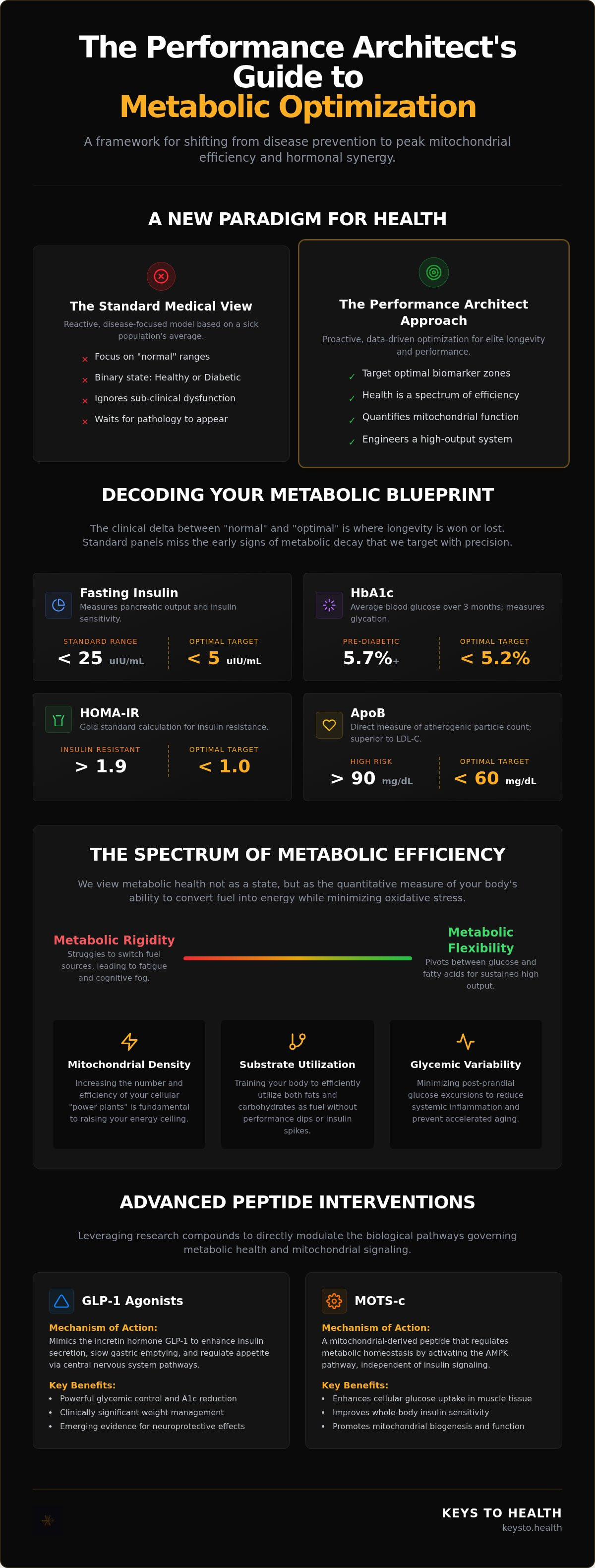
Standard medicine defines metabolic health as the absence of pathology. If your blood pressure is under 130/85 and your fasting glucose is below 100 mg/dL, you are told you're healthy. This is a dangerous oversimplification. I've spent two decades observing that "normal" markers often mask significant mitochondrial decay and poor substrate flexibility.
We view metabolic health as a spectrum of efficiency rather than a binary state of disease. True optimization requires metabolic health protocols that prioritize glycemic variability and post-prandial response over a single morning glucose snapshot. High variability, even within the "normal" range, correlates strongly with systemic inflammation and accelerated biological aging.
The Spectrum of Metabolic Efficiency
Metabolic health is the quantitative measure of an organism's efficiency in converting nutrient substrates into cellular energy while minimizing oxidative byproducts.
Most individuals operate in a state of metabolic rigidity, where the body struggles to switch between burning glucose and fatty acids. Optimized performance depends on mitochondrial density and the integrity of the electron transport chain. When your mitochondria fail to utilize substrates efficiently, you experience the fatigue and cognitive fog that standard blood panels fail to capture. We target metabolic flexibility to ensure your system can pivot between fuel sources without performance drops.
The Performance Architect Approach
We don't build protocols for the average person. We design them for the elite. Average markers represent a population that is increasingly sedentary and metabolically compromised. Using those benchmarks as a goal is a recipe for mediocrity. Our approach shifts the focus to proactive biological design, mapping your unique metabolic blueprint through rigorous data acquisition.
- Analyze deep biomarkers through the HRT Bloodwork Analyzer to identify sub-clinical trends.
- Implement data-driven metabolic health protocols that stabilize blood glucose excursions.
- Prioritize hormone synergy to support lean mass preservation and insulin sensitivity.
- Optimize substrate utilization to lower biological age and improve recovery times.
This isn't about avoiding a diagnosis. It's about engineering a biological system capable of sustained high-output performance for decades. We treat longevity as an architectural project where every variable is measured, managed, and mastered. If you aren't tracking your specific metabolic data, you're merely guessing at your future health span.
Decoding Your Metabolic Blueprint: Essential Biomarkers
Standard reference ranges provided by most laboratories are a reflection of a sick population, not a blueprint for peak performance. Relying on a Comprehensive Metabolic Panel (CMP) alone often misses the sub-clinical nuances of early-stage insulin resistance. I've found that the clinical delta between what is "normal" and what is "optimal" is where longevity is either won or lost.
Standard vs. Optimal: The Clinical Delta
HOMA-IR (Homeostatic Model Assessment for Insulin Resistance) serves as the gold standard for quantifying insulin sensitivity. While a fasting glucose of 95 mg/dL might pass a routine physical, a concomitant fasting insulin of 15 uIU/mL reveals a system under severe stress. In our metabolic health protocols, we target the following elite thresholds:
- Fasting Insulin: Target < 5 uIU/mL to ensure maximum substrate flexibility.
- HbA1c: Target < 5.2% to minimize systemic protein glycation.
- ApoB: Target < 60 mg/dL to address atherogenic particle count directly.
- HOMA-IR: Target < 1.0 for peak insulin sensitivity.
ApoB is a far more accurate predictor of vascular risk than standard LDL-C measurements. High glycemic variability causes endothelial damage, which allows these particles to lodge in the arterial wall more easily. We prioritize particle count over cholesterol weight because it provides a more precise view of your cardiovascular trajectory.
AI-Driven Analysis: Quantifying the Data
Manual data interpretation is prone to human error and oversight. We utilize the HRT Bloodwork Analyzer to process dozens of markers simultaneously, identifying trends before they manifest as performance drops. This tool is essential for visualizing the interplay between your metabolic markers and your hormonal profile.
Hormone synergy is the foundation of a high basal metabolic rate. Testosterone Replacement Therapy (TRT), for instance, has been shown to significantly reduce HbA1c levels in hypogonadal men by improving insulin-stimulated glucose uptake in skeletal muscle. If your hormones are suboptimal, your metabolic floor will remain low regardless of your nutritional precision.
Predictive longevity scaling requires a synthesis of these data points. Once you identify your baseline, you can begin to implement more targeted metabolic health protocols that address your specific biological gaps.
Advanced Pharmacological and Peptide Interventions
While mainstream academic journals continue to debate the merits of Metformin, elite metabolic health protocols have moved toward more sophisticated bioregulatory peptides. We prioritize compounds with pleiotropic effects, specifically those that target mitochondrial signaling and systemic inflammation. This shift allows us to move beyond simple glucose management into the territory of biological optimization.
GLP-1 agonists like Semaglutide and Tirzepatide are frequently mischaracterized as mere weight-loss drugs. In a clinical context, their value lies in metabolic neuroprotection and the stabilization of post-prandial insulin response. By activating GLP-1 receptors, these agents reduce neuroinflammation and improve synaptic plasticity, which are critical for maintaining cognitive function as we age.
I frequently integrate BPC-157 to address systemic inflammation, which is often the silent driver of metabolic dysfunction. When you pair BPC-157 with TB-500, you create a synergistic environment for tissue repair and reduced oxidative stress. This combination is essential for performance architects who need to maintain high training volumes while managing metabolic health.
Mitochondrial Peptides and Substrate Flexibility
MOTS-c is a mitochondrial-derived peptide that functions as a powerful exercise mimetic. It enhances glucose metabolism by activating the AMPK pathway and increasing GLUT4 translocation in skeletal muscle. MOTS-c facilitates fat oxidation by upregulating the expression of carnitine palmitoyltransferase 1 (CPT1), the rate-limiting enzyme in mitochondrial fatty acid entry.
For mitochondrial biogenesis and repair, we typically implement a protocol of 5 mg of MOTS-c administered subcutaneously three times per week for a four-week cycle. Animal data has demonstrated that MOTS-c can prevent high-fat diet-induced insulin resistance, while emerging human observations suggest it is vital for maintaining substrate flexibility. You can find more details on these interventions in our metabolic protocol documentation.
Precision Dosing and Reconstitution
Precise administration is the difference between a successful protocol and a wasted cycle. When handling research compounds, the math must be absolute. I've seen too many researchers fail because they estimated their concentrations rather than calculating them. We utilize the Peptide Reconstitution Calculator to ensure every dose is accurate to the microgram.
Before introducing any agent into your framework, verify its mechanism of action in the Compound Encyclopedia. This resource provides data on over 112 research compounds, including synergistic stacks and specific dosing ranges. Relying on verified data is the only way to build a sustainable and effective metabolic health protocol.
The Performance Architect Checklist: Implementing Your Protocol
Implementing a clinical framework requires a systematic approach that prioritizes data over intuition. We utilize a four-phase execution model to ensure that metabolic health protocols deliver measurable results. This structural hierarchy prevents the common mistake of layering advanced compounds onto a fractured biological foundation.
- Phase 1: Baseline Data Acquisition. We begin with a comprehensive assessment via the HRT Bloodwork Analyzer to identify sub-clinical insulin resistance and hormonal imbalances.
- Phase 2: Glycemic Control. Establish nutritional timing and mapping of glycemic excursions using a Continuous Glucose Monitor (CGM).
- Phase 3: Targeted Integration. Layer in pharmacological agents and peptides identified in our Compound Encyclopedia based on your specific biomarker gaps.
- Phase 4: Iterative Optimization. Re-test biomarkers every 90 days to adjust dosages and training volume based on systemic response.
Nutritional Architecture for Metabolic Health
We prioritize a protein-centric approach, targeting 2.2g of protein per kilogram of body mass. This strategy ensures adequate lean mass for glucose disposal; skeletal muscle is your primary metabolic sink. I've found that circadian fasting, specifically a restricted 8-hour feeding window, significantly improves insulin sensitivity by allowing for a prolonged period of low systemic insulin.
Tactical use of a CGM allows us to identify individual responses to specific carbohydrate sources. We don't guess which foods cause spikes; we measure the area under the curve (AUC) for every major meal. This data informs the precise timing of carbohydrate intake around high-intensity training sessions to maximize glycogen replenishment while minimizing fat storage.
Training for Mitochondrial Density
Mitochondrial volume is the engine of substrate flexibility. We utilize Zone 2 aerobic training, performed at 60 to 70 percent of maximum heart rate, to stimulate mitochondrial biogenesis without inducing excessive systemic fatigue. This base building is mandatory for anyone looking to optimize their metabolic health protocols.
High-intensity interval training (HIIT) serves a different purpose by upregulating GLUT4 translocation. This mechanism allows for insulin-independent glucose uptake, which is critical for clearing surplus blood sugar after high-output sessions. Resistance training completes the framework by increasing the total volume of the metabolic sink, ensuring that nutrients are partitioned toward muscle tissue rather than adipose storage.
To begin building your customized framework, select the relevant metabolic health protocols that align with your current biomarker data.
The final stage of biological mastery involves leveraging technology to eliminate human error and interpretation bias. We've moved beyond static spreadsheets into dynamic, AI-driven environments that allow for predictive health modeling. By synthesizing longitudinal data, we can forecast metabolic trajectories and adjust metabolic health protocols before performance dips occur. This proactive stance is what separates an elite performance architect from a reactive patient.The Keys to Health Ecosystem
The HRT Bloodwork Analyzer serves as the foundational diagnostic engine of our ecosystem. It processes complex biomarker interactions that a standard clinical review might overlook, providing a quantitative score for metabolic and hormonal health. This data integrates directly with our Compound Encyclopedia, a clinical database covering 112 research compounds with verified mechanisms of action and specific dosing ranges.
We designed the Protocol Builder to translate this data into an actionable blueprint. This tool allows you to select specific metabolic targets and receive a structured administration schedule based on your unique biological markers. It removes the guesswork from complex cycles, ensuring that your optimization strategy remains grounded in clinical evidence rather than anecdotal forum advice.
Extending the Protocol: Animal Metabolic Health
Metabolic decay is a cross-species phenomenon. The same mechanisms of mitochondrial dysfunction and insulin resistance that drive human aging also dictate the lifespan of our canine and feline companions. We've adapted our human metabolic health protocols to address these parallels, focusing on substrate flexibility and cellular repair in senior animals to extend their active years.
- Canine Longevity: Protocols focus on lean mass preservation and mitochondrial signaling to extend the healthspan of working and senior dogs.
- Feline Recovery: Targeted interventions address the specific metabolic requirements of cats, particularly those dealing with kidney support or post-surgical recovery.
- Equine Performance: Advanced protocols for horses prioritize energy endurance and joint integrity through precise compound administration.
I frequently use peptides like BPC-157 for senior animals to manage systemic inflammation and accelerate tissue recovery. You can find these specialized frameworks in our Canine Longevity Protocol and Feline Longevity Protocol. The future of longevity science is a unified framework where the same data-driven precision applied to humans is used to optimize the health of every mammal in our care. This holistic approach ensures that the entire environment, human and animal alike, operates at peak biological efficiency.
Mastering Your Biological Architecture
Biological optimization is an ongoing architectural project, not a singular destination. We've moved past the era of generic health advice and reactive medicine into a period defined by data-driven precision. By integrating AI-driven bloodwork analysis with the rigorous administration of research compounds, you'll take absolute control of your metabolic trajectory. I've spent 25 years refining these metabolic health protocols to ensure that every variable, from mitochondrial biogenesis to substrate flexibility, is managed with clinical precision.
Our Compound Encyclopedia, covering 112 research compounds, provides the technical depth you need to eliminate the guesswork from your performance regimen. You now have the tools to synchronize your hormones and metabolism for elite longevity. The blueprint for your biological peak is ready for implementation. It's time to stop guessing and start measuring your progress toward a lower biological age through quantitative analysis.
Access the AI Bloodwork Analyzer and Build Your Protocol. Your highest performing self is waiting for the right framework.
Frequently Asked Questions
What is the most important marker for metabolic health?
Fasting insulin is the most critical marker for assessing metabolic health. While HbA1c and fasting glucose are important, they are lagging indicators that only shift once significant dysfunction has occurred. A low fasting insulin score, ideally under 5 uIU/mL, indicates that your pancreas is not overcompensating to maintain glucose homeostasis. Identifying this early allows you to adjust your framework before you hit the threshold of clinical metabolic syndrome.
How do metabolic health protocols differ for athletes vs. sedentary individuals?
Athletes prioritize substrate flexibility while sedentary individuals focus on reducing insulin load within their metabolic health protocols. High performers require strategic carbohydrate timing to fuel glycolytic output and recovery. Conversely, those with lower activity levels must prioritize glucose clearance and high insulin sensitivity through longer fasting windows and lower glycemic variability. Both groups benefit from data-driven tracking to ensure their specific metabolic floor remains high.
Can peptides like BPC-157 improve metabolic health?
BPC-157 improves metabolic health indirectly by mitigating systemic inflammation and repairing intestinal permeability. Leaky gut often leads to metabolic endotoxemia, where lipopolysaccharides enter the bloodstream and trigger insulin resistance. By stabilizing the gut barrier and reducing inflammatory cytokines, BPC-157 creates a more favorable environment for insulin signaling. We often stack it with TB-500 to address the oxidative stress that drives mitochondrial decay.
How often should I use the AI Bloodwork Analyzer to track my protocol?
You should use the HRT Bloodwork Analyzer every 90 to 120 days to track your progress. This timeframe provides enough data for cellular and hormonal adjustments to stabilize in your blood chemistry. Frequent testing allows us to identify sub-clinical trends early and iterate on your dosing or nutritional strategy. It is the only way to ensure your protocol remains aligned with your actual biological data.
What are the optimal ranges for fasting insulin in high-performers?
High performers should target a fasting insulin level of 2.0 to 5.0 uIU/mL. Standard laboratory reference ranges often include values as high as 24.9 uIU/mL, which represents a population in various stages of metabolic failure. If your insulin is creeping toward the double digits, you are likely losing substrate flexibility and increasing your risk for systemic inflammation. Maintaining this tight range is a primary goal of optimized metabolic health protocols.
Is there a specific metabolic protocol for senior dogs?
Specific protocols exist for senior dogs that prioritize mitochondrial signaling and the preservation of lean muscle mass. As dogs age, their metabolic efficiency drops, leading to lethargy and cognitive decline. We use targeted research compounds to improve energy conversion and reduce oxidative damage in canine tissues. You can find these specialized frameworks, including dosing for senior animals, in our Canine Longevity Protocol documentation.
How do I use the Peptide Reconstitution Calculator for my research?
You use the Peptide Reconstitution Calculator by entering the total milligrams in the vial and the volume of bacteriostatic water added. This tool calculates the exact micrograms per tick mark on your administration device. Precision is mandatory when handling research compounds to avoid significant dosing errors. Always cross-reference your compound's mechanism of action in our Compound Encyclopedia before starting a new cycle.
What is the relationship between HRT and metabolic efficiency?
Hormone Replacement Therapy (HRT) directly influences metabolic efficiency by upregulating glucose transporters in skeletal muscle. Testosterone, for example, improves insulin-stimulated glucose uptake and reduces the accumulation of visceral adipose tissue. When hormones are suboptimal, the body struggles to partition nutrients effectively, leading to metabolic rigidity. Synchronizing your hormonal profile with your metabolic framework is essential for achieving a lower biological age and sustained performance.

Article by
Samir Levin
Samir Levin is a biohacker and longevity researcher with 25 years of personal experimentation across peptides, hormonal optimization, and regenerative medicine. He is the founder of Keys to Health — a platform combining a 112-compound research encyclopedia, AI-powered bloodwork analyzer, peptide protocol builder, and evidence-based PDF protocols used by thousands of biohackers worldwide.
Samir's work is grounded in first-person experimentation, not theory. He personally reversed 10+ years of AAS-induced gynecomastia without surgery using an enzymatic stack he developed and documented. His protocols are built from clinical literature, N=1 data, and feedback from the Keys to Health community.
He covers peptides, TRT/HRT, GLP-1 agents, senolytics, longevity stacks, cognitive enhancement, and animal longevity protocols for dogs, cats, and horses.
metabolic healthbiohackinglongevitypeptidesmitochondrial healthGLP-1MOTS-cinsulin sensitivityperformance optimization