Protocols
InsideTracker Alternative: Why Data Without Protocols is Dead Weight in 2026
By Samir Levin · August 15, 2026 · 16 min read
Disclaimer
This article is for informational and educational purposes only. It does not constitute medical advice, diagnosis, or treatment. Always consult a qualified healthcare provider before starting any new supplement, peptide, or protocol. Keys to Health and Samir Levin are not responsible for any actions taken based on this content.
Most biohackers believe more data leads to better health, but in 2026, an uninterpreted blood panel is just expensive digital noise. You've likely spent thousands on tests only to receive generic "optimal" ranges that don't account for elite performance goals or high-stakes biological demands. Finding a functional InsideTracker alternative requires moving beyond simple tracking and toward a system that provides actionable, clinical-grade blueprints.
I've spent 25 years at the intersection of high-stakes performance and biological science, and I've seen how data without a protocol is dead weight. You don't need another app telling you to eat more spinach. You need a roadmap for hormone optimization and precision dosing for research compounds. This article explores why elite performers are abandoning basic biomarker platforms for AI-driven analysis that understands the nuances of biohacking.
We'll break down the specific limitations of mainstream tracking and introduce you to the architecture of advanced clinical protocols. You'll discover how to bridge the gap between raw data and measurable biological execution using the latest in peptide science and endocrine strategy. It's time to stop collecting data and start executing a plan that actually moves the needle.
Key Takeaways
- Convert raw biomarker data into actionable clinical protocols to bridge the gap between diagnostic measurement and biological execution.
- Identify why elite performers require an InsideTracker alternative that integrates advanced hormonal stacks and regenerative research compounds.
- Leverage AI-driven analysis via the HRT Bloodwork Analyzer to move beyond generic "safe" ranges toward performance-optimized levels.
- Learn the mechanism of action for "Forbidden Markers" like IGF-1 and DHEA that are essential for metabolic mastery and longevity.
- Implement a structured framework for precision dosing and synergistic compound stacking to achieve measurable high-performance outcomes.
Table of Contents
The Limitations of Measurement: Why You Need an InsideTracker Alternative
Data points are not results. If you're an elite performer, "normal" is a failing grade. Most biohackers fall into the trap of collecting endless metrics while their physiology remains stagnant. InsideTracker provides a clean dashboard, but it lacks the clinical engine to drive meaningful change. You don't need more charts; you need an InsideTracker alternative that functions as a biological architect rather than a digital librarian.
The transition from tracking to active intervention is the hallmark of 2026 biohacking. Mainstream platforms use reference ranges derived from a statistically unwell general population. A "normal" testosterone level of 450 ng/dL might keep you off a prescription list, but it won't support the cognitive clarity or muscle protein synthesis required for high-stakes performance. We focus on optimal markers that push you into the top 1% of human function, not just the "safe" middle ground.
The Lifestyle Ceiling of Mainstream Platforms
InsideTracker relies almost exclusively on diet, exercise, and basic supplementation as levers for change. While these are foundational, they have a definitive ceiling. High-stress environments and the biological tax of aging require more aggressive, precision-based interventions. If your bloodwork shows chronic systemic inflammation or declining growth hormone markers, eating more kale isn't the solution. You need to integrate your data with Regenerative Protocols that utilize bioregulators and synthetic peptides to bypass these lifestyle-only limitations.
Data Without Direction: The Cost of Analysis Paralysis
Collecting data without a protocol is a waste of capital. Many users suffer from "Measurement Fatigue," where they track 50+ biomarkers but lack a blueprint to fix them. Personalized medicine must prioritize execution over observation. Generic AI guides fail because they treat biomarkers in isolation, ignoring the complex interplay between systems. For example, they rarely account for how suppressed SHBG levels fundamentally change your requirements for hormone optimization.
In my 25 years of practitioner experience, I've found that the most expensive data is the data you never act on. You need practitioner-led blueprints that translate a low IGF-1 reading into a specific dosing schedule for growth hormone secretagogues like Ipamorelin. We don't just tell you what's wrong; we provide the chemical and biological architecture to fix it. This shift from passive observation to active biological intervention is what separates elite performers from the average biohacker.
Comparing Clinical Depth: Keys to Health vs. InsideTracker
InsideTracker functions as a diagnostic window. It provides a clean view of your current state but fails to offer the architectural blueprints required for actual change. If you're seeking a legitimate InsideTracker alternative, you must look for a system that transitions from measurement to clinical intervention. While most platforms stop at 50 biomarkers, we utilize comprehensive hormone panels and metabolic markers to build a complete biological profile. We don't just measure; we optimize via our AI Bloodwork Analyzer.
The primary failure of mainstream tracking is the "one-size-fits-all" approach. A static PDF report suggesting you eat more fiber is not a protocol. Our methodology leverages a Compound Encyclopedia featuring over 100 research compounds to bridge the gap between laboratory data and physical performance. This allows for the creation of specific, data-backed strategies that mainstream AI guides simply aren't programmed to handle.
AI Bloodwork Analyzer: Precision Interpretation
Standard Direct-to-Consumer Tests often lack the technical depth necessary for elite optimization. Our analyzer identifies performance gaps by evaluating the interplay between markers like SHBG, Albumin, and Free Testosterone. This level of detail is essential when implementing our Testosterone Protocols. We look for the specific biochemical friction points that prevent peak endocrine function, rather than just checking if you fall within a broad "normal" range.
The Protocol Builder vs. The AI Guide
A static report is a dead document. Our Protocol Builder creates a dynamic execution plan that evolves with your bloodwork. It allows for the customization of stacks based on real-time physiological shifts, ensuring that your biological intervention remains precise. This system accounts for individual biochemical nuances that I've refined over 25 years in the field.
We prioritize metabolic panels that include fasting insulin and HbA1c alongside performance markers like IGF-1. This data informs the precise dosing of compounds, such as 2IU of growth hormone or specific secretagogue ranges. For those ready to move from observation to mastery, exploring our advanced human optimization protocols is the logical next step in your biological evolution.
The Missing Middle: Peptides and Advanced Hormonal Stacks
InsideTracker avoids discussing peptides or hormone replacement therapy (HRT) because they operate within a conservative framework that prioritizes general wellness over elite optimization. If you're seeking an InsideTracker alternative, you're likely ready for biological interventions that go beyond basic vitamin recommendations. We bridge this "missing middle" by providing the clinical architecture for regenerative medicine and advanced hormonal stacks that mainstream platforms are too risk-averse to mention.
The risks of direct-to-consumer tests often stem from a lack of actionable context. Data without a protocol is just a diagnostic dead end. We solve this by pairing your biomarkers with a 112-compound Compound Encyclopedia that outlines specific mechanisms of action, synergistic stacks, and evidence-based dosing ranges for compounds like BPC-157 and TB-500.
BPC-157 and TB-500: The Regenerative Gold Standard
BPC-157 (Body Protection Compound 157) is a pentadecapeptide that functions by upregulating growth factor receptors and promoting angiogenesis. While much of the foundational data comes from animal studies, such as a 2010 study on rats where BPC-157 significantly accelerated Achilles tendon healing, human practitioner data suggests a standard research dose of 250-500 mcg/day for systemic recovery. It's most effective when paired with TB-500 (Thymosin Beta-4).
TB-500 promotes vascular repair and cell migration through G-actin sequestration. This mechanism is vital for tissue remodeling and reducing chronic inflammation in joints and connective tissue. Stacking these two creates a synergistic stack that addresses both structural and vascular components of an injury, a strategy commonly utilized in our Regenerative Protocols.
Precision Dosing and Reconstitution
Precision is non-negotiable in longevity science. Most research errors occur during the mixing phase, where improper math leads to significant under or over-dosing of sensitive compounds. Our Peptide Reconstitution Calculator eliminates this risk by providing exact liquid-to-powder ratios based on your specific vial concentration and desired mcg dose.
- Always use bacteriostatic water to prevent microbial growth and ensure compound stability over a 30-day cycle.
- Store reconstituted peptides at 2-8°C (36-46°F) to prevent thermal degradation of the delicate peptide chains.
- Utilize the BPC-157 Reconstitution Calculator to ensure zero-margin-of-error mixing for every 5mg or 10mg vial.
This level of technical rigor is what separates a professional optimization plan from amateur experimentation. We don't just give you a list of numbers; we provide the tools to execute your protocol with clinical certainty.
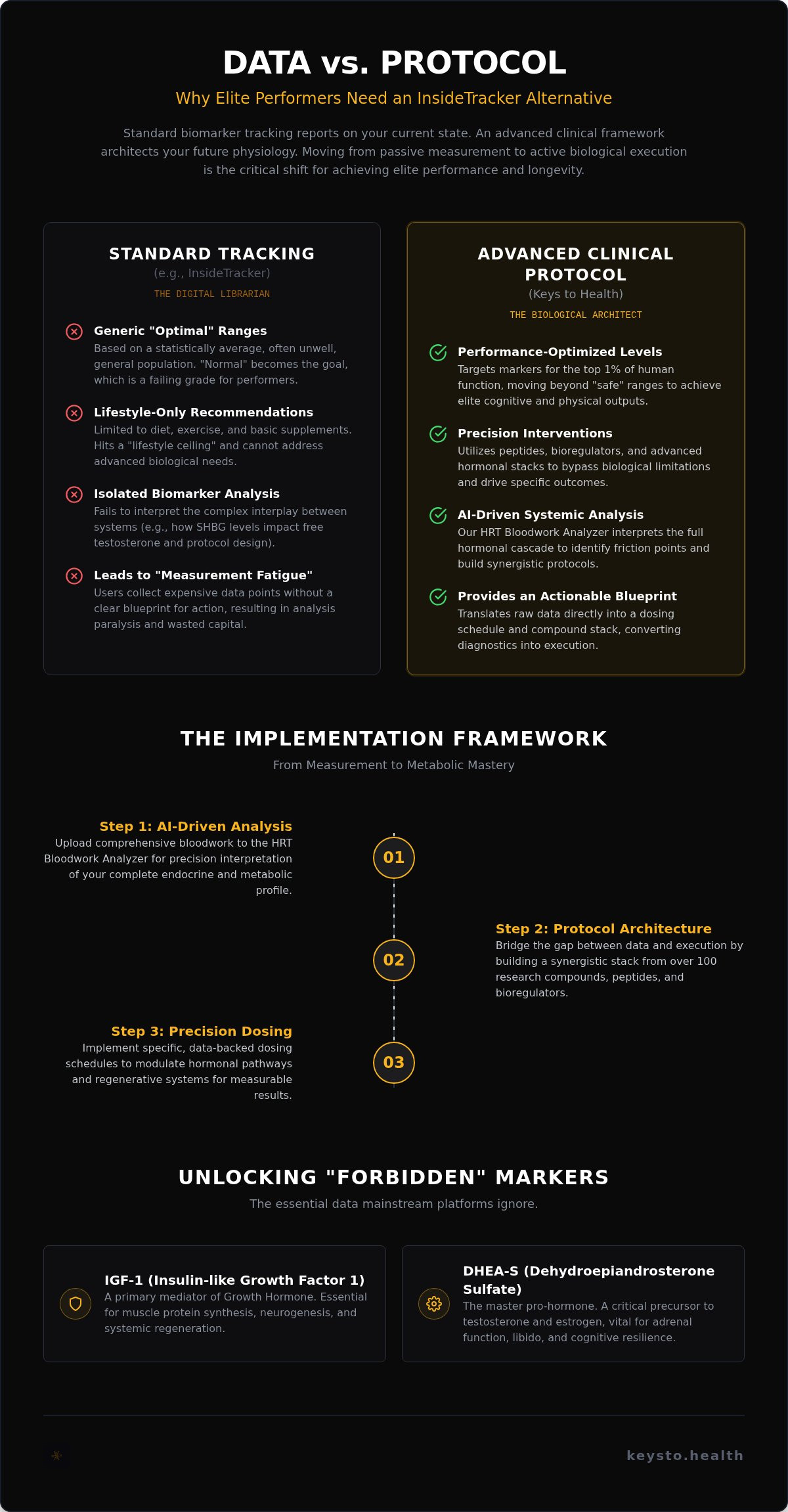
The Keys to Health Implementation Framework
Most platforms leave you stranded at the "what" without ever reaching the "how." As a comprehensive InsideTracker alternative, we provide a clinical architecture that moves from raw data to biological execution. This framework is designed for practitioners and elite performers who require zero margin for error in their optimization journey. We don't just observe your decline; we build the engine to reverse it.
- Comprehensive Bloodwork Acquisition: We prioritize "Forbidden Markers" that mainstream labs often omit. This includes IGF-1 (Insulin-like Growth Factor 1) to assess growth hormone status and DHEA-S to determine adrenal reserve and immune resilience.
- AI-Driven Interpretation: Upload your raw data to the HRT Analyzer. Our system identifies systemic friction points and hormonal imbalances that standard reference ranges ignore.
- Protocol Selection: Identify your primary biological objective. We match your markers to specific blueprints for metabolic health, cognitive enhancement, or systemic longevity.
- Precision Execution: Move into the execution phase with exact dosing schedules. This step involves calculating precise compound concentrations to ensure maximum bioavailability.
- Iterative Re-Testing: Biohacking is a dynamic process. We use follow-up labs to measure the physiological response and adjust the blueprint accordingly.
Selecting Your Primary Optimization Lever
Choosing the right starting point is critical for long-term success. You must decide between Metabolic Protocols to fix insulin resistance or Longevity Protocols to address cellular senescence and DNA repair. I always prioritize vascular health as the foundation. Without efficient nutrient delivery and waste removal, even the most advanced peptide stack will fail to reach target tissues effectively. We look for bottlenecks in markers like Homocysteine and ApoB to ensure your circulatory system can support high-performance demands.
The Iterative Loop: Testing vs. Optimization
Optimization is not a destination; it's a constant state of refinement. Re-testing every 90 days is the clinical standard for hormone and peptide management. This window is sufficient to see the "delta," which is the specific change in your biomarkers in response to a protocol. If your systemic inflammation markers haven't dropped after a cycle, we don't guess. We refine the dosing or investigate underlying pathologies. This iterative loop allows us to use data as a steering mechanism rather than a static trophy. It ensures your InsideTracker alternative strategy remains responsive to your body's real-time needs.
Conclusion: Moving From Measurement to Mastery
InsideTracker serves as a capable dashboard, but Keys to Health functions as the engine. High-performance individuals require clinical protocols to bridge the gap between diagnostic data and biological mastery. If you manage a high-stress, high-output lifestyle, you cannot afford the luxury of trial and error. Integrating Human Biohacking & Longevity Protocols provides the necessary architecture to maintain peak performance while mitigating the biological tax of systemic stress.
The future of biological optimization rests on the convergence of AI-driven analysis, precision peptides, and practitioner-led expertise. We have moved past the era of generic wellness advice. In 2026, the competitive edge belongs to those who treat their physiology as a high-stakes engineering project requiring specific, data-backed interventions. This shift from observation to execution is why a specialized InsideTracker alternative is now a requirement for the elite performer.
Your Next Steps in Biological Optimization
Audit your current tracking platform with clinical skepticism. Ask yourself if your service provides actionable answers or merely generates more digital noise. If you receive suggestions to "reduce stress" or "eat more fiber" in response to complex hormonal declines, you are using an inadequate tool. Access the Keys to Health Protocols to begin implementing a rigorous, evidence-based strategy that handles the technical complexity of advanced biohacking. The "Elite Performance Architect" model succeeds because it prioritizes measurable outcomes over passive observation.
The Bottom Line
The transition from data to execution marks the end of amateur biohacking and the beginning of biological mastery. High-performance readers must demand more than just a list of biomarkers. You need a blueprint that accounts for your specific biochemical individuality and performance goals. Protocol-based optimization is superior to tracking-only models because it provides the clinical architecture required to move from biological observation to total physiological mastery.
- Stop collecting digital noise and start executing clinical protocols that drive measurable physiological change.
- Leverage AI-driven tools like the HRT Analyzer to identify systemic bottlenecks that mainstream platforms consistently ignore.
- Transition from passive tracking to active biological intervention using precision compounds and synergistic stacks.
- Implement an iterative testing loop to refine your optimization strategy based on real-time biological feedback.
Execute Your Biological Blueprint
Measurement is merely the diagnostic entry point. To achieve elite status, you must transition from passive observation to active biological execution. I've spent 25 years refining the intersection of high-stakes performance and clinical science; the results are clear. You need an InsideTracker alternative that provides a clinical engine rather than just a digital dashboard.
By leveraging our AI-Driven HRT Bloodwork Analyzer and the Compound Encyclopedia containing 112+ research compounds, we provide the architecture for total physiological mastery. We move beyond generic advice to provide precision dosing and synergistic stacks that actually move the needle. Stop staring at charts and start implementing protocols that reflect your performance goals.
The tools for your biological evolution are ready. We've built the blueprints; you simply need to execute the plan. Your peak performance is no longer a matter of chance, but a matter of precision engineering.
Frequently Asked Questions
Is Keys to Health better than InsideTracker for hormone optimization?
Yes, we specialize in high-performance endocrine strategy while InsideTracker stays within conservative reference ranges. We use the HRT Analyzer to calculate optimal ratios for free testosterone and growth hormone markers. Our system is a superior InsideTracker alternative because it provides specific clinical blueprints for intervention rather than just lifestyle suggestions. We prioritize the top 1% of human function over the statistically unwell normal average.
Can I use my InsideTracker bloodwork results with the Keys to Health AI Analyzer?
You can upload raw data from any laboratory provider into our system. Our HRT Bloodwork Analyzer accepts standard PDF or CSV formats to generate optimization reports. This allows you to leverage existing data while upgrading to our more aggressive clinical protocols. We focus on the interplay between markers like SHBG and albumin to determine your actual biological availability of hormones.
Does Keys to Health provide dosing for peptides like BPC-157?
We provide specific research-based dosing ranges for over 100 compounds in our Compound Encyclopedia. For BPC-157, we detail the 250-500 mcg/day range used in clinical literature for tissue repair. Our protocols also cover synergistic stacks, such as pairing BPC-157 with TB-500. This level of technical detail is what makes our platform a necessary InsideTracker alternative for advanced biohackers and elite performers.
How often should I update my bloodwork for the optimization protocols?
Re-testing every 90 days is the clinical standard for monitoring hormonal and metabolic shifts. This window allows us to track the delta or the specific physiological response to your current protocol. Testing more frequently often leads to chasing noise; waiting longer risks missing critical adjustment periods. We use these iterative loops to refine your blueprint and ensure your internal chemistry remains performance-optimized at all times.
What biomarkers are missing from InsideTracker that Keys to Health prioritizes?
InsideTracker often omits markers like IGF-1, DHEA-S, and Reverse T3. We prioritize these because they provide a deeper look into your adrenal reserve and metabolic efficiency. We also focus on vascular health markers like Homocysteine and ApoB to ensure your circulatory system can support advanced peptide stacks. These markers are essential for anyone moving beyond basic wellness into true biological mastery and high-performance longevity.
Is the Peptide Reconstitution Calculator free to use?
The Peptide Reconstitution Calculator is a standard tool we provide to ensure precision in research settings. It eliminates the math errors that often lead to improper dosing of sensitive compounds. By entering the vial size and desired mcg dose, you get an exact volume for bacteriostatic water. Precision is the foundation of our methodology; we don't leave your biological execution to amateur guesswork.
How do clinical protocols differ from generic health advice?
Generic advice tells you to sleep more, while a clinical protocol provides a specific sequence of compounds and lifestyle adjustments to fix sleep architecture. Our Human Biohacking & Longevity Protocols are engineered blueprints for execution. They define the mechanism of action, exact dosing, and timing for every intervention. We treat your body like a high-stakes engineering project rather than a generic wellness blog.
Do you offer protocols for animal longevity as well?
We offer specialized protocols for horses, dogs, and cats through our pet-specific resources. Our Canine Longevity Protocol and equine recovery strategies apply the same rigorous science to animal health. We utilize bioregulators and peptides to address joint mobility and systemic aging in high-performance animals. This ensures that your companions benefit from the same level of optimization that we apply to human biology.

Article by
Samir Levin
Samir Levin is a biohacker and longevity researcher with 25 years of personal experimentation across peptides, hormonal optimization, and regenerative medicine. He is the founder of Keys to Health — a platform combining a 112-compound research encyclopedia, AI-powered bloodwork analyzer, peptide protocol builder, and evidence-based PDF protocols used by thousands of biohackers worldwide.
Samir's work is grounded in first-person experimentation, not theory. He personally reversed 10+ years of AAS-induced gynecomastia without surgery using an enzymatic stack he developed and documented. His protocols are built from clinical literature, N=1 data, and feedback from the Keys to Health community.
He covers peptides, TRT/HRT, GLP-1 agents, senolytics, longevity stacks, cognitive enhancement, and animal longevity protocols for dogs, cats, and horses.
InsideTrackerbiohackingbloodwork analysishormone optimizationpeptidesperformance enhancementbiomarker datalongevity protocols