Hormones
Hormone Optimization for Men: Elite Performance Blueprint
By Samir Levin · August 23, 2026 · 16 min read
Disclaimer
This article is for informational and educational purposes only. It does not constitute medical advice, diagnosis, or treatment. Always consult a qualified healthcare provider before starting any new supplement, peptide, or protocol. Keys to Health and Samir Levin are not responsible for any actions taken based on this content.
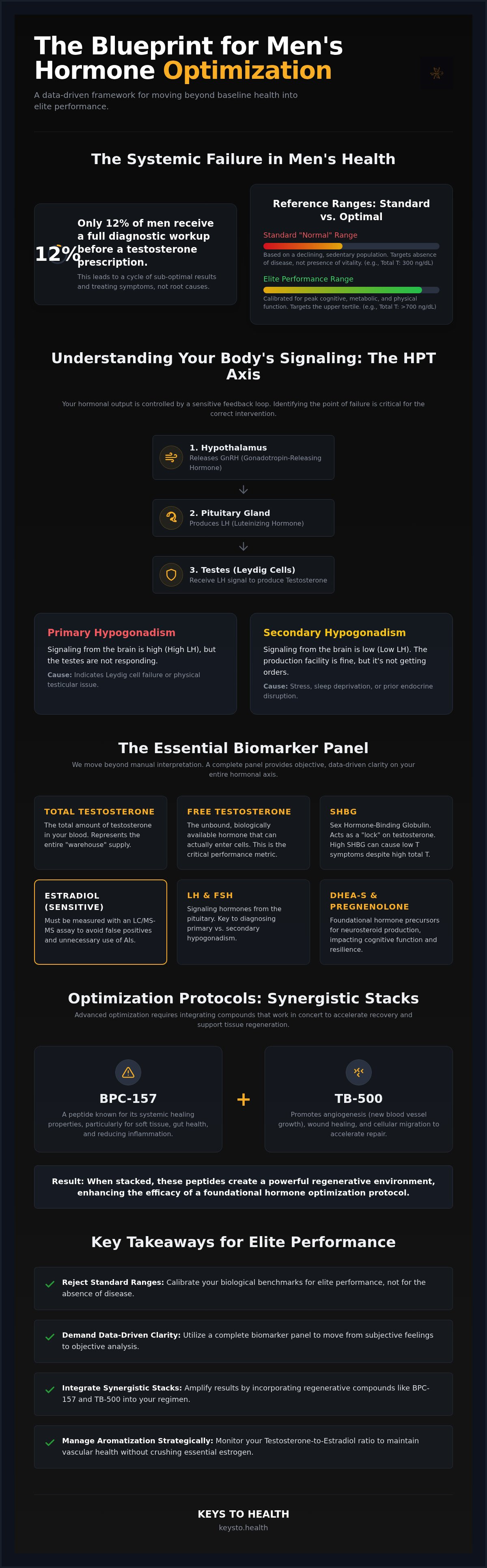
Research presented at the ENDO 2026 conference revealed that only 12% of men receiving an initial testosterone prescription underwent the full diagnostic workup recommended by clinical guidelines. This systemic failure explains why so many men feel trapped in a cycle of sub-optimal recovery and cognitive decline despite having "normal" bloodwork. If you're frustrated by a medical system that prioritizes the absence of disease over the presence of elite health, you recognize that hormone optimization for men requires a more rigorous, data-driven approach. We don't settle for reference ranges designed for the average; we engineer for the exceptional.
I've spent 25 years refining these protocols at the intersection of professional athletics and biological science. You deserve clinical-grade clarity on your biomarkers rather than the vague advice found in mainstream wellness circles. This blueprint provides the technical architecture for moving beyond baseline levels into true biological optimization. We'll analyze specific dosing protocols for Testosterone Optimization, the synergistic stacking of BPC-157 and TB-500, and the integration of the HRT Bloodwork Analyzer. It's time to treat your biology like the high-performance machine it is.
Key Takeaways
- Reject standard medical reference ranges that prioritize the absence of disease in favor of biological benchmarks calibrated for elite performance.
- Identify the critical biomarkers required for a complete hormonal profile to move from manual interpretation toward data-driven clinical clarity.
- Master the technical protocols for hormone optimization for men by integrating synergistic stacks of BPC-157 and TB-500 into your existing regimen.
- Apply rigorous technical standards to peptide reconstitution and dosing to prevent common calculation errors that compromise the efficacy of your protocols.
- Build a sustainable foundation for longevity by prioritizing vascular health and strategically managing aromatization without crushing essential estrogen levels.
Table of Contents
- The Clinical Framework: Moving Beyond "Normal" Reference Ranges
- Biomarker Precision: The AI Approach to Bloodwork Analysis
- Optimization Protocols: Synergistic Stacks and Peptide Integration
- Practical Implementation: Reconstitution, Dosing, and Administration
- The Performance Horizon: Vascular Health and Long-Term Maintenance
The Clinical Framework: Moving Beyond "Normal" Reference Ranges
Hormone optimization for men isn't a medical treatment for the infirm; it's a precision engineering protocol for the elite. I define optimization as the strategic calibration of your endocrine system to maximize biological healthspan and performance. Most physicians look for pathology. If you aren't at death's door, they label you "normal." We ignore these bureaucratic definitions. We focus on the upper tertile of the physiological range where cognitive function, metabolic efficiency, and physical recovery are at their peak.
The Problem with Modern Reference Ranges
Standard laboratory reference ranges are derived from a bell curve of the general population. This population is increasingly sedentary, obese, and hormonally deficient. When a lab tells you that 300 ng/dL is "normal," they're comparing you to the bottom 10% of a declining demographic. I've found that high-performers rarely feel optimal below 700 or 800 ng/dL. We target specific biomarkers using the HRT Bloodwork Analyzer to ensure your data is compared against performance standards, not societal averages.
Primary vs. Secondary Hypogonadism
Understanding the Hypothalamic-Pituitary-Testicular (HPT) Axis is critical for identifying where your system is failing. The hypothalamus releases GnRH, which signals the pituitary to produce Luteinizing Hormone (LH). LH then travels to the Leydig cells in the testes to trigger testosterone production. This feedback loop is sensitive. If the brain senses enough androgen in the blood, it shuts down signaling to maintain homeostasis.
- Primary Hypogonadism: The signaling is high, but the testes aren't responding. This indicates Leydig cell failure or physical damage.
- Secondary Hypogonadism: The signaling is low. The brain isn't telling the body to produce enough, often due to stress, sleep deprivation, or prior endocrine disruption.
Identifying this signaling break determines whether you need a restart protocol or direct Androgen Replacement Therapy (ART). I prioritize free testosterone over total testosterone in every assessment. Your total T represents the entire warehouse, but Sex Hormone-Binding Globulin (SHBG) acts as a lock on the door. SHBG binds to testosterone, making it biologically unavailable. If your SHBG is too high, you can have high total T and still suffer from brain fog and poor recovery. You must optimize for the free, unbound hormone that can actually cross the cell membrane. For a deeper dive into these mechanics, refer to our Testosterone Optimization protocol.
Biomarker Precision: The AI Approach to Bloodwork Analysis
Manual interpretation of lab results is inherently flawed and prone to human bias. Most clinicians look for "out of range" flags, ignoring sub-clinical trends that signal declining performance long before a disease state manifests. I've reviewed thousands of labs where a man's numbers were technically "normal" but his biological systems were clearly failing. This is why we move beyond subjective assessment toward objective, data-driven analysis.
We utilize the AI Bloodwork Analyzer to identify complex patterns across multiple hormonal axes. Testing DHEA-S and Pregnenolone is a non-negotiable component of hormone optimization for men because these precursors serve as the foundational substrates for neurosteroid production. Pregnenolone, specifically, modulates GABAergic and glutamatergic signaling in the brain, influencing everything from cognitive processing speed to emotional resilience.
The Essential Lab Panel for Men
A complete profile must include Total T, Free T, SHBG, LH, FSH, and Prolactin. You must insist on the LC/MS-MS (Liquid Chromatography/Mass Spectrometry) assay for Estradiol (Sensitive). Standard immunoassay tests frequently yield false positives by misidentifying other steroids as estrogen. This leads to the unnecessary use of aromatase inhibitors which can crush your bone density and lipid profile.
We also monitor the Testosterone-to-E2 ratio and track Hematocrit and Hemoglobin to manage blood viscosity. While there are clear benefits and risks of testosterone therapy, most risks like erythrocytosis are easily mitigated with precise data. Maintaining an optimal balance between these markers ensures that your blood remains an efficient delivery system for nutrients and oxygen rather than a sludge that strains the cardiovascular system.
Leveraging AI for Protocol Calibration
Optimization is a dynamic process, not a static destination. Our HRT Bloodwork Analyzer tracks delta changes over time, allowing us to see how your body responds to specific interventions. If we detect outlier biomarkers like elevated hs-CRP or Ferritin, it signals systemic inflammation or overtraining that requires an immediate adjustment to your recovery protocol.
The Protocol Builder then translates this refined data into actionable steps. This eliminates the guesswork that plagues most hormone optimization for men strategies. If you're ready to stop guessing and start measuring, you can explore our specialized optimization protocols to begin your calibration.
Optimization Protocols: Synergistic Stacks and Peptide Integration
Hormone optimization for men reaches its full potential when we move beyond mono-therapy. While Testosterone Replacement Therapy (TRT) restores androgenic signaling, it often creates a gap in systemic recovery. As your muscle strength increases rapidly on a protocol, your connective tissues must keep pace to prevent injury. I use synergistic peptide stacks to bridge this gap, ensuring your structural integrity matches your hormonal output.
The Testosterone Optimization Protocol
A standard baseline for most high-performers involves 100–200 mg/week of Testosterone Cypionate or Enanthate. I advocate for subcutaneous (SubQ) injections over traditional intramuscular (IM) routes. SubQ administration results in more stable serum levels and lower peaks, which minimizes aromatization and the subsequent need for estrogen management. We've seen that smaller, more frequent doses, such as every other day or daily, lead to a better Free-T-to-E2 ratio. You can find specific frequency schedules and injection techniques in our Testosterone Protocol.
Regenerative Recovery Stacks
I consistently pair TRT with BPC-157 and TB-500 to manage the increased load on tendons and ligaments. BPC-157, a gastric-derived pentadecapeptide, functions by upregulating growth factor receptors, specifically VEGFR2. This mechanism accelerates angiogenesis and collagen synthesis, which is critical for tissue remodeling. A daily dose of 250–500 mcg provides the systemic support necessary for continuous high-intensity training. We combine this with Thymosin Beta-4 (TB-500) at 2.5–5 mg/week to leverage its role in actin sequestration, which facilitates cell migration to damaged sites.
For those seeking endogenous growth hormone optimization, we integrate secretagogues like Ipamorelin and CJC-1295 without DAC. Ipamorelin acts as a selective ghrelin receptor agonist, while CJC-1295 functions as a Growth Hormone Releasing Hormone (GHRH) analog. Together, they stimulate the pituitary to release GH in a pulsatile manner that mimics natural physiological rhythms. This stack enhances fat oxidation, improves sleep quality, and supports the hormone optimization for men framework by maximizing IGF-1 levels without the side effects of exogenous GH. For injury-specific dosing and advanced stacking strategies, I recommend reviewing our Regenerative Protocol.
Practical Implementation: Reconstitution, Dosing, and Administration
Precision is the variable that separates biological engineering from expensive guesswork. The technical reality of peptide research involves transitioning compounds from a lyophilized powder into an active solution. I've found that a 10% error in reconstitution often leads to a 100% failure in protocol efficacy. If your math is off, your serum levels will never reach the targets required for true hormone optimization for men.
We utilize the Peptide Reconstitution Calculator to eliminate mathematical errors and ensure every tick on the syringe represents a precise dose. Beyond the math, maintaining the cold chain is non-negotiable. Peptides are structurally delicate; they degrade rapidly when exposed to heat or UV light. Once reconstituted, these compounds must remain refrigerated to preserve their molecular stability.
The Reconstitution Process
You must add Bacteriostatic Water (BAC) with extreme care to avoid damaging delicate peptide bonds. I recommend angling the needle so the diluent drips slowly down the interior glass wall of the vial rather than spraying directly onto the powder. Never shake the vial. Gently swirl the solution until the powder is fully dissolved and the liquid is clear.
Calculating the "mcg per tick" depends entirely on your vial volume and the amount of BAC water added. For example, adding 2ml of water to a 5mg vial of BPC-157 creates a concentration where each 10-unit mark on a standard U-100 syringe equals 250mcg. You should consult our Peptide Mixing Guide for visual tools that simplify this calibration.
Administration Best Practices
Injection site rotation is essential to prevent localized lipohypertrophy, which is the accumulation of extra fat under the skin that can impede absorption. Subcutaneous injections in the abdominal fat or outer thigh provide the most consistent absorption rates. I always advocate for the "Empty Stomach" rule when administering growth hormone secretagogues like Ipamorelin. High blood glucose or elevated insulin levels trigger the release of somatostatin, a hormone that actively inhibits the endogenous growth hormone pulse you're trying to stimulate.
You should also prepare for the "flushing" effect common with peptides like CJC-1295. This is a result of rapid vasodilation and typically lasts for 10 to 20 minutes. It's a sign of biological activity rather than a cause for concern. By following these technical standards, you ensure that your hormone optimization for men protocol remains both safe and effective over the long term.
The Performance Horizon: Vascular Health and Long-Term Maintenance
Hormone optimization for men is a marathon, not a sprint. While the initial surge in performance is rewarding, the long-term objective is to maintain this state without compromising your internal architecture. We prioritize Vascular Health because the endothelium is the ultimate arbiter of longevity. Your blood vessels must remain elastic and responsive to the increased metabolic demands of an optimized system.
Managing the side effects of optimization requires a nuanced approach to Aromatization. Many practitioners reflexively prescribe high-dose aromatase inhibitors (AIs) to crush estrogen. This is a strategic error. Estrogen is neuroprotective, cardioprotective, and essential for bone density. We aim to control the conversion of testosterone to estradiol without driving levels into the sub-physiological range, which would otherwise elevate your cardiovascular risk profile.
Vascular Aging and Prevention
Androgens influence nitric oxide production by modulating endothelial nitric oxide synthase (eNOS) activity. While optimized levels support vascular tone, chronic elevation can sometimes lead to lipid profile shifts, such as a reduction in HDL. We mitigate these risks by integrating a Cardiovascular Protocol designed to preserve arterial elasticity and endothelial function. I recommend regular screening through Coronary Artery Calcium (CAC) scores and carotid ultrasounds to provide an objective baseline of your structural vascular health.
Sustainable Monitoring Strategies
I advocate for a "Quarterly Calibration" schedule to ensure your protocol remains aligned with your biological data. This includes comprehensive bloodwork, consistent blood pressure monitoring, and tracking subjective markers like sleep quality and cognitive clarity. As the science of optimization evolves, you should utilize our Compound Encyclopedia to research emerging bioregulators and metabolic agents that can be integrated into your regimen.
Transitioning from an aggressive performance phase to a sustainable Longevity Protocol is the final step in the blueprint. This shift focuses on maintaining the gains of optimization while maximizing your healthy lifespan. By adhering to a rigorous Prevention Protocol, you protect your biological investments and ensure that your peak performance years extend well into the future.
Engineering Your Biological Future
True hormone optimization for men requires a shift from passive healthcare to active biological management. We've established that relying on outdated lab ranges is a recipe for mediocrity. By leveraging AI-driven biomarker analysis and strategic peptide integration, you can achieve a level of physiological precision that was once reserved for professional athletes. I've spent 25 years refining these blueprints to ensure every protocol is backed by clinical data and practical experience.
You're no longer guessing at dosages or settling for sub-optimal recovery. Our platform provides access to over 112 clinically-referenced compound profiles to help you navigate this complex landscape with certainty. This isn't just about feeling better; it's about calibrating your endocrine architecture for long-term healthspan and elite performance. The tools for this transformation are now at your disposal.
Take control of your biological data and start building a foundation for lifelong vitality. Your biology is the most important asset you'll ever own, so treat it with the precision it deserves.
Hormone Optimization FAQ
Is hormone optimization the same as TRT?
Hormone optimization for men is a comprehensive strategy while Testosterone Replacement Therapy (TRT) is a single tool within that framework. Optimization involves the calibration of all endocrine axes, including thyroid, adrenal, and growth hormone signaling. While TRT focuses on replacing deficient testosterone levels, optimization utilizes tools like the HRT Bloodwork Analyzer to achieve peak physiological function across multiple biomarkers, including DHEA and Pregnenolone.
How long does it take to see results from hormone optimization?
Physiological timelines vary by system. You'll typically notice improvements in cognitive clarity and neurotransmitter balance within 14 to 21 days. Metabolic shifts and changes in body composition generally require 3 to 6 months of adherence to a calibrated optimization protocol. Stabilization of the lipid profile and bone mineral density takes longer. Consistent monitoring ensures the protocol remains effective as your biological baseline shifts during the first year of implementation.
Can I optimize my hormones naturally without exogenous compounds?
You can improve your baseline through rigorous sleep hygiene, micronutrient density, and resistance training. However, natural interventions often hit a biological ceiling dictated by age related decline. While lifestyle factors support the Hypothalamic-Pituitary-Testicular (HPT) Axis, they cannot always overcome primary or secondary hypogonadism. Exogenous compounds are used when data indicates that lifestyle alone is insufficient to reach the upper tertile of the physiological performance range.
What are the risks of long-term testosterone optimization?
Primary risks include erythrocytosis, which is an increase in red blood cell mass that elevates blood viscosity. We manage this by monitoring hematocrit and hemoglobin levels. Long term hormone optimization for men can also suppress endogenous production via the negative feedback loop of the HPT axis. Utilizing the Prevention Protocol allows us to mitigate these risks through precise dosing and regular cardiovascular screening, ensuring performance gains don't compromise systemic health.
Do I need to take an Aromatase Inhibitor (AI) if I start TRT?
An AI is not mandatory and should never be used reflexively. Aromatization is the process where testosterone converts to estradiol via the aromatase enzyme. Estrogen is critical for vascular health and neuroprotection. I only recommend an AI if your Estradiol (Sensitive) levels exceed the optimal ratio and you manifest clinical symptoms. Most men can manage estrogen through injection frequency adjustments or body fat reduction rather than pharmacological suppression.
How do peptides like BPC-157 interact with male hormones?
Peptides like BPC-157 don't directly alter androgen levels but enhance the environment where hormones function. BPC-157 upregulates growth factor receptors, specifically VEGFR2, which accelerates the repair of tissues that are under increased load from higher testosterone levels. This creates a synergistic effect where hormones drive the signal for growth and peptides provide the structural support. You can research specific mechanisms in our Compound Encyclopedia.
What is the best age to start a hormone optimization protocol?
There is no universal age. The decision depends entirely on your biomarker data and clinical symptoms. Most men begin to see a decline in androgen production and growth hormone pulses in their early 30s. I've worked with elite performers who required intervention in their late 20s due to high systemic stress. The first step is always an objective assessment using the HRT Bloodwork Analyzer to establish your biological baseline.
Will hormone optimization affect my fertility?
Exogenous testosterone suppresses the production of Luteinizing Hormone (LH) and Follicle Stimulating Hormone (FSH), which are essential for spermatogenesis. This typically results in a significant reduction in sperm count. If fertility is a priority, we integrate Human Chorionic Gonadotropin (HCG) into the protocol. HCG acts as an LH mimetic, maintaining intratesticular testosterone and preserving Leydig cell function. Refer to our Fertility Protocol for specific protective strategies.

Article by
Samir Levin
Samir Levin is a biohacker and longevity researcher with 25 years of personal experimentation across peptides, hormonal optimization, and regenerative medicine. He is the founder of Keys to Health — a platform combining a 112-compound research encyclopedia, AI-powered bloodwork analyzer, peptide protocol builder, and evidence-based PDF protocols used by thousands of biohackers worldwide.
Samir's work is grounded in first-person experimentation, not theory. He personally reversed 10+ years of AAS-induced gynecomastia without surgery using an enzymatic stack he developed and documented. His protocols are built from clinical literature, N=1 data, and feedback from the Keys to Health community.
He covers peptides, TRT/HRT, GLP-1 agents, senolytics, longevity stacks, cognitive enhancement, and animal longevity protocols for dogs, cats, and horses.
hormone optimizationtestosteroneTRTBPC-157TB-500peptidesbiohackingmen's healthelite performance