Hormones
Hormone Health Analysis: The Clinical Blueprint for Biological Optimization
By Samir Levin · August 26, 2026 · 16 min read
Disclaimer
This article is for informational and educational purposes only. It does not constitute medical advice, diagnosis, or treatment. Always consult a qualified healthcare provider before starting any new supplement, peptide, or protocol. Keys to Health and Samir Levin are not responsible for any actions taken based on this content.
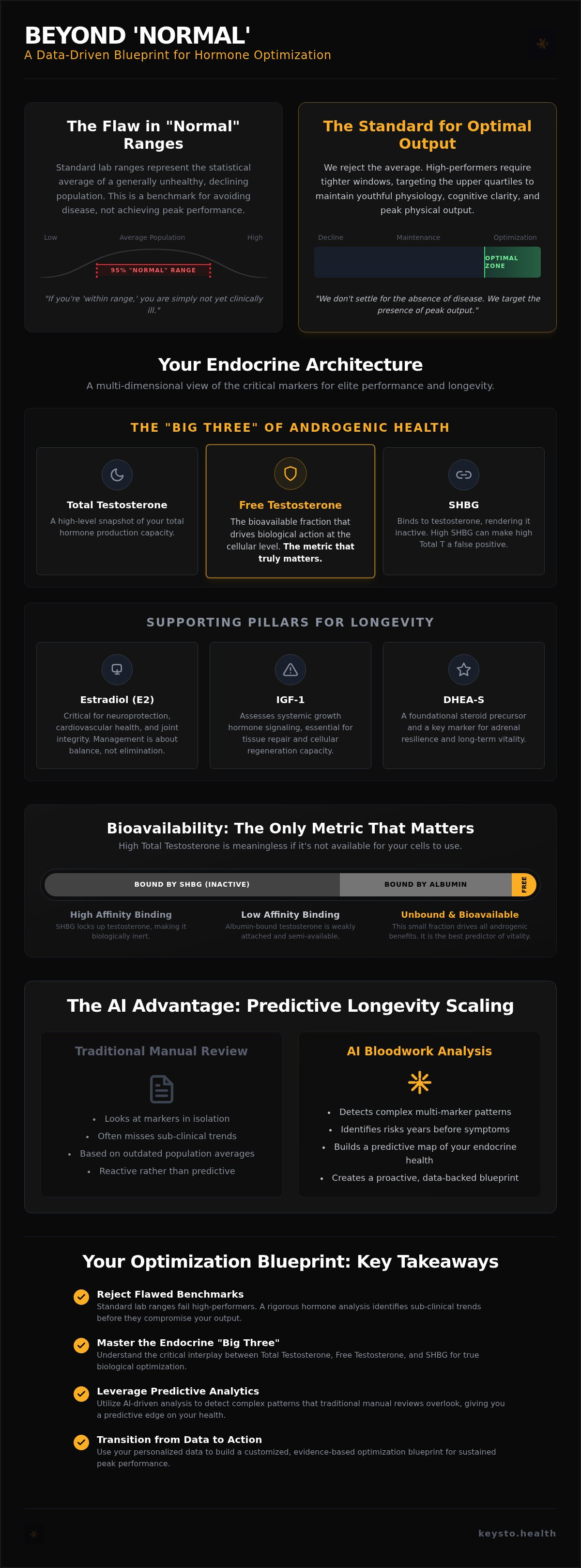
Your doctor’s "normal" range is a statistical average of a declining population, not a blueprint for elite performance. If you are operating within the standard 2.5th to 97.5th percentile, you aren't optimized; you are simply not clinical. I have spent 25 years dissecting why high-performers feel sub-optimal despite having "clean" labs. A sophisticated hormone health analysis requires moving past these generic benchmarks to identify your specific biological ceiling. We don't settle for the absence of disease. We target the presence of peak output.
You likely feel the frustration of being told "everything is fine" while your energy, libido, and cognitive clarity suggest otherwise. Following the FDA's landmark 2026 decision to remove boxed warnings from HRT products, the path to optimization has never been clearer. This article provides the clinical blueprint for interpreting your data. I will show you how to build a predictive map of your endocrine health, utilize data-backed protocols for optimization, and gain actionable insights into your individual aging process.
Key Takeaways
- Learn why standard laboratory reference ranges fail high-performers and how a rigorous hormone health analysis identifies sub-clinical trends before they compromise your output.
- Master the "Big Three" of endocrine architecture by understanding the interplay between Total Testosterone, Free Testosterone, and SHBG for biological optimization.
- Discover how we use AI Bloodwork Analysis to detect complex multi-marker patterns that traditional manual reviews often overlook.
- Access practical dosing ranges and synergistic stacking strategies, such as pairing BPC-157 with TB-500 for accelerated regenerative recovery.
- Transition from raw data to action using our HRT Bloodwork Analyzer to build a customized, data-backed optimization blueprint.
Table of Contents
- Beyond Reference Ranges: The Philosophy of Hormone Health Analysis
- Endocrine Architecture: Critical Markers for Elite Performance
- AI Interpretation vs. Manual Review: Predictive Longevity Scaling
- Strategic Hormone Optimization: Dosing, Stacking, and Rhythms
- Implementing the Keys to Health HRT Bloodwork Analyzer
Beyond Reference Ranges: The Philosophy of Hormone Health Analysis
"Within range" is the diagnostic equivalent of mediocrity. Standard laboratory reference ranges represent the statistical average of the general population, which increasingly includes individuals with metabolic dysfunction, sedentary lifestyles, and chronic inflammation. I have spent 25 years in elite performance environments. My experience confirms that "within range" results often mask underlying biological stagnation. A hormone health analysis is the systematic evaluation of endocrine markers to reach biological peaks rather than simply avoiding clinical disease.
We utilize Biological Optimization Blueprints to shift the focus from reactive treatment to proactive architecture. This framework treats your endocrine system as a high-performance engine that requires precise calibration. If you settle for the "normal" range, you are accepting the health profile of an average, declining individual. We reject that standard. We prioritize data-driven protocols that target the upper quartiles of performance markers.
The "Normal" vs. "Optimal" Divide
Standard lab ranges are derived from a 95% confidence interval of the people who visited that specific lab in the recent past. This population is not a cohort of elite athletes or longevity seekers. Elite performance requires tighter performance windows. For example, a total testosterone level of 350 ng/dL is often flagged as "normal" because it sits within the bottom of the reference range. However, for a 40-year-old male seeking cognitive clarity and lean mass retention, that number represents a state of deficiency. We prioritize absolute optimization goals over age-adjusted declines to maintain youthful physiological function as long as biologically possible.
Predictive Longevity through Endocrine Mapping
Hormone fluctuations serve as the earliest warning signals for systemic decline. Subtle shifts in your endocrine profile often precede the onset of metabolic syndrome or Vascular Health issues by years. By mapping these markers, we can identify sub-clinical trends before they manifest as physical symptoms. This proactive approach allows for the implementation of targeted interventions that preserve metabolic flexibility and cellular resilience. You can begin this process by utilizing our HRT Bloodwork Analyzer to identify exactly where your current levels sit on the spectrum of performance. Integrating these data points into a comprehensive Longevity Protocol ensures your biological architecture remains robust against the stressors of aging.
Endocrine Architecture: Critical Markers for Elite Performance
A sophisticated hormone health analysis requires a multi-dimensional view of the endocrine system. We don't look at markers in isolation. We analyze the "Big Three" of male optimization: Total Testosterone, Free Testosterone, and Sex Hormone-Binding Globulin (SHBG). While Total Testosterone provides a snapshot of production, it's the Free fraction that drives biological action at the cellular level.
Beyond the androgenic axis, we prioritize Estradiol (E2) management for its critical role in neuroprotection and cardiovascular health. Many practitioners mistakenly drive E2 too low, which compromises cognitive function and joint integrity. We also monitor IGF-1 to assess systemic growth hormone signaling and tissue repair capacity. For adrenal resilience, DHEA-S serves as the foundational steroid precursor and an essential marker for longevity. You can find technical data on the specific mechanisms of action for the compounds we use to modulate these markers in our Compound Encyclopedia.
The Testosterone-SHBG-Albumin Synergy
Bioavailability is the only metric that matters for performance. SHBG binds to testosterone with high affinity, while Albumin binds with lower affinity. Only the unbound "Free" testosterone and the weakly bound albumin fraction are truly bioavailable. I have seen countless cases where high Total T levels were rendered useless by elevated SHBG. A study of 1,200 men confirmed that Free T is a significantly better predictor of vitality and biological age than Total T. If your SHBG is high, your "normal" Total T is a false positive.
Adrenal and Thyroid Interplay
A comprehensive hormone health analysis must account for the cross-talk between the thyroid and the gonadal axes. Metabolic substrate utilization depends on the thyroid axis. We track TSH, Free T3, and Free T4 to ensure the cellular engine is actually running. Chronic cortisol elevation from high-stress environments will suppress the HPTA axis and blunt your results. You cannot optimize sex hormones if your thyroid is sluggish or your adrenals are fried. For a structured approach to these markers, I recommend reviewing our Metabolic Protocol to ensure your foundation is secure before escalating your strategy.
AI Interpretation vs. Manual Review: Predictive Longevity Scaling
Human clinicians are trained to spot pathology, not to synthesize complex multi-marker interactions for elite performance. A standard hormone health analysis often fails because the human brain struggles to correlate thirty different biomarkers simultaneously in a linear consultation. AI Bloodwork Analysis solves this by identifying sub-clinical trends long before they manifest as a diagnosable disease. By cross-referencing markers like HbA1c, hs-CRP, and specific androgens, AI generates a predictive model of your systemic health that exceeds the capabilities of traditional review.
Our HRT Bloodwork Analyzer serves as the gold standard for this level of synthesis. It removes the guesswork from your labs by identifying subtle correlations between metabolic markers and endocrine output. As of 2026, AI platforms are achieving accuracy rates between 94% and 99% on industry benchmarks for biomarker interpretation. This data-driven framework provides a level of precision that a typical general practitioner simply cannot replicate.
Pattern Recognition in Hormonal Stacks
AI excels at identifying the "Fingerprint of Overtraining" by analyzing the specific ratio of cortisol to free testosterone. It also predicts your likely response to Testosterone Replacement Therapy by evaluating initial LH and FSH levels to distinguish between primary and secondary hypogonadism. This analysis allows us to move from generic dosing to precision protocols tailored to your specific receptor sensitivity. We use these data points to refine the architecture of your endocrine system for maximum output. Instead of trial and error, we use predictive modeling to determine the most efficient path to optimization.
Biological Age vs. Chronological Age
Chronological age is a fixed variable, but biological age is fluid and measurable. We track the mechanism of DNA methylation and its high correlation with your hormone lab markers to determine your true rate of cellular aging. Optimizing your hormone health can effectively "rewind" these biological markers by improving cellular repair and reducing systemic inflammation. Integrating these insights into a Longevity Protocol provides a strategic roadmap for maintaining youthful physiological function. We target the epigenetic signals that dictate how your body repairs itself at the most fundamental level, ensuring your biological age remains significantly lower than the date on your birth certificate.
Strategic Hormone Optimization: Dosing, Stacking, and Rhythms
Maximizing biological output requires precision, not brute force. Following your hormone health analysis, the transition from data to application must be calculated. I have seen many biohackers fail by "blasting" high doses indefinitely, which eventually leads to receptor downregulation and systemic inflammation. A longevity-focused approach utilizes "cycling" to maintain sensitivity while targeting specific performance windows. We prioritize the minimum effective dose to achieve the desired physiological outcome.
Precise administration is non-negotiable when dealing with research compounds. Use our Peptide Reconstitution Calculator to ensure your concentrations are exact. For most optimization compounds, we utilize practical dosing ranges of 250, 500 mcg per day, depending on the specific metabolic clearance rate of the peptide. This methodical scaling allows us to monitor for side effects while moving toward the upper quartile of the performance range.
The Regenerative Stack: BPC-157 and TB-500
Synergy is the cornerstone of advanced biological architecture. We frequently pair BPC-157 with TB-500 to exploit their complementary mechanisms of action. BPC-157 increases the expression of VEGFR2 to accelerate angiogenesis, while TB-500 upregulates Actin to facilitate rapid cellular migration to injury sites. This combination has shown significant accelerated tendon-to-bone healing in research settings, making it the gold standard for regenerative recovery.
- BPC-157 Dosing: 250mcg administered twice daily for systemic or localized support.
- TB-500 Dosing: 2.5mg administered twice weekly for a duration of 4, 6 weeks.
- Outcome: Enhanced structural integrity and reduced downtime following high-intensity training cycles.
Circadian Hormonal Rhythms
Biological timing dictates the efficacy of any intervention. Your endocrine system follows a strict circadian rhythm, with Testosterone and Cortisol typically peaking in the early morning hours. Bloodwork for a valid hormone health analysis must be conducted between 7:00 AM and 9:00 AM to capture these natural peaks. Administering exogenous hormones or secretagogues in alignment with these biological clocks prevents the disruption of endogenous feedback loops. I recommend integrating our Sleep Protocol to maximize your natural production and ensure your recovery windows are fully optimized.
Implementing the Keys to Health HRT Bloodwork Analyzer
Raw laboratory results are nothing more than isolated data points until they are synthesized into a coherent strategy. To execute a high-level hormone health analysis, you must move beyond the PDF of your lab report and into a data-driven framework. We have built the infrastructure to transform your raw biomarkers into a precision-engineered biological roadmap. This isn't about reading numbers; it's about architecting a state of peak physiological output.
Our platform provides an end-to-end solution that traditional labs cannot replicate. While competitors offer simple data visualization, we provide the tools to bridge the gap between diagnosis and implementation. We focus on the interplay between your markers to ensure that your optimization strategy is both safe and effective over the long term. You aren't just looking for "normal" results. You're looking for the specific calibration that unlocks your individual potential.
Uploading Your Data
The transition to optimization begins by inputting your raw markers into our HRT Analyzer. This AI-driven tool identifies "Gaps in the Armor" where your current endocrine output fails to support your performance goals. The analyzer evaluates your data against elite benchmarks, generating an optimization score that reflects your true biological standing. This process exposes sub-clinical trends that a standard manual review would likely overlook, such as subtle shifts in the ratio between your androgens and metabolic markers.
Refining the Protocol
Once the analysis identifies your baseline, you can utilize the Protocol Builder to integrate peptides and HRT into a unified strategy. This tool allows you to customize your approach based on the specific deficiencies identified in your labs. For men seeking to maximize cognitive clarity and physical vigor, I recommend starting with the Testosterone Protocol as your primary foundation. This protocol ensures that your androgenic axis is properly supported before you layer in more complex regenerative compounds.
Biological optimization requires a commitment to continuous monitoring. We mandate re-testing every 90 days to refine the architecture of your protocol. It takes approximately three months for the endocrine system to reach a new steady state after an intervention. This iterative cycle allows us to make micro-adjustments to your dosing based on bio-feedback and follow-up lab data. This prevents the "plateau effect" and ensures your metabolic flexibility remains intact as you age.
Start your optimization journey today at keysto.health.
Architecting Your Endocrine Future
Biological optimization is a continuous engineering process, not a one-time fix. I have spent over 25 years at the intersection of elite performance and clinical science; this experience has proven that raw data only provides value when synthesized through a rigorous framework. By shifting from population-average reference ranges to precise performance windows, you can identify sub-clinical trends before they manifest as systemic decline. This proactive approach ensures that markers like IGF-1 and Free Testosterone are working in synergy rather than lagging behind.
A sophisticated hormone health analysis allows you to leverage AI-driven precision and clinical evidence-based protocols to rewind biological age markers. We have moved beyond the era of reactive medicine. You now have the tools to map your endocrine architecture, implement synergistic stacks, and refine your protocol through consistent 90-day monitoring cycles. This data-driven methodology ensures that your biological output remains at its peak while preserving long-term metabolic flexibility.
Take command of your data and begin the transition from maintenance to elite output. Your biological peak is within reach.
Frequently Asked Questions
How often should I perform a hormone health analysis?
You should perform a comprehensive hormone health analysis every 90 days during an active optimization phase. This duration allows the endocrine system to reach a new steady state following any protocol adjustments. Once you achieve your target biological markers, semi-annual testing is sufficient for maintenance. Frequent monitoring prevents the accumulation of sub-clinical side effects and ensures your metabolic flexibility remains intact as you age.
Can I optimize my hormones without pharmaceutical intervention?
Optimization is possible through lifestyle variables, but the ceiling is dictated by your genetics and environmental stressors. High-quality sleep, micronutrient density, and resistance training can improve endogenous production by 15% to 20% in some cohorts. However, individuals with clinical deficiencies or those seeking elite-level performance often require targeted compounds to move beyond their natural biological limits. We prioritize a foundation of lifestyle health before introducing exogenous support.
What is the most important marker in a hormone panel?
Free Testosterone is the most critical marker because it represents the unbound, bioavailable fraction capable of entering cells and initiating biological action. Total Testosterone is a useful production metric, but it is often misleading if SHBG is elevated. A thorough hormone health analysis must prioritize the Free fraction to accurately assess vitality. We also monitor high-sensitivity CRP to ensure systemic inflammation isn't blunting your hormonal response.
Is hormone health analysis different for athletes vs. non-athletes?
Athletes require much tighter performance windows and higher thresholds for recovery markers like IGF-1 and Free T3. Non-athletes typically focus on longevity and metabolic stability, whereas athletes prioritize power output and systemic repair. We analyze different ratios for high-performance cohorts, specifically looking for the "Fingerprint of Overtraining" through cortisol-to-testosterone imbalances. The optimization goal shifts from baseline health maintenance to maximizing workload capacity and neural drive.
What happens if my estradiol is too high during testosterone optimization?
High estradiol during testosterone optimization is often a sign of excessive aromatization, but you must avoid "crushing" E2 with high-dose aromatase inhibitors. Estradiol is essential for neuroprotection, bone density, and lipid metabolism. We prefer managing E2 through injection frequency adjustments or modest dosing of compounds that modulate receptor sensitivity. If you drive estradiol too low, you will experience joint pain, cognitive fog, and a significant loss of libido.
How much does a comprehensive hormone health analysis cost?
As of June 2026, the cost for a basic hormone panel typically ranges from $100 to $300. Comprehensive panels that include growth markers, inflammatory cytokines, and full thyroid profiles can cost between $400 and $600. Direct-to-consumer services have democratized access to these labs, allowing individuals to bypass traditional clinical gatekeepers. We recommend investing in a detailed panel to capture the multi-marker patterns necessary for a precision optimization blueprint.
Can peptides be analyzed through standard bloodwork?
Standard bloodwork does not directly measure peptide concentrations, but we track their efficacy through downstream biomarkers. For example, growth hormone secretagogues are analyzed by measuring changes in serum IGF-1 levels. Peptides like BPC-157 or TB-500 are monitored through systemic inflammatory markers like hs-CRP and physical recovery feedback. To ensure precise administration of these compounds, utilize our Peptide Reconstitution Calculator before beginning any new regenerative cycle.
Is there a difference between human and animal hormone protocols?
The fundamental biological mechanisms are often similar across mammalian species, but dosing and administration rhythms vary significantly. We utilize specialized Canine Longevity Protocols that account for the unique metabolic rates of animals. You must never apply human dosing ranges to animals, as the receptor density and clearance half-lives are not comparable. We maintain distinct databases for human and animal performance to ensure safety and precision.

Article by
Samir Levin
Samir Levin is a biohacker and longevity researcher with 25 years of personal experimentation across peptides, hormonal optimization, and regenerative medicine. He is the founder of Keys to Health — a platform combining a 112-compound research encyclopedia, AI-powered bloodwork analyzer, peptide protocol builder, and evidence-based PDF protocols used by thousands of biohackers worldwide.
Samir's work is grounded in first-person experimentation, not theory. He personally reversed 10+ years of AAS-induced gynecomastia without surgery using an enzymatic stack he developed and documented. His protocols are built from clinical literature, N=1 data, and feedback from the Keys to Health community.
He covers peptides, TRT/HRT, GLP-1 agents, senolytics, longevity stacks, cognitive enhancement, and animal longevity protocols for dogs, cats, and horses.
hormone optimizationbloodwork analysisHRTtestosteronebiohackinglongevitypeak performancepeptides