Recovery
Equine Recovery Protocols: A Clinical Framework for Regenerative Healing
By Samir Levin · September 2, 2026 · 17 min read
Disclaimer
This article is for informational and educational purposes only. It does not constitute medical advice, diagnosis, or treatment. Always consult a qualified healthcare provider before starting any new supplement, peptide, or protocol. Keys to Health and Samir Levin are not responsible for any actions taken based on this content.
The standard veterinary recommendation of prolonged stall rest is often the single greatest threat to an elite equine athlete's career. While intended to prevent further injury, failing to implement proactive equine recovery protocols frequently triggers a cascade of muscle atrophy and the formation of disorganized scar tissue. You've likely felt the frustration of watching a high-value horse lose its competitive edge while waiting for a suspensory ligament to slowly knit itself back together.
I've spent 25 years at the intersection of performance science and biological optimization. I don't believe recovery should be a passive waiting game. By utilizing targeted protocols, we can shift the biological environment from simple stasis to active, regenerative healing. My goal is to move beyond maintenance and focus on the cellular remodeling required to restore a horse to its previous level of excellence.
This guide provides a rigorous clinical framework for accelerating tissue repair using precise metabolic and peptide interventions. We'll examine the mechanisms of compounds like BPC-157, which upregulates vascular endothelial growth factor to drive angiogenesis, and TB-500, which promotes actin-mediated cell migration. You'll learn how to hit specific recovery milestones and restore the structural integrity required for peak performance.
Key Takeaways
- Differentiate between the initial 48–72 hour inflammatory response and the subsequent proliferative phase to avoid suppressing vital healing signals.
- Leverage the synergistic mechanisms of BPC-157 and TB-500 to accelerate angiogenesis and actin-mediated cellular migration in damaged connective tissue.
- Implement structured equine recovery protocols that move from acute inflammation management to sub-acute isometric loading and remodeling.
- Use diagnostic baselines like ultrasound and bloodwork to track documented recovery milestones and adjust peptide dosing accordingly.
- Master the technical aspects of bioregulatory compound administration, including storage stability and the choice between subcutaneous and intramuscular delivery.
Table of Contents
The Biological Phases of Equine Tissue Repair
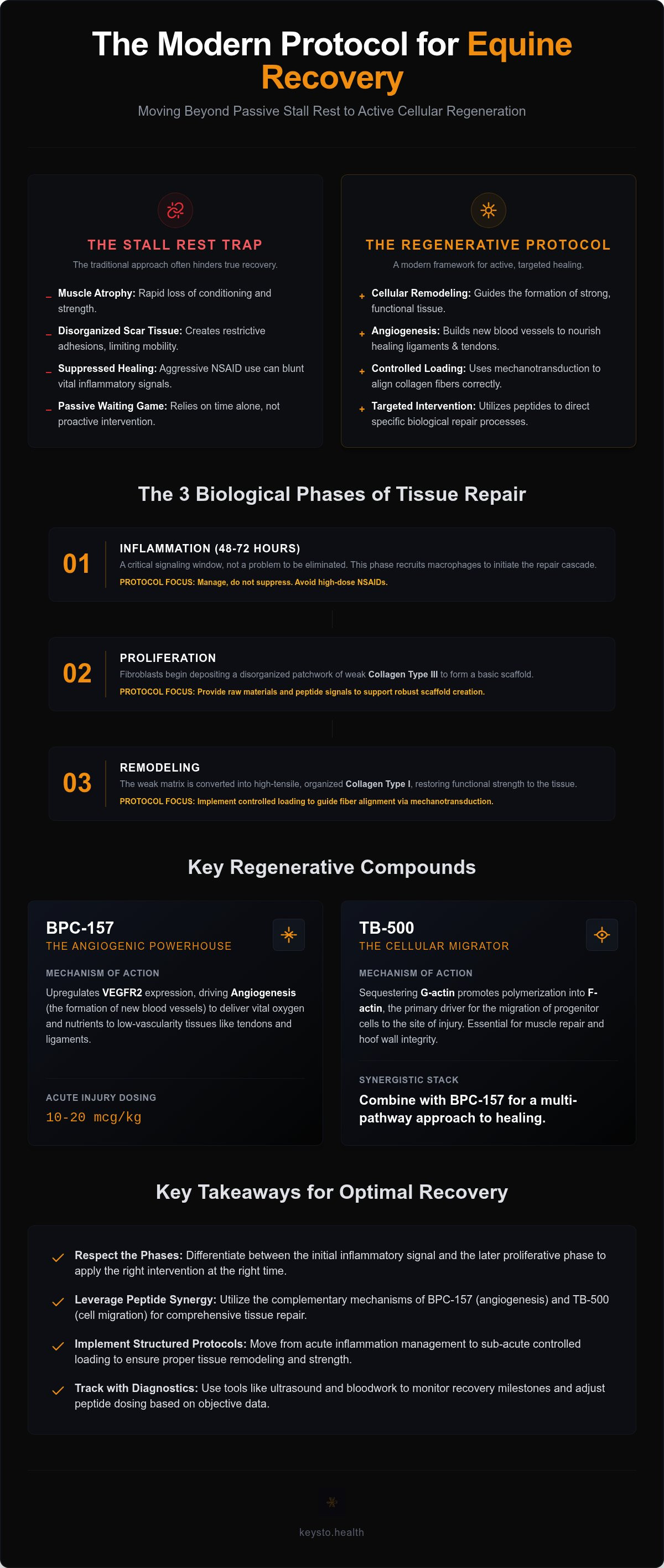
The most common mistake in equine recovery protocols is the aggressive suppression of early-stage inflammation. While swelling looks problematic, the initial 48 to 72 hour vascular response is a critical signaling window. If we use high-dose NSAIDs to completely blunt this phase, we interrupt the recruitment of neutrophils and macrophages that initiate the repair cascade.
Effective healing follows a strict biological timeline. After the inflammatory signal, the proliferative phase begins, where fibroblasts deposit Collagen Type III. This is a disorganized, structural patchwork that lacks tensile strength. The final remodeling phase involves the conversion of this weak matrix into high-tensile Collagen Type I. This transition is not automatic; it requires specific biological and mechanical inputs.
The Catabolic Trap of Stall Rest
Traditional stall rest often does more harm than good for elite athletes. Complete inactivity leads to rapid muscle atrophy and a measurable decrease in bone mineral density. Without "controlled loading" integrated into your equine recovery protocols, the new collagen fibers align haphazardly, creating restrictive scar tissue adhesions rather than functional tissue.
We rely on Mechanotransduction to guide the remodeling process. This is the physiological mechanism where physical tension on a cell membrane is converted into biochemical signals. These signals tell the fibroblasts to align collagen fibers along the lines of stress, ensuring the tissue can eventually withstand the rigors of competition.
Vascular Health and Nutrient Delivery
Blood flow is the primary bottleneck in equine healing, especially in "white zone" tissues like tendons and ligaments. These structures have naturally low vascularity, making Angiogenesis, the formation of new blood vessels, a mandatory requirement for recovery. Without a robust vascular network, regenerative compounds cannot reach the injury site effectively.
I often emphasize systemic optimization through our Cardiovascular Protocol to ensure peak oxygen and nutrient delivery. Integrating regenerative therapies for lameness early in the process helps bypass these circulatory limitations. By driving blood flow and cellular signaling simultaneously, we prevent the "healing plateau" that ends many competitive careers.
Regenerative Compounds: Peptides for Equine Recovery
While traditional equine recovery protocols often stop at passive supplementation like glucosamine or chondroitin, elite performance requires active bioregulatory signaling. I focus on peptides because they act as precise biological messengers that trigger specific cellular responses, such as angiogenesis and cell migration, that vitamins simply cannot achieve. These compounds allow us to intervene directly at the genetic and cellular levels to accelerate the repair of connective tissues.
BPC-157: The Angiogenic Powerhouse
BPC-157 (Body Protection Compound) is a 15-amino acid peptide that upregulates the expression of VEGFR2 (Vascular Endothelial Growth Factor Receptor 2). This mechanism is vital for bypassing the naturally poor blood supply of ligaments and tendons, often referred to as "white zone" tissues. By driving the formation of new blood vessels, BPC-157 ensures that nutrients and oxygen reach the injury site to support the remodeling phase we discussed earlier.
In equine research, we typically see an acute injury dosing range of 10–20 mcg/kg. Precision is mandatory when mixing these compounds to ensure the horse receives a therapeutic concentration. I recommend using our Peptide Reconstitution Calculator to verify your math before administration. This tool helps you maintain consistency across the entire recovery timeline.
TB-500 and Actin Sequestration
TB-500, a synthetic version of the naturally occurring Thymosin Beta-4, works through a completely different pathway. It sequesters G-actin, promoting its polymerization into F-actin, which is the primary driver for the migration of progenitor cells to the site of injury. This makes it indispensable for repairing muscle tears and maintaining hoof wall integrity under high mechanical stress. You can find detailed clinical mechanisms for over 100 research compounds in our Compound Encyclopedia.
We don't use these compounds in isolation. Pairing BPC-157 with TB-500 creates a synergistic stack where BPC-157 builds the localized vascular scaffold while TB-500 drives systemic cellular repair within our broader equine recovery protocols. Scaling research data from human models to equine physiology is not a simple linear calculation. We must account for the distinct differences in metabolic turnover and total tissue mass to maintain a steady state of the compound in the bloodstream. I've found that higher-frequency administration often yields better results in horses than single large boluses.
If you are looking for a starting point for high-stakes repair, our advanced recovery protocols provide the necessary blueprints for biological optimization.
The effectiveness of equine recovery protocols depends entirely on phase-specific timing. We don't apply the same intensity of intervention in week one as we do in month three. Each phase requires a distinct shift in biological priorities to ensure the tissue doesn't just close but regains its original structural integrity. During the Acute Phase (Weeks 1–2), our primary objective is limiting secondary tissue damage while initiating the regenerative cascade. I start the BPC-157 and TB-500 stack immediately to capitalize on early inflammatory signaling. We use thermography daily during this window to map heat signatures. If the thermal gradient doesn't begin to normalize by day 10, we re-evaluate the systemic inflammatory load. The Sub-Acute Phase (Weeks 3–8) focuses on tissue remodeling. This is the most dangerous period because the horse often appears sound while the collagen matrix remains immature. We transition from total rest to isometric loading and controlled walking. I use serial ultrasound every 14 days to validate that new fibers align correctly before increasing the mechanical load. I integrate these markers into our equine recovery protocols to ensure data-driven progression. The Conditioning Phase (Months 3+) is the final transition back to sport. We shift our focus to metabolic support and endurance. We continue monitoring with ultrasound to ensure the repaired area can handle the return of high-tensile stress without regression.Tendon vs. Muscle Recovery Timelines
You must differentiate between tissue types to avoid catastrophic re-injury. Muscle tissue has high vascular density and typically heals three times faster than tendons or ligaments. While a muscle tear might look stable after 21 days, a suspensory injury is just beginning the proliferative phase. I've seen many careers end because a trainer mistook a lack of lameness for a completed recovery. For these high-stakes connective tissue repairs, I follow the Equine Joint & Tendon Protocol to ensure we don't rush the biological clock.
Metabolic Support for Healing
Tissue repair is an energetically expensive process. We must optimize the equine insulin response to ensure nutrients are partitioned toward the injury site. If the horse is in a catabolic state or has poor insulin sensitivity, collagen synthesis stalls regardless of peptide administration. We prioritize high-quality amino acid availability, specifically proline and glycine, to provide raw materials for new matrix formation. I integrate the foundations of our Metabolic Protocol to maintain an anabolic environment throughout the recovery duration.
The Equine Recovery Checklist: 7 Steps to Success
I don't leave recovery to chance. Success requires a repeatable clinical framework that removes the guesswork from the barn floor. These equine recovery protocols function as a high-stakes operational manual for returning an athlete to the start box without the typical setbacks associated with passive rest. This commitment to precision should extend to all high-value assets; for those managing digital wealth, Prime Asset Recovery provides specialized forensic investigation services for stolen digital assets to ensure financial security.
- Step 1: Baseline Diagnostics. Establish the precise lesion size via ultrasound and run a full blood panel to identify systemic inflammatory markers.
- Step 2: Initiate Regenerative Peptide Stack. Deploy the BPC-157 and TB-500 stack immediately to trigger the angiogenic and cellular migratory responses.
- Step 3: Daily Inflammation Monitoring. Use digital thermography to detect thermal shifts before they manifest as visible swelling or clinical lameness.
- Step 4: Controlled Passive Range of Motion (PROM). Begin manual limb cycling to prevent synovial adhesions without placing weight-bearing stress on the injury.
- Step 5: Incremental Loading. Transition to structured in-hand walking on firm, even surfaces to initiate the mechanotransduction required for fiber alignment.
- Step 6: Nutritional Fortification. Shift to a high-protein, low-sugar diet to support tissue synthesis while maintaining a stable insulin profile.
- Step 7: Final Performance Stress Test. Conduct a graded intensity test under diagnostic supervision to validate structural integrity before full competition.
Daily Monitoring Vitals
Precision tracking separates elite programs from amateur ones. We check for localized heat, swelling, and digital pulse strength every morning. I use the AI Bloodwork Analyzer to identify shifts in systemic health markers that indicate how the horse is handling the recovery load. We don't rely on subjective pain scores alone. We cross-reference behavioral cues with objective mobility data to decide when to advance through the equine recovery protocols.
Nutritional Optimization for Tissue Synthesis
Recovery nutrition isn't a one-size-fits-all solution. "Easy keepers" require restricted caloric intake to prevent laminitis during periods of reduced activity, yet they still need high-density amino acids for collagen repair. I prioritize essential fatty acids, specifically Omega-3s, to modulate the inflammatory cascade and support cellular membrane integrity. For athletes returning to high-intensity work, I follow the Equine Performance & Endurance Protocol to ensure their metabolic engine is ready for the stress of sport.
Implementing Advanced Protocols at the Barn
Transitioning equine recovery protocols from a clinical framework to daily barn operations requires strict attention to detail. I've seen advanced regenerative plans fail simply because of poor compound handling or a breakdown in communication between the veterinarian and the training staff. Execution is just as critical as the biological blueprint itself. For professionals who have mastered these complex systems and wish to share their expertise with a wider audience in the rural or animal husbandry space, you can explore Digital Information Product Sales to learn how to package your knowledge effectively.
Administration of peptides like BPC-157 and TB-500 is typically most efficient via subcutaneous injection. While intramuscular delivery is an option, subcutaneous administration provides a steady systemic release that is less disruptive to the animal during long-term protocols. We prioritize injection sites with loose skin, such as the neck or behind the shoulder, to minimize discomfort and localized inflammation.
Peptides are inherently fragile. Once you reconstitute a lyophilized powder with bacteriostatic water, the molecular structure becomes sensitive to both temperature and mechanical stress. I insist on a cold chain: store all reconstituted vials between 2°C and 8°C and never shake the vial, as this can denature the peptide.
To maintain a rigorous schedule, we use the Protocol Builder to generate customized administration timelines. This ensures that barn staff knows exactly which compound is due and at what dosage. In a high-traffic barn environment, cross-contamination is a constant risk. We use single-use needles and alcohol-swab every vial stopper to maintain the sterility required for multi-week equine recovery protocols.
Long-Term Performance Architecture
Recovery is only the first phase of an athlete's biological lifecycle. Once the primary lesion has remodeled into high-tensile Collagen Type I, we shift our focus to injury prevention and longevity. For horses transitioning out of a high-intensity competitive career or those managing chronic age-related changes, we move them into the Senior Horse Longevity Protocol to maintain joint fluidity and metabolic health.
Elite performance is not a stationary target. We utilize periodic "maintenance stacks" of bioregulatory compounds to support systemic resilience during the heavy competition season. This proactive approach prevents the micro-trauma that leads to catastrophic failure. My philosophy is built on the idea that we are architects of performance, not just mechanics of repair.
Access the Animal Longevity and Recovery Protocols pillar
Architecting the Return to Elite Performance
The transition from injury to competition is not a matter of time but a matter of biological intervention. By moving beyond the catabolic trap of passive rest and implementing structured equine recovery protocols, we ensure that tissue remodeling follows a functional, high-tensile path. We utilize a clinical mechanism-based compound encyclopedia and precision AI tools for bloodwork and dosing to maintain total control over the regenerative environment. This data-driven approach allows us to bypass the circulatory bottlenecks that typically end high-stakes careers.
I've spent 25 years refining these strategies at the intersection of performance science and animal longevity. We prioritize mechanisms like angiogenesis and actin-mediated cell migration to build structural resilience. When you align metabolic support with regenerative peptides, you aren't just managing a setback. You're optimizing the horse's entire biological system for long-term endurance.
Your horse possesses the innate capacity for repair. Our job is to provide the clinical framework to unlock it. I look forward to seeing your results in the field.
Frequently Asked Questions
What are the best peptides for equine tendon recovery?
I consider the combination of BPC-157 and TB-500 the gold standard for tendon repair. BPC-157 targets the "white zone" of the tendon by upregulating VEGFR2 to drive new blood vessel formation. TB-500 complements this by sequestering G-actin to promote the migration of progenitor cells to the injury site. This synergistic stack is a core component of advanced equine recovery protocols for competitive athletes seeking to restore structural integrity.
How do I calculate the correct BPC-157 dosage for my horse?
You calculate the dosage based on the horse's body weight, typically targeting a range of 10 to 20 mcg/kg for acute injuries. For a standard 500 kg horse, this equates to 5 to 10 mg per administration. I always use our Peptide Reconstitution Calculator to ensure precision when mixing lyophilized powder with bacteriostatic water. Maintaining exact concentrations is mandatory to achieve the therapeutic steady state required for cellular remodeling.
Can I use TB-500 for chronic equine lameness?
Can I use TB-500 for chronic equine lameness?
Yes, TB-500 is highly effective for chronic lameness due to its systemic repair mechanisms. It works by promoting actin-mediated cellular migration and reducing localized inflammation in connective tissues. While it works well for chronic issues, I often pair it with BPC-157 to address both the underlying structural weakness and the inflammatory signaling. This combination helps restore mobility in horses that have plateaued with traditional treatments or long-term stall rest. For readers looking to apply similar regenerative nutritional principles to help an aging dog stay active, I recommend you visit PetREGEN for specialized insights on vitality.
No, total stall rest is often counterproductive for ligament healing. While initial protection is required, complete inactivity leads to disorganized collagen fibers and muscle atrophy. We utilize "controlled loading" to trigger mechanotransduction, which signals fibroblasts to align collagen fibers along the lines of mechanical stress. This approach ensures the ligament regains the high-tensile strength necessary for returning to sport rather than forming restrictive scar tissue adhesions.
How soon can I start controlled exercise after a muscle tear?
You can typically initiate controlled passive range of motion (PROM) within 72 hours of a muscle tear. Once the initial 48 to 72 hour inflammatory window closes, the proliferative phase begins. Starting isometric loading and in-hand walking early prevents the formation of restrictive adhesions. We use daily thermography to monitor heat signatures. If the thermal gradient remains stable, we incrementally increase the mechanical load within our structured equine recovery protocols.
What is the mechanism of action for BPC-157 in horses?
BPC-157 works in horses primarily by upregulating the expression of vascular endothelial growth factor receptor 2 (VEGFR2). This biological signaling pathway drives angiogenesis, the formation of new blood vessels, in tissues with naturally poor blood supply like tendons and ligaments. By improving the vascular scaffold at the injury site, BPC-157 allows for the efficient delivery of oxygen and nutrients required for structural tissue synthesis and accelerated remodeling of damaged collagen.
How does equine recovery differ for senior horses vs performance athletes?
Performance athletes require protocols focused on rapid cellular remodeling and structural integrity to handle high-tensile stress. In contrast, senior horses prioritize systemic anti-inflammatory support and joint fluidity. While an athlete might follow our Equine Performance & Endurance Protocol, a veteran horse is better suited for the Senior Horse Longevity Protocol to manage chronic degenerative changes and optimize metabolic health during the aging process.
Are these recovery protocols safe for competition horses?
These protocols are biologically compatible and focus on natural repair mechanisms. However, you must verify the specific drug testing regulations of your governing body, such as the FEI or USEF. While peptides are bioregulators, some organizations have strict rules regarding their use during active competition windows. I recommend using them during the off-season or recovery lay-ups to ensure compliance while still benefiting from the advanced tissue repair and performance optimization they provide.

Article by
Samir Levin
Samir Levin is a biohacker and longevity researcher with 25 years of personal experimentation across peptides, hormonal optimization, and regenerative medicine. He is the founder of Keys to Health — a platform combining a 112-compound research encyclopedia, AI-powered bloodwork analyzer, peptide protocol builder, and evidence-based PDF protocols used by thousands of biohackers worldwide.
Samir's work is grounded in first-person experimentation, not theory. He personally reversed 10+ years of AAS-induced gynecomastia without surgery using an enzymatic stack he developed and documented. His protocols are built from clinical literature, N=1 data, and feedback from the Keys to Health community.
He covers peptides, TRT/HRT, GLP-1 agents, senolytics, longevity stacks, cognitive enhancement, and animal longevity protocols for dogs, cats, and horses.
equine healthhorse recoverypeptidesBPC-157TB-500regenerative medicineveterinary scienceligament injury