Peptides
BPC-157 Reconstitution Calculator: Precision Dosing for Regenerative Research
By Samir Levin · August 19, 2026 · 16 min read
Disclaimer
This article is for informational and educational purposes only. It does not constitute medical advice, diagnosis, or treatment. Always consult a qualified healthcare provider before starting any new supplement, peptide, or protocol. Keys to Health and Samir Levin are not responsible for any actions taken based on this content.
A single math error transforms a high-stakes regenerative protocol into an expensive vial of wasted compound. I've spent 25 years optimizing biological systems, and I've seen even experienced researchers falter when converting milligrams to micrograms. If your math is off by a single decimal point, your results won't just be inconsistent; they'll be non-existent.
We understand the frustration of staring at a 5mg vial of lyophilized powder and wondering exactly how much bacteriostatic water is required for a precise 250 mcg dose. Utilizing a professional bpc-157 reconstitution calculator eliminates the guesswork that leads to improper dosing and degraded peptides. This guide provides the clinical-grade protocols necessary to master the math of peptide preparation.
I'll walk you through the exact mixing techniques used in elite performance circles to maintain compound stability. You'll learn how to navigate syringe unit conversions and how to integrate this pentadecapeptide into a synergistic stack with compounds like TB-500. We're moving past general advice and into the rigorous data required for actual biological optimization.
Key Takeaways
- Understand the biological mechanism of BPC-157, including its role in triggering angiogenesis and upregulating growth factor receptors.
- Utilize our bpc-157 reconstitution calculator to eliminate decimal errors and ensure every dose meets clinical precision standards.
- Master aseptic preparation protocols to maintain compound stability and prevent bacterial contamination during the mixing process.
- Learn the specific math required for synergistic stacking, including how to handle complex BPC-157 and TB-500 blends for accelerated recovery.
- Combine precise dosing with our AI Bloodwork Analyzer to objectively monitor your systemic response to regenerative protocols.
Table of Contents
The Science of Precision: Why BPC-157 Reconstitution Math Matters
Peptide math isn't just about measurement; it's about biological availability. BPC-157 is a pentadecapeptide composed of 15 amino acids. This BPC-157 overview highlights its origin in human gastric juice. Its primary mechanism involves triggering angiogenesis, the formation of new blood vessels, and upregulating growth factor receptors in tendon fibroblasts. It specifically influences the expression of early growth response 1 (EGR-1) and vascular endothelial growth factor (VEGF).
I've witnessed researchers fail because their concentration was too high for localized absorption. When the solution is too dense, the peptide doesn't disperse effectively. This leads to poor bioavailability and wasted compound. If the compound can't reach the target receptors due to poor diffusion, the regenerative signal is lost. Using a reliable bpc-157 reconstitution calculator ensures your math matches the biological requirements of the target tissue.
Lyophilization and Stability Constants
Most research peptides arrive as lyophilized powder. This freeze-dried state is necessary for long-term storage and transport stability. A 2010 study on peptide stability demonstrated that degradation rates accelerate significantly at room temperature, often losing 5 to 10% potency within days if exposed to heat. Once you add a diluent, the molecular bonds become more susceptible to hydrolysis. We maintain a strict 2 to 8°C environment post-reconstitution to preserve the peptide's structural integrity.
The Risk of Improper Concentration
High-concentration draws often cause injection site irritation. If you use too little diluent, the resulting solution is caustic to localized tissue. We prioritize Bacteriostatic Water with 0.9% benzyl alcohol over sterile saline. Benzyl alcohol inhibits bacterial growth, which is critical for multi-use vials. Accuracy on a 31G syringe depends on having enough volume to measure.
If your total draw is only two units, a half-unit error represents a 25% deviation in dose. This level of variance is unacceptable in high-performance research. You want enough volume to ensure the plunger movement is deliberate and measurable. A bpc-157 reconstitution calculator helps you find the balance between volume and concentration. We generally aim for a volume that allows for a 10 to 20 unit draw per dose.
Using the Keysto.Health BPC-157 Reconstitution Calculator
I've built the bpc-157 reconstitution calculator to eliminate the margin for error in your laboratory work. Manual arithmetic is a liability when you're working with potent compounds. The tool requires three data points: the total mass of the peptide, the volume of your diluent, and your desired dose. It provides an immediate output showing exactly where to set the plunger on your syringe.
- Input 1: Total peptide mass in the vial (typically 5mg or 10mg for BPC-157).
- Input 2: Volume of Bacteriostatic Water added (standard is 1mL to 3mL).
- Input 3: The target research dose (e.g., 250mcg or 500mcg).
By automating this process, we ensure that every draw is consistent across the entire life of the vial. This level of precision is fundamental when following a regenerative protocol designed for elite results. You don't want your research data skewed by fluctuating concentrations.
Defining Your Variables
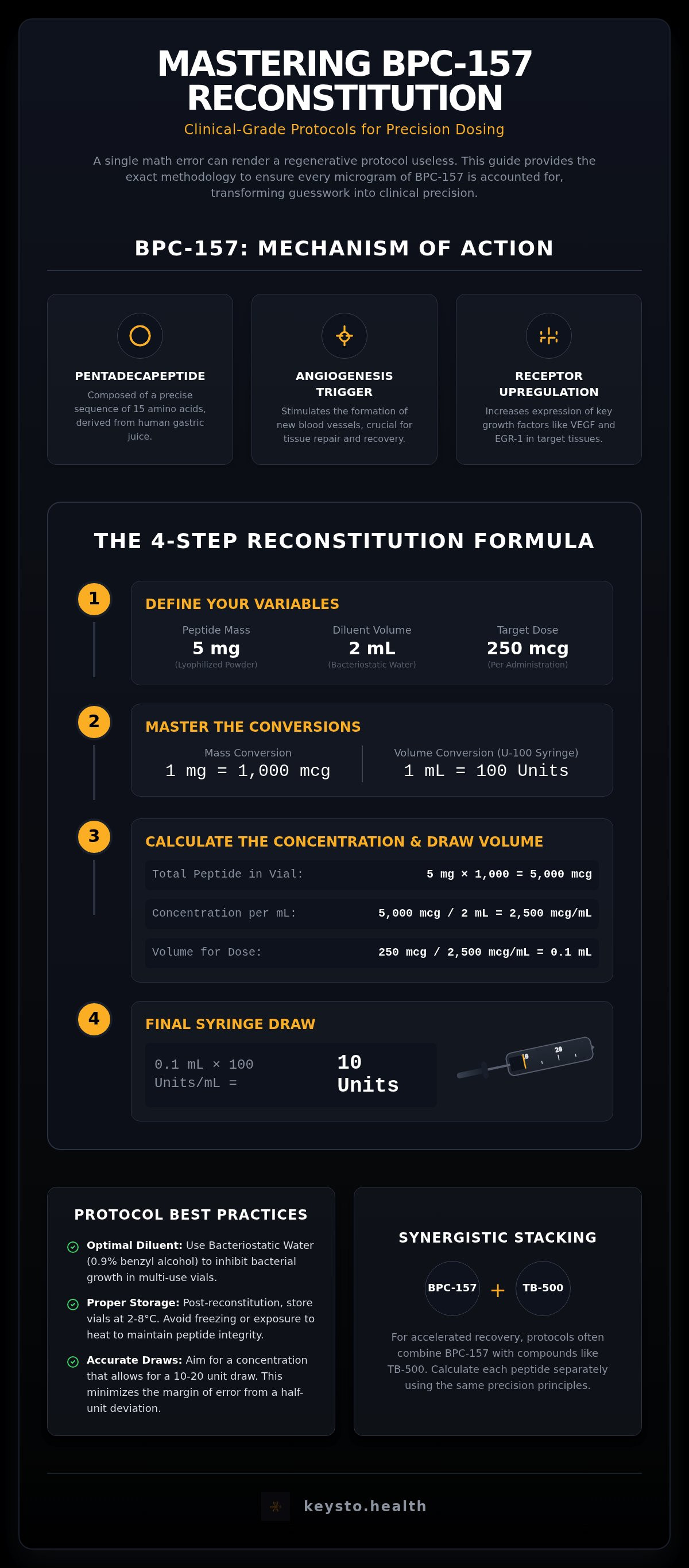
We distinguish strictly between milligrams (mg) and micrograms (mcg). One milligram equals 1,000 micrograms. While BPC-157 vials range from 2mg to 10mg, 5mg remains the industry standard for research because it provides a manageable concentration. I find that 2mL of diluent is the "sweet spot" for most protocols. This volume ensures complete solubility while providing enough liquid to make accurate 10 or 20 unit draws on a standard syringe.
Interpreting Syringe Units vs. Milliliters
Most researchers use a standard 100-unit insulin syringe, where 100 units equals 1.0mL. To calculate your draw manually, you follow this logic: (Target Dose / Vial Amount) * Diluent Volume = Draw Volume. For example, if you have 5,000mcg (5mg) of peptide in 2mL of water and want a 250mcg dose, the math results in 0.1mL. On a 100-unit syringe, 0.1mL is exactly 10 units. Grounding your dosing in scientific research on BPC-157 ensures you are operating within established parameters for tissue repair.
The formula for determining draw volume is the quotient of the target dose and total vial mass multiplied by the diluent volume. Using the bpc-157 reconstitution calculator allows you to bypass these manual steps and move straight to execution. We prioritize this tool because it accounts for the specific graduation marks of various syringe sizes, reducing the risk of parallax error during the draw.
Clinical Reconstitution Protocol: Step-by-Step Execution
I recommend a strictly aseptic technique to prevent bacterial growth. Even a microscopic introduction of pathogens can compromise the entire vial and lead to systemic inflammation. Preparation begins with alcohol-prepping the vial septum and the diluent stopper using 70% isopropyl alcohol. Allow the surfaces to air-dry completely before piercing to ensure the sanitizer has effectively neutralized surface contaminants.
Using the bpc-157 reconstitution calculator ensures your math is flawless, but your physical technique must be equally precise. Reconstituted BPC-157 should be used within 28 days for peak efficacy. Beyond this window, hydrolytic degradation begins to reduce the potency of the peptide bonds, even when stored at optimal temperatures.
The Wall-Slide Method for Diluent
Never spray water directly onto the lyophilized powder cake. High-pressure contact can cause peptide shearing, breaking the delicate amino acid chains before they even enter the body. Direct the stream down the side of the glass to allow the diluent to gently saturate the powder from the bottom up. Gently rotate the vial between your palms rather than shaking it. Shaking creates air bubbles and mechanical stress that can denature the compound and affect the accuracy of your draw.
Vacuum Management and Pressure Equalization
Vials are typically packaged under a vacuum to ensure long-term stability and sterility. If you don't equalize the pressure, the vacuum will aggressively pull the diluent from your syringe, leading to the spray-back and shearing I mentioned earlier. To manage this, draw an amount of air into your syringe equal to the volume of Bacteriostatic Water you intend to use. Inject this air into the BAC water vial first to ease the draw.
When you first pierce the BPC-157 vial, maintain a firm grip on the plunger to resist the vacuum's pull. Allow the liquid to enter at a slow, controlled rate. Once the liquid is in, you must equalize the pressure again before removing the needle. Draw a small amount of air back into the syringe from the vial's headspace to prevent liquid from leaking out of the puncture site. This step is critical for maintaining the exact concentration calculated by the bpc-157 reconstitution calculator.
Synergistic Stacking: Calculating BPC-157 and TB-500 Blends
I consider BPC-157 and TB-500 the gold standard for tissue repair. While BPC-157 focuses on angiogenesis and collagen synthesis, TB-500 targets actin sequestration and cell migration. This combination addresses both the structural and mobility requirements of damaged tissue. Animal models demonstrate that BPC-157 can accelerate tendon healing by 60 to 80% compared to controls. Human data is currently limited to three published pilot studies involving fewer than 30 participants, but the preclinical synergy is undeniable. I typically suggest a dosage of 250–500mcg of BPC-157 daily for systemic healing. Our Regenerative Protocol details the specific timing and frequency for these compounds.
The BPC-157 + TB-500 Ratio
TB-500 works by binding to G-actin, which prevents its polymerization into F-actin. This process is essential for the migration of cells to the site of injury. While a 1:1 ratio is common in research circles, it isn't always optimal. Acute injuries often benefit from higher initial TB-500 concentrations to stimulate rapid cell movement, whereas chronic issues require the sustained growth factor upregulation provided by BPC-157. You can find detailed data on these mechanisms in our Compound Encyclopedia.
Reconstituting Multi-Peptide Vials
Managing the math for a multi-peptide vial requires extra attention. If a vial contains 5mg of BPC-157 and 5mg of TB-500, the "Total Milligrams" in the vial is 10mg, but your dosing calculation must focus on the concentration of each specific compound. If you add 2mL of Bacteriostatic Water, each compound exists at a concentration of 2.5mg/mL. You then use the bpc-157 reconstitution calculator to determine the draw for your target BPC-157 dose, knowing the TB-500 will be delivered in the same volume.
Pre-blended vials present a significant pitfall: they lock you into a fixed ratio. If your research protocol requires adjusting one compound without changing the other, you lose that flexibility. I prefer mixing my own stack by drawing from separate vials into the same syringe. This allows for precise titration based on the specific recovery phase of the subject. Regardless of your choice, the bpc-157 reconstitution calculator remains the essential tool for ensuring your final draw volume aligns with your target micrograms.
Optimizing Your Regenerative Protocol with Keys to Health
Precision reconstitution is the entry point. To achieve elite-level tissue repair, you must move beyond the vial. I've spent two decades refining the transition from chemical application to physiological result. While the bpc-157 reconstitution calculator ensures your input is accurate, data-driven optimization requires tracking the systemic output. We provide the blueprints for biological optimization, from vascular health to advanced longevity.
From Calculation to Implementation
We emphasize logging every dose alongside objective recovery markers. Heart Rate Variability (HRV) serves as a primary indicator of autonomic nervous system balance during regenerative phases. If your HRV remains depressed despite BPC-157 use, your systemic recovery capacity is likely bottlenecked by poor metabolic health. Pairing regenerative peptides with our Metabolic Protocol creates a superior environment for cellular repair. This approach ensures the substrate for healing is available when the peptide signals for tissue synthesis.
Integrating AI-Driven Data
Peptides don't fix what you aren't measuring. We use the AI Bloodwork Analyzer to monitor systemic inflammation markers like C-Reactive Protein (CRP) and Erythrocyte Sedimentation Rate (ESR). These metrics reveal whether the angiogenesis triggered by BPC-157 is translating into a reduction of global inflammatory stress. CRP levels above 1.0 mg/L often indicate that while localized repair may be occurring, the body is still in a pro-inflammatory state. High ESR values suggest that fibrinogen levels are elevated, which can impede the very microcirculation BPC-157 aims to improve.
Our AI Peptide Protocol Builder uses this bloodwork data to generate tailored schedules that align with your specific performance goals. It identifies performance gaps that peptides alone cannot fix, such as micronutrient deficiencies or hormonal imbalances. Use the Protocol Builder to move from isolated calculations to a comprehensive recovery strategy. This tool removes the guesswork by adjusting variables based on your biological feedback loop.
The elite practitioner uses these tools to remove guesswork. We've developed this ecosystem to ensure every microgram calculated by the bpc-157 reconstitution calculator is backed by a rigorous longevity strategy. Optimization is a continuous loop of measurement, application, and refinement that separates the amateur from the professional researcher.
Executing Precision in Regenerative Science
Precision dosing represents the divide between an anecdotal experiment and a successful research outcome. We've established that the biological efficacy of BPC-157 depends on chemical stability and exact concentration. My 25 years of experience in human optimization led to the development of the bpc-157 reconstitution calculator to solve the math errors that plague most protocols. This toolkit provides clinical-grade math for 112 compounds and is fully integrated with our Compound Encyclopedia.
When you combine flawless reconstitution with aseptic technique and synergistic stacking, you maximize the regenerative signal. Don't let a decimal error compromise your research results. We provide the architectural blueprints for biological performance, allowing you to move from guesswork to measurable data. Tracking inflammation markers ensures your protocol evolves with your physiology.
You now have the technical tools and the clinical protocols required for elite results. Start building your optimized recovery framework today.
Frequently Asked Questions
How much Bacteriostatic Water do I add to a 5mg BPC-157 vial?
I recommend adding 2mL of Bacteriostatic Water to a standard 5mg vial. This volume creates a concentration of 2.5mg/mL, which allows for precise measurement on a standard insulin syringe. If you use only 1mL, the solution becomes too concentrated for accurate small-dose draws. If you use 3mL, the volume may become excessive for localized administration. I find 2mL provides the best balance of solubility and measurement accuracy.
Can I use sterile water instead of Bacteriostatic Water for BPC-157?
No, you should prioritize Bacteriostatic Water containing 0.9% benzyl alcohol for any multi-use vial. Sterile water lacks a preservative, meaning bacterial growth can occur within 24 hours of the first puncture. Bacteriostatic Water inhibits this growth, preserving the peptide's integrity for up to 28 days. Using sterile water increases the risk of localized infection and systemic inflammatory responses during your research protocol.
How long does BPC-157 stay stable after reconstitution?
Reconstituted BPC-157 remains stable for approximately 28 days when stored at 2 to 8°C. After this period, the peptide bonds begin to undergo hydrolysis, leading to a loss of potency. I recommend keeping the vial in a light-protected container in the refrigerator. Exposure to heat or direct UV light will accelerate degradation significantly, often reducing efficacy by 10% or more within just a few days of improper storage.
What is the standard BPC-157 dosage for research purposes?
Standard research dosages typically range from 250mcg to 500mcg administered daily. Some protocols for acute tissue injury utilize twice-daily administration to maintain steady-state levels of the compound. We use our bpc-157 reconstitution calculator to ensure these microgram targets are met with absolute precision. Dosing should be adjusted based on the subject's systemic response and tracked through objective markers like HRV or inflammatory bloodwork.
How do I calculate BPC-157 dosage for a senior dog?
Dosing for canines is generally calculated based on body weight, often ranging from 10mcg to 20mcg per kilogram of mass. For a senior dog with joint mobility issues, a daily dose helps upregulate growth factor receptors in damaged connective tissue. You can input the total vial mass and diluent volume into our calculator to find the exact unit draw for the dose. We provide specific canine longevity protocols for detailed guidance.
Can I mix BPC-157 and TB-500 in the same syringe?
Yes, you can draw both BPC-157 and TB-500 into the same syringe for immediate administration. This practice is common in regenerative research because it reduces the number of punctures required. You must calculate the draw for each compound separately using their respective vial concentrations. I prefer drawing the BPC-157 first and then the TB-500 to ensure the ratios remain consistent with the established recovery blueprint.
What happens if the BPC-157 solution is cloudy after mixing?
A cloudy solution usually indicates that the peptide has denatured or that the solution has been contaminated. BPC-157 should be crystal clear once the lyophilized powder has fully dissolved. If cloudiness persists after gentle rotation, don't use the vial. This can happen if you used the wrong diluent, shook the vial too aggressively, or if the peptide was exposed to extreme temperatures during transit.
How many units on a 1mL syringe is 250mcg of BPC-157?
On a 100-unit syringe, 250mcg equals 10 units if you reconstituted a 5mg vial with 2mL of water. If you used only 1mL of water, the same 250mcg dose would be only 5 units. This illustrates why the bpc-157 reconstitution calculator is essential. It accounts for your specific diluent volume to prevent dosing errors. I recommend using enough diluent to ensure your draw is at least 10 units for accuracy.

Article by
Samir Levin
Samir Levin is a biohacker and longevity researcher with 25 years of personal experimentation across peptides, hormonal optimization, and regenerative medicine. He is the founder of Keys to Health — a platform combining a 112-compound research encyclopedia, AI-powered bloodwork analyzer, peptide protocol builder, and evidence-based PDF protocols used by thousands of biohackers worldwide.
Samir's work is grounded in first-person experimentation, not theory. He personally reversed 10+ years of AAS-induced gynecomastia without surgery using an enzymatic stack he developed and documented. His protocols are built from clinical literature, N=1 data, and feedback from the Keys to Health community.
He covers peptides, TRT/HRT, GLP-1 agents, senolytics, longevity stacks, cognitive enhancement, and animal longevity protocols for dogs, cats, and horses.
bpc-157peptide calculatorpeptide reconstitutionpeptide dosingtb-500peptidesbiohackingregenerative medicine