Cognitive
Blood Markers for Cognitive Decline: 2026 Clinical Guide
By Samir Levin · August 13, 2026 · 16 min read
Disclaimer
This article is for informational and educational purposes only. It does not constitute medical advice, diagnosis, or treatment. Always consult a qualified healthcare provider before starting any new supplement, peptide, or protocol. Keys to Health and Samir Levin are not responsible for any actions taken based on this content.
Waiting for a "senior moment" to assess your neurological health is a clinical failure. By the time you notice symptoms, your brain has likely been accumulating damage for two decades. The standard medical model only tests for pathology once it is irreversible. We focus on optimization. Identifying specific blood markers for cognitive decline allows us to map the metabolic trajectory of brain aging and intervene while the architecture is still intact.
I know the frustration of being told your labs are "normal" by a physician who only looks for end-stage disease. You don't want a diagnosis; you want a blueprint for prevention. This guide provides exactly that. I will teach you to master the technical markers of brain aging so you can intercept neurological decline years before symptoms emerge. We will analyze the 2026 landscape of FDA-cleared tests, including p-tau217 and NfL. You will learn the precise difference between amyloid and tau pathology and how to use AI to interpret your results with surgical precision.
Key Takeaways
- Identify the 20-year preclinical window where protein misfolding occurs before any cognitive symptoms emerge.
- Distinguish between amyloid-beta 42/40 ratios and p-tau217 to pinpoint specific Alzheimer's pathology with clinical precision.
- Address metabolic drivers such as homocysteine and insulin resistance to mitigate the "Type 3 Diabetes" neuro-inflammatory cascade.
- Establish a high-resolution screening protocol using specialized blood markers for cognitive decline to move beyond standard reactive medicine.
- Leverage AI-driven interpretation tools to synthesize complex proteomic data into a personalized roadmap for neuro-optimization.
Table of Contents
- The Paradigm Shift: From Reactive Diagnosis to Proactive Neuro-Surveillance
- Core Proteomic Markers: Deciphering the Amyloid-Tau-Neurofilament Axis
- Beyond Plaques: Metabolic and Inflammatory Drivers of Cognitive Erosion
- Designing a High-Resolution Cognitive Screening Protocol
- The Future of Neuro-Optimization: AI-Driven Bloodwork Interpretation
The Paradigm Shift: From Reactive Diagnosis to Proactive Neuro-Surveillance
Waiting for clinical symptoms to manifest before testing your brain is a strategy for failure. Traditional medicine operates on a binary model: you either have dementia or you don't. This ignores the biological reality that neurodegeneration is a slow, metabolic erosion. By the time a physician confirms cognitive impairment, your brain has likely been accumulating pathology for two decades. We don't wait for the engine to seize before checking the oil.
The 20-year "silent" window is our greatest opportunity for intervention. During this period, protein misfolding and axonal damage occur without noticeable memory loss. Detection relies on the fact that the blood-brain barrier is not an impenetrable wall. As neural integrity fluctuates, specific blood markers for cognitive decline leak into the systemic circulation. Tracking these Biomarkers of Alzheimer's disease allows us to see the "smoke" long before the "fire" of clinical symptoms.
The 'Silent' Phase of Neurodegeneration
Standard metabolic panels are insufficient for neurological surveillance. A perfect HbA1c or lipid profile tells me nothing about your tau phosphorylation or amyloid deposition. There is a massive lag between biological aging and clinical symptoms. I've seen patients in their 40s with "perfect" bloodwork who already show elevated neurofilament light chain (NfL) levels. This indicates active axonal shearing that remains invisible on a basic physical exam.
Establishing a baseline in your 30s or early 40s is non-negotiable. Without a baseline, we can't distinguish between a high stable value and an accelerating trend. We focus on the trajectory of these markers rather than a single data point. If your NfL levels jump 20% in twelve months, we have a problem, even if you are still within the "normal" lab range.
The Precision Medicine Advantage
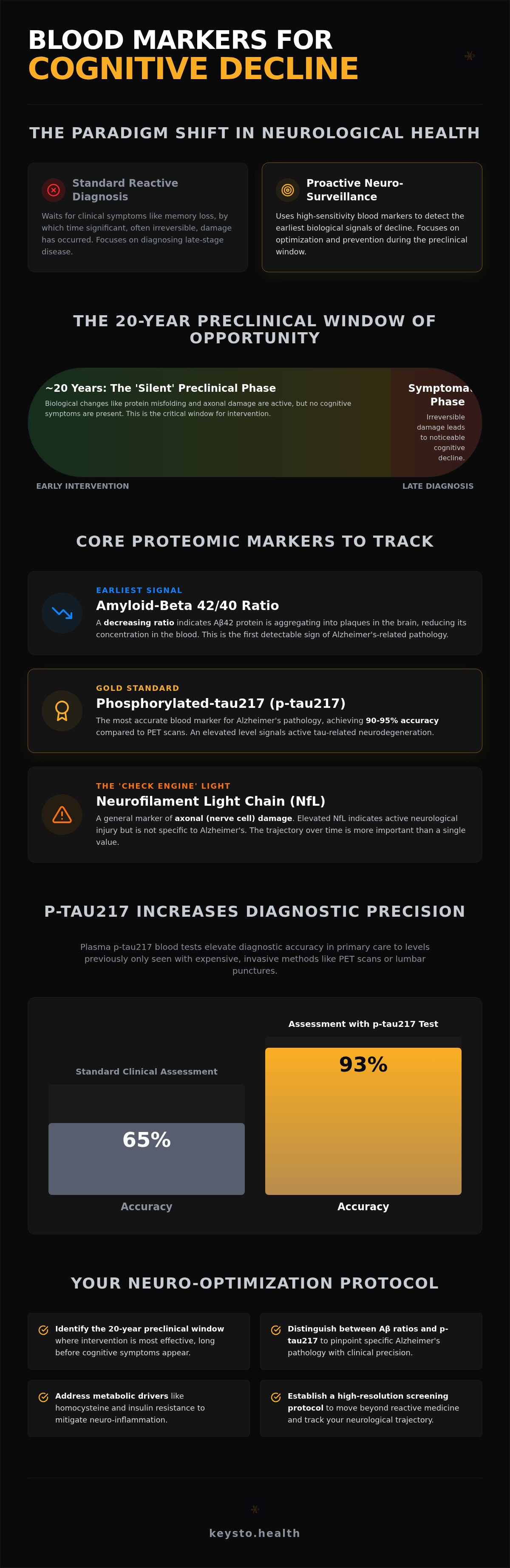
We move beyond the "Normal Range" toward "Optimal Performance." A 2026 Swedish study presented at the AAIC found that using validated plasma p-tau217 results increased diagnostic accuracy from 65% to 93% in primary care settings. This level of precision was previously only possible with expensive PET scans or invasive lumbar punctures. Now, we use proteomic-based blood analysis to identify risk with surgical accuracy.
I interpret these complex data sets using our HRT Bloodwork Analyzer to identify correlations that human eyes often miss. Serial testing reveals the velocity of brain aging. Once we identify an aggressive trajectory, we don't just watch it happen. We deploy a targeted Cognitive Optimization Protocol to address the underlying metabolic or inflammatory drivers. This is the difference between being a victim of your genetics and being an architect of your biology.
Core Proteomic Markers: Deciphering the Amyloid-Tau-Neurofilament Axis
We've moved beyond basic metabolic screening into the high-resolution proteomic era. The modern battery of blood markers for cognitive decline centers on four specific proteins that reveal the precise state of your neural architecture. We start with the Amyloid-Beta 42/40 Ratio. A decrease in this ratio serves as the earliest signal of protein misfolding. As Aβ42 aggregates into plaques within the brain, its concentration in the plasma drops, providing a window into plaque formation years before an MRI shows atrophy.
P-tau217: The High-Sensitivity Disruptor
By 2026, p-tau217 has marginalized older markers like p-tau181 and p-tau231. It is the current gold standard for diagnosing Alzheimer's and dementia pathology via blood. Clinical data demonstrates that p-tau217 achieves 90% to 95% accuracy when compared against the previous "gold standards" of amyloid PET scans and invasive lumbar punctures. For a non-symptomatic individual, a positive p-tau217 result indicates that the biological machinery of Alzheimer's is already active. This is the critical moment to deploy aggressive neuro-protective protocols to halt the progression while you still have full cognitive function.
Neurofilament Light (NfL): The 'Check Engine' Light
While p-tau217 is specific to Alzheimer's pathology, Neurofilament Light Chain (NfL) acts as a universal indicator of axonal damage. If p-tau is the specific disease marker, NfL is the general "check engine" light for the brain. NfL is the primary metric for global neuronal attrition. High levels confirm that neurons are physically breaking down due to trauma, vascular erosion, or neurotoxicity. We use serial NfL testing to track the efficacy of our interventions. If your levels stabilize or drop after six months of optimization, we have objective proof that your brain is no longer in an accelerated state of decay.
To complete the axis, we monitor Glial Fibrillary Acidic Protein (GFAP). This marker detects early neuroinflammation by measuring astrocyte activation. GFAP often rises before amyloid plaques become significant, signaling that the brain's immune system is in a state of chronic alarm. When we see elevated GFAP alongside a declining Aβ42/40 ratio, we know the neuro-inflammatory cascade is in full effect. We don't guess; we use these proteomic signals to build a data-driven defense against cognitive erosion.
Beyond Plaques: Metabolic and Inflammatory Drivers of Cognitive Erosion
Amyloid and tau are the end-stage wreckage of a decades-long biological fire. If you only track proteomic plaques, you're monitoring the damage rather than the fuel. True neuro-optimization requires measuring metabolic blood markers for cognitive decline that drive mitochondrial failure and synaptic loss long before proteins begin to misfold. We treat the brain as a metabolic organ that is highly sensitive to systemic volatility.
The Neuro-Metabolic Connection
The brain is the most glucose-demanding organ in the body, yet it's incredibly fragile under conditions of insulin resistance. This is the foundation of the "Type 3 Diabetes" model of neurodegeneration. An HbA1c of 5.6% is often categorized as "normal" by standard labs, but for brain health, it's a marker of dysfunction. High glycemic variability generates advanced glycation end-products (AGEs) that cross-link proteins and induce oxidative stress in the hippocampus.
I utilize our HRT Bloodwork Analyzer to identify these metabolic trends before they manifest as brain fog. We look for fasting insulin levels below 5 uIU/mL to ensure the brain remains metabolically flexible. If your markers show rising insulin resistance, we deploy a targeted Metabolic Optimization Protocol to restore insulin sensitivity and protect the mitochondrial health of your neurons.
Vascular Health as Cognitive Health
Vascular erosion is a primary driver of cognitive aging. Homocysteine acts as a potent neurotoxin and a marker of poor methylation. Levels above 10 µmol/L correlate directly with accelerated hippocampal atrophy in human clinical trials. This is often an epigenetic failure involving deficiencies in B12, Folate, and B6. High homocysteine levels damage the delicate vascular endothelium, compromising the blood-brain barrier integrity we discussed in section one.
We also track ApoE4 status because it dictates how your body manages lipids and clears amyloid. If you carry an E4 allele, your tolerance for systemic inflammation is significantly lower. We pair this with the Omega-3 Index to measure your brain's inflammatory buffer. A low index, specifically below 8%, predicts a failure in cognitive resilience. We address these deficiencies in our Cognitive Optimization Protocol to cool the fire of neuroinflammation. Maintaining Vitamin D3 levels between 60 and 80 ng/mL further ensures the chemical environment is optimized for DNA repair and neurotransmitter synthesis.
Designing a High-Resolution Cognitive Screening Protocol
I don't believe in "standard" physicals when it comes to the brain. A routine checkup is designed to find pathology that has already arrived. To intercept decline, you need a high-resolution screening protocol that treats blood markers for cognitive decline as dynamic data points. We use a four-step architecture to build your neurological baseline and track the velocity of your biological aging.
The first step is establishing a comprehensive neuro-metabolic baseline. We then integrate specialized proteomic markers like p-tau217 and NfL to look for specific protein misfolding. Third, we assess genetic risk through ApoE and MTHFR testing to understand your individual susceptibility to inflammation and methylation failures. Finally, we contextualize this biological data with objective cognitive performance tracking to ensure your "brainware" matches your "hardware."
The Essential Lab Stack
Your annual audit must go beyond the basic metabolic panel. I require my clients to request a specific cluster of markers to gain a 360-degree view of their neuro-metabolic health. Metabolic markers like fasting insulin and HbA1c must be drawn in a fasted state to ensure accuracy. However, proteomic markers like p-tau217 are generally stable and do not require fasting, though drawing them alongside your metabolic stack is more efficient.
- Metabolic: Fasting Insulin, HbA1c, Homocysteine, and hs-CRP.
- Nutritional Co-factors: Vitamin D3, B12, and Folate.
- Proteomic Axis: p-tau217, Neurofilament Light (NfL), and Glial Fibrillary Acidic Protein (GFAP).
- Amyloid Status: Amyloid-Beta 42/40 Ratio.
You must prioritize the Amyloid 42/40 ratio over single Amyloid tests to account for individual protein production variations. This ratio is far more predictive of plaque deposition than measuring Aβ42 in isolation.
Interpreting the Data
Data without context is noise. We look for discordant markers to determine the current stage of neurodegeneration. For instance, finding high amyloid levels alongside low tau levels often indicates an early, preclinical phase where intervention is most effective. If both markers are elevated, the inflammatory cascade is likely well underway. We prioritize tracking the rate of change over absolute values; a sharp spike in NfL is a signal for immediate escalation to advanced imaging like a 3T MRI or an Amyloid PET scan.
I use our HRT Bloodwork Analyzer to synthesize these complex variables into an actionable score. Once your labs are in hand, you can build a defensive strategy using our targeted optimization protocols to address any identified vulnerabilities. We don't wait for a diagnosis to start the work of preservation.
The Future of Neuro-Optimization: AI-Driven Bloodwork Interpretation
Human clinicians are limited by linear thinking. Synthesizing 50 or more blood markers for cognitive decline requires algorithmic power that exceeds standard medical training. I've found that human interpretation often fails at the intersection of multi-system data. A physician might see "normal" fasting insulin and "normal" p-tau217, but an AI identifies the specific delta where these variables begin to diverge, signaling the onset of metabolic-driven neurodegeneration.
We leverage AI to identify hidden correlations between metabolic and neuro-proteomic markers. The relationship between glucose variability and GFAP elevation is often subtle and remains invisible to the naked eye. Our HRT Bloodwork Analyzer processes these complex inputs to provide a high-resolution view of your cognitive trajectory. This moves you from passive observation to active surveillance, transforming raw data into a tactical roadmap for brain preservation.
The AI Advantage in Longevity Science
Algorithms detect patterns of decline years before they hit clinical thresholds. Once the AI identifies a specific vulnerability, we use the Compound Encyclopedia to select the most effective interventions. We often look at Cerebrolysin, a porcine-derived peptide mixture that mimics endogenous neurotrophic factors. Human clinical data, such as a study of 60 patients with vascular dementia, showed significant cognitive improvements with a protocol of 5ml/day administered via intramuscular injection over 20 days.
We also look for synergistic combinations. Pairing Cerebrolysin with Dihexa can potentially enhance synaptic connectivity by modulating the hepatocyte growth factor (HGF) system. Customizing these peptide and hormone protocols based on your specific neurological blood data is the only way to achieve elite-level optimization. We don't use a "one size fits all" approach; we use your biological data to build a custom-coded defense for your brain.
Immediate Next Steps for Biological Optimization
You cannot optimize what you do not measure. Your immediate priority is to gather high-resolution data and synthesize it into a coherent strategy. We provide the tools to bridge the gap between complex laboratory science and practical implementation.
- Analyze your cognitive markers with the Keys to Health AI Bloodwork Analyzer by uploading your latest lab results for immediate interpretation.
- Review the Cognitive Optimization Protocol for evidence-based stacks and dosing schedules.
- Utilize the Peptide Calculator to ensure precise reconstitution of any neuro-regenerative compounds identified in your plan.
Seizing the 20-Year Window for Neurological Preservation
The era of reactive neurology is over. We now have the proteomic tools to identify the biological signature of brain aging decades before it translates into clinical impairment. By tracking specific blood markers for cognitive decline like p-tau217 and NfL, you gain the clinical clarity needed to intervene while your neural architecture is still resilient.
I've spent 25 years at the intersection of high-stakes performance and longevity science to refine these strategies. We pair AI-driven precision for complex lab interpretation with my expert-led protocols to move your health beyond standard medical guesswork. Our comprehensive Compound Encyclopedia provides the research-backed interventions required to address the specific metabolic and inflammatory vulnerabilities identified in your bloodwork. This isn't about managing decline; it's about architecting a brain that performs at its peak for life.
Your brain is your most valuable asset. It deserves the same level of rigorous optimization you apply to your physical performance and financial portfolio. Take control of your neurological trajectory today. Optimize your brain health with the Keys to Health AI Bloodwork Analyzer and secure your cognitive future.
Frequently Asked Questions
What is the most accurate blood test for Alzheimer's in 2026?
p-tau217 is the most accurate marker for Alzheimer's pathology as of August 2026. It achieves 90% to 95% accuracy when compared to traditional PET scans and invasive lumbar punctures. A Swedish study presented at the 2026 AAIC confirmed that disclosing p-tau217 results increased diagnostic accuracy to 93% in primary care settings. It's the primary disruptor in clinical diagnostics because it detects specific protein misfolding before memory loss occurs.
Can blood markers detect cognitive decline before symptoms appear?
Yes, specific blood markers for cognitive decline can detect pathology up to 20 years before symptoms emerge. Proteomic shifts, such as a declining Amyloid-Beta 42/40 ratio, occur during a "silent" phase of neurodegeneration. We use these markers to identify the metabolic trajectory of brain aging. This allows for early intervention while the neural architecture remains intact, rather than waiting for irreversible atrophy to manifest.
Is p-tau217 testing available to the general public?
p-tau217 testing is available to the general public through direct-to-consumer labs and physician orders. As of early 2026, services like Apollo Health offer panels including p-tau217 for approximately $799. BetterBrain provides the test as a $200 add-on to their core cognitive blueprints. While physician-ordered tests like Lumipulse exist, traditional clinics often restrict these to patients who already show signs of impairment.
What does a high Neurofilament Light (NfL) level indicate?
Elevated NfL levels signify active axonal damage and global neuronal attrition. It's a non-specific "check engine" light for the brain, meaning it rises due to trauma, vascular erosion, or neurotoxicity rather than just Alzheimer's. We track NfL to measure the velocity of brain aging. If your levels are rising, it indicates that your neurons are physically breaking down, necessitating an immediate shift in your neuro-optimization protocol.
How often should I test my blood for cognitive health markers?
I recommend an annual neuro-metabolic audit to establish and maintain a biological baseline. If you're currently deploying a specific intervention, such as Cerebrolysin or targeted hormone replacement, testing every six months is more appropriate. This frequency allows us to track the rate of change in markers like NfL and GFAP. Serial testing is the only way to distinguish between a stable high value and an accelerating decline.
Can I lower my homocysteine levels to reduce dementia risk?
You can lower homocysteine levels using a targeted methylation stack of B12, Folate, and B6. Clinical data shows that homocysteine levels above 10 µmol/L correlate directly with accelerated hippocampal atrophy. By optimizing these co-factors, you reduce the vascular and epigenetic threat to your brain. This is a critical step in any comprehensive protocol designed to mitigate long-term dementia risk and maintain synaptic integrity.
Does insurance cover specialized neuro-proteomic blood tests?
Medicare Part B may cover 80% of physician-ordered diagnostic tests for patients already showing clinical cognitive impairment. However, insurance almost never covers screening for asymptomatic individuals. If you're testing proactively for longevity optimization, expect to pay out-of-pocket. Direct-to-consumer options often provide a more streamlined path for those focusing on prevention and performance rather than waiting for a reactive diagnosis.
What is the difference between a PET scan and the new blood tests?
PET scans visualize physical amyloid plaques and cost between $5,000 and $7,000, while new blood tests measure circulating proteomic markers for significantly less. Blood tests are less invasive and now reach accuracy levels above 90% for detecting pathology. While PET scans remain a definitive tool for staging, blood markers for cognitive decline offer a more accessible and repeatable way to monitor brain health trajectories over time.

Article by
Samir Levin
Samir Levin is a biohacker and longevity researcher with 25 years of personal experimentation across peptides, hormonal optimization, and regenerative medicine. He is the founder of Keys to Health — a platform combining a 112-compound research encyclopedia, AI-powered bloodwork analyzer, peptide protocol builder, and evidence-based PDF protocols used by thousands of biohackers worldwide.
Samir's work is grounded in first-person experimentation, not theory. He personally reversed 10+ years of AAS-induced gynecomastia without surgery using an enzymatic stack he developed and documented. His protocols are built from clinical literature, N=1 data, and feedback from the Keys to Health community.
He covers peptides, TRT/HRT, GLP-1 agents, senolytics, longevity stacks, cognitive enhancement, and animal longevity protocols for dogs, cats, and horses.
cognitive declinebrain healthlongevitybiohackingAlzheimer'sp-tau217preventative medicineblood testing