Longevity
Biohacking for Longevity: 2026 Human Optimization Protocol
By Samir Levin · August 11, 2026 · 16 min read
Disclaimer
This article is for informational and educational purposes only. It does not constitute medical advice, diagnosis, or treatment. Always consult a qualified healthcare provider before starting any new supplement, peptide, or protocol. Keys to Health and Samir Levin are not responsible for any actions taken based on this content.
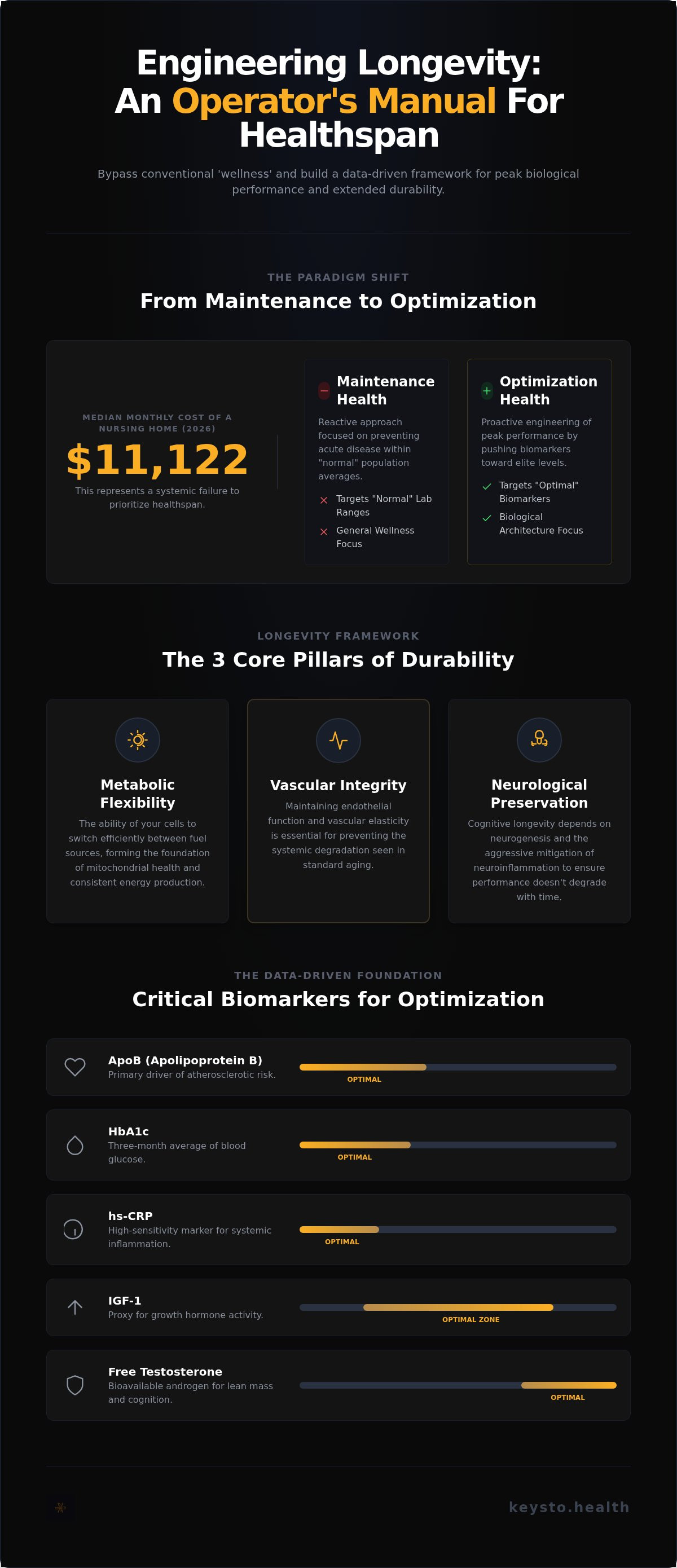
By 2026, the median cost for a private room in a nursing home has reached $11,122 per month. This figure represents a systemic failure to prioritize healthspan over mere survival. You're likely frustrated by the noise of non-expert influencers and the lack of precision in standard medical screenings. You understand that real results require clinical data, not lifestyle guesswork. This guide delivers a rigorous, manual-style framework for biohacking for longevity. We'll bypass the fluff to focus on the biological architecture required to extend your healthspan.
You'll master the elite-level strategies used to optimize metabolic and hormonal health through advanced research and precision protocols. We'll examine the 2026 regulatory landscape for research compounds, including the recent FDA advisory board recommendations on peptides like BPC-157 and MOTS-c. This protocol provides a clear roadmap for measurable biological age reduction using the same tools employed by elite performance architects. It's time to stop managing decline and start engineering peak biological performance.
Key Takeaways
- Shift from standard maintenance to elite biological architecture by mastering advanced strategies for biohacking for longevity.
- Identify critical biomarkers like ApoB and IGF-1 that standard lab ranges often overlook when optimizing for maximum healthspan.
- Evaluate the pharmacological potential of signaling molecules such as BPC-157 and TB-500 using a clinical, research-first approach.
- Build a data-driven protocol that layers precision bloodwork analysis with metabolic and pharmacological interventions for measurable results.
- Leverage professional-grade tools like the AI Bloodwork Analyzer to interpret complex data and maintain peak biological performance.
Table of Contents
- Beyond Wellness: Biohacking as Biological Architecture
- The Data-Driven Foundation: Biomarkers and AI Bloodwork Analysis
- Pharmacological Frontiers: Peptides and Research Compounds for Longevity
- Implementation Strategy: Designing Your Longevity Protocol
- Keys to Health: Advanced Research Tools for Elite Optimization
Beyond Wellness: Biohacking as Biological Architecture
Biohacking for longevity is the systematic application of biological data to delay, halt, or reverse markers of physiological decay. It's a discipline that treats the human body as a complex piece of architecture that can be reinforced through precision inputs. Unlike traditional medicine, which focuses on "Maintenance Health" to prevent acute disease, this framework prioritizes "Optimization Health." You aren't merely aiming for the absence of illness. You're engineering the presence of peak performance and extended durability.
The primary metric in this framework is biological age. While chronological age counts the years since your birth, biological age measures cellular integrity and systemic efficiency. Success in this field requires moving beyond the "normal" lab ranges that satisfy general practitioners. It involves pushing biomarkers toward elite levels that support high-stakes performance. This shift is the cornerstone of the modern anti-aging movement, which has transitioned from speculative theories to high-precision biological engineering. By targeting specific cellular signaling and metabolic pathways, you can influence how your body handles stress, energy, and repair.
The Shift from Healthspan to Biological Optimization
2026 marks a decisive turning point in accessible longevity science. We've moved past the era of anecdotal "hacks" and entered an age of rigorous, evidence-based protocols. Modern biohacking for longevity relies on precise interventions into pathways like mTOR, AMPK, and Sirtuins. mTOR (mammalian target of rapamycin) regulates growth and autophagy, while AMPK acts as your cellular energy sensor. Sirtuins are critical for DNA stability and repair. Controlling these levers requires a strategist's mindset and a manual-style approach to human performance. It's no longer about general wellness; it's about executing a blueprint for biological longevity.
Core Pillars of a Longevity Framework
A robust protocol targets three critical systems to ensure sustained output and structural durability. You can't optimize one while neglecting the others. These pillars form the foundation of any elite-level strategy:
- Metabolic flexibility: This is the ability of your cells to switch efficiently between different fuel sources. It's the foundation of mitochondrial health and consistent energy production.
- Vascular integrity: Endothelial function is a primary driver of age-related decline. Maintaining vascular elasticity is essential for preventing the systemic degradation seen in standard aging populations.
- Neurological preservation: Cognitive longevity depends on neurogenesis and the aggressive mitigation of neuroinflammation. Strategies here focus on maintaining the structural health of the brain to ensure performance doesn't degrade with time.
The Data-Driven Foundation: Biomarkers and AI Bloodwork Analysis
Standard medical diagnostics utilize reference ranges based on the average population. This is a flawed metric for anyone focused on biohacking for longevity. The average person is not a baseline for excellence; they are a baseline for mediocrity. To engineer a longer healthspan, you must move beyond "normal" and target "optimal" biomarkers that reflect peak physiological function. The rise of mainstream biohacking has shifted the focus from reactive treatment to this type of proactive, data-driven biological management.
Effective longevity protocols prioritize a specific set of critical biomarkers. These data points provide a high-resolution map of your internal environment:
- ApoB (Apolipoprotein B): The primary driver of atherosclerotic risk, providing a more accurate cardiovascular assessment than standard LDL.
- HbA1c: A three-month average of blood glucose levels, serving as a critical indicator of metabolic stability.
- hs-CRP: A high-sensitivity marker for systemic inflammation and vascular health.
- IGF-1: A proxy for growth hormone activity, essential for balancing cellular repair with the risks of over-proliferation.
- Free Testosterone: The bioavailable androgen necessary for maintaining lean mass, bone density, and cognitive clarity.
Interpreting Hormone and Metabolic Markers
Hormone optimization is central to maintaining tissue health as you age. It isn't just about performance; it's about structural preservation. Declining androgens and estrogens signal the body to enter a state of systemic breakdown. By tracking inflammatory markers like hs-CRP, you can identify sub-clinical inflammation before it manifests as chronic disease. The interplay between your metabolic health and these markers dictates your biological age. If your fasting insulin is elevated, your body's ability to repair itself is compromised, regardless of your chronological years.
Leveraging AI Research Tools for Precision
Analyzing the thousands of data points in a comprehensive blood panel is beyond the capacity of traditional manual review. AI-driven analyzers identify subtle performance gaps and complex interactions that human practitioners frequently miss. These tools can cross-reference your hormonal data with metabolic markers to refine your peptide stacks or HRT dosages. Utilizing an AI Bloodwork Analyzer allows you to synthesize lab data into actionable steps with clinical precision. AI tools bridge the gap between raw lab data and clinical implementation by identifying precise biological priorities and recommending data-backed adjustments. Regular testing is mandatory to ensure your protocol remains aligned with your real-time biological feedback.
Pharmacological Frontiers: Peptides and Research Compounds for Longevity
Peptides are short chains of amino acids that function as precision signaling molecules within the body. They don't simply provide raw materials for growth; they instruct specific biological pathways to initiate repair, modulate immune response, or optimize metabolic function. While mainstream biohacking practices often focus on foundational lifestyle adjustments, pharmacological interventions represent the true frontier of biohacking for longevity. These compounds allow for targeted interventions that lifestyle changes alone cannot achieve.
BPC-157 (Body Protection Compound) and TB-500 (Thymosin Beta-4) are cornerstone tools for systemic tissue regeneration and vascular repair. BPC-157 is highly effective at accelerating the healing of tendons, ligaments, and the gastric lining by promoting angiogenesis and modulating the inflammatory response. TB-500 works synergistically by regulating actin, a protein critical for cell migration and wound healing. Together, these compounds maintain the structural integrity of the body's connective tissues and vascular systems, preventing the cumulative damage that characterizes aging.
Growth Hormone Releasing Hormones (GHRHs) and Peptides (GHRPs), such as Ipamorelin, offer a controlled method for growth hormone optimization. Unlike direct administration of synthetic growth hormone, these secretagogues stimulate the pituitary gland to release natural pulses of GH. This supports cellular repair and lean mass preservation while avoiding the desensitization risks associated with exogenous hormones. Bioregulatory peptides, such as Epitalon, target organ-specific longevity by influencing gene expression and telomere maintenance to restore youthful function at a cellular level.
The Mechanism of Action: How Peptides Influence Aging
Peptide-driven autophagy is a critical mechanism for the clearance of senescent cells. These "zombie cells" accumulate with age and secrete inflammatory factors that degrade surrounding healthy tissue. By facilitating the removal of this cellular debris, peptides reduce systemic inflammation and preserve organ function. Enhancing mitochondrial function through NAD+ precursors and mitochondrial-derived peptides like MOTS-c further optimizes cellular energy production. This prevents the energetic decline that leads to metabolic dysfunction and decreased healthspan. Maintaining vascular health through endothelial signaling ensures that these repair signals are delivered efficiently across all biological systems.
Navigating the Compound Encyclopedia
Safe experimentation requires access to clinical evidence and precise mechanism-of-action data. The Compound Encyclopedia serves as a definitive resource, providing detailed research on 112 peptides and research compounds. It's essential to differentiate between compounds designed for acute performance, such as fat loss or muscle hypertrophy, and those intended for systemic longevity. A centralized database of research compounds ensures that every intervention is backed by data and aligned with your broader biological architecture. This research-first approach is the only way to safely integrate advanced pharmacology into a framework for biohacking for longevity.
Implementation Strategy: Designing Your Longevity Protocol
Designing a protocol for biohacking for longevity requires a clinical hierarchy. You don't start with complex pharmacological stacks. You start with objective data. Establishing a baseline through precision bloodwork is the first step. This identifies your specific biological priorities and prevents the "shotgun approach" common in mainstream wellness. Once your baseline is set, you can layer interventions to ensure systemic stability and measurable progress.
The hierarchy of implementation follows a logical progression. First, optimize foundational lifestyle variables like sleep architecture and nutrient density. Second, address metabolic efficiency by targeting glucose disposal and mitochondrial output. Third, integrate advanced pharmacological tools such as peptides or hormone replacement therapy. This tiered structure ensures that your biological architecture is stable enough to handle high-potency interventions. Human optimization isn't an approximation; it's an exact science that demands a 90-day review cycle for protocol adjustment.
Peptide Reconstitution and Dosing Precision
Accurate reconstitution is the most critical technical skill in peptide research. Most research compounds arrive as lyophilized powder and require the addition of bacteriostatic water to create a stable solution. Inaccurate math leads to significant dosing errors that can compromise your results or cause systemic stress. Utilize a Peptide Reconstitution Calculator to eliminate these risks and ensure every microgram is accounted for. Compound integrity also depends on handling protocols. Refrigeration and minimal light exposure are non-negotiable for preserving fragile molecular chains.
Safety and Risk Mitigation in Advanced Biohacking
Advanced biohacking for longevity demands a rigorous risk management strategy. You must identify potential side effects and contraindications before introducing new stacks into your system. Cycling compounds is a core requirement of any professional-grade protocol. Continuous administration often leads to receptor desensitization, where the body stops responding to the signaling molecule. Sourcing remains the final pillar of safety. Only utilize research-grade compounds with verified purity certificates. Contaminated or under-dosed products introduce unnecessary variables into your data and can cause irreversible damage to your biological systems. Precision and purity are the only paths to successful optimization.
Keys to Health: Advanced Research Tools for Elite Optimization
Keys to Health serves as the technical infrastructure for biohacking for longevity. Moving from theoretical knowledge to practical execution requires a specialized toolkit designed for precision and clinical accuracy. This platform provides the blueprints and analytical tools necessary to manage biological systems with the same rigor found in professional athletics and laboratory science. By centralizing high-level research and diagnostic utilities, it eliminates the guesswork that often plagues the mainstream wellness industry.
The AI Bloodwork Analyzer is the cornerstone of this optimization framework. It's an essential resource for tracking HRT efficacy and monitoring systemic performance. Unlike standard lab reviews, this tool identifies subtle physiological shifts that signal a need for protocol adjustment. This analytical depth is matched by the Compound Encyclopedia, a comprehensive database covering 112 peptides and research compounds. Each entry is rooted in clinical evidence, providing the mechanism-of-action data required for safe and effective experimentation. This holistic approach extends to animal longevity and recovery protocols, offering specialized knowledge for dogs, cats, and horses to ensure peak health for every member of the high-performance household.
Clinical Confidence Through Specialized Tools
Precision is the primary requirement for successful biological engineering. The Peptide Reconstitution Calculator simplifies complex research math, ensuring that dosing is accurate to the microgram. This tool removes the risk of human error during the preparation of fragile signaling molecules. Accessing expert-led human optimization blueprints provides a structured path for maintaining vascular and cognitive health. In a field often saturated with influencer-driven hype, a science-backed knowledge base is the only reliable source of truth. These tools provide the clinical confidence needed to move from passive health maintenance to active biological optimization.
The Future of Longevity Science
Founder Samir Levin brings 25 years of experience in elite sport performance to the field of longevity. His vision bridges the gap between high-stakes athletic achievement and long-term biological durability. The goal isn't just to live longer; it's to maintain peak output across the entire lifespan. Integrating Keys to Health tools into a daily optimization routine allows for real-time adjustments based on objective data. This is the future of human performance, where data-driven strategies replace anecdotal advice. It's time to take control of your biological trajectory with professional-grade resources.
Engineering Your Biological Future
Biological optimization is a fundamental shift from passive health maintenance to active structural engineering. Success in this discipline requires moving beyond general wellness trends to embrace a rigorous, data-driven protocol. You've learned how precision bloodwork, metabolic flexibility, and targeted pharmacology form the essential foundation of biohacking for longevity. This framework demands clinical accuracy and regular iteration to yield measurable results in biological age reduction.
Keys to Health provides the technical infrastructure required for this transition. Founder Samir Levin leverages 25 years of optimization expertise to deliver tools that prioritize elite-level performance. By utilizing the AI-driven bloodwork analyzer and the index of 112 research compounds, you can eliminate the clinical guesswork that often compromises biological progress. It's time to replace anecdotal "hacks" with a manual-style approach to human durability and systemic health.
Access the Keys to Health Compound Encyclopedia and Research Tools to begin your optimization protocol with professional precision. Your biological trajectory is no longer a matter of chance; it's a matter of strategic design.
Frequently Asked Questions
What is the most effective biohack for extending lifespan?
The most effective strategy for biohacking for longevity is the maintenance of metabolic flexibility through precise nutrient timing and pharmacological signaling. Single "hacks" like cold exposure provide acute stress benefits, but systemic lifespan extension requires managing the AMPK and mTOR pathways. It's a cumulative effect of biological architecture rather than a solitary intervention. You must prioritize the systemic stability of your cellular energy sensors to see significant results.
Is biohacking for longevity safe for beginners?
Biohacking is safe for beginners provided they prioritize diagnostic data over experimental compounds. You should establish a baseline with comprehensive bloodwork before introducing advanced protocols. Starting with sleep architecture and metabolic stability provides the necessary foundation for higher-potency interventions like peptides or hormone optimization. Randomly stacking compounds without data is a failure of strategy; precision is the only way to ensure long-term safety and efficacy.
How do peptides like BPC-157 contribute to longevity?
BPC-157 contributes to longevity by accelerating systemic tissue repair and maintaining vascular integrity. It promotes angiogenesis, which is the formation of new blood vessels, ensuring efficient nutrient delivery to aging tissues. By modulating the inflammatory response, it prevents the chronic "inflammaging" that degrades organ function over time. This compound is a cornerstone for anyone looking to maintain the structural durability of their ligaments, tendons, and gastric lining.
How often should I get bloodwork done for a longevity protocol?
You should perform comprehensive bloodwork every 90 days to maintain an effective longevity protocol. This quarterly review cycle allows for precise adjustments to hormone dosages or peptide stacks based on real-time biological feedback. Frequent testing ensures that your markers remain in the "optimal" range rather than drifting toward the population average. Without regular data, you aren't optimizing; you're guessing. Data-driven iteration is the only path to elite performance.
Can biohacking really reverse my biological age?
Biohacking for longevity can measurably reduce biological age by influencing epigenetic expression and cellular autophagy. Interventions that target senescent cell clearance and mitochondrial efficiency can shift biomarkers toward a more youthful state. Success is measured through epigenetic clocks and systemic performance metrics rather than chronological years. While you can't stop time, you can optimize the rate at which your biological systems decay by using precision-engineered protocols.
What is the difference between a supplement and a research compound?
Supplements provide raw materials or vitamins to support basic health, whereas research compounds like peptides act as precision signaling molecules. Research compounds target specific cellular pathways to trigger repair or growth responses that supplements cannot achieve. These compounds require higher levels of technical knowledge for reconstitution and dosing precision. They are tools for biological architecture rather than simple dietary additions, offering a much higher degree of physiological control.
How does the Keys to Health AI Bloodwork Analyzer work?
The Keys to Health AI Bloodwork Analyzer uses advanced algorithms to identify performance gaps within your lab data. It cross-references markers like ApoB, HbA1c, and free testosterone to provide a high-resolution map of your biological state. This tool synthesizes complex interactions that traditional manual reviews often overlook. It bridges the gap between raw data and clinical application, providing the blueprints needed for precise metabolic and hormonal optimization.
Are there biohacking protocols for senior dogs and cats?
Specialized protocols exist for senior dogs, cats, and horses to extend their healthspan and accelerate recovery. These animal longevity protocols utilize the same research-grade signaling molecules to address joint degradation and metabolic decline. Optimizing the biology of household animals ensures they maintain peak vitality alongside their owners. Keys to Health provides specific research blueprints to help your animals recover from injury and resist the systemic effects of aging.

Article by
Samir Levin
Samir Levin is a biohacker and longevity researcher with 25 years of personal experimentation across peptides, hormonal optimization, and regenerative medicine. He is the founder of Keys to Health — a platform combining a 112-compound research encyclopedia, AI-powered bloodwork analyzer, peptide protocol builder, and evidence-based PDF protocols used by thousands of biohackers worldwide.
Samir's work is grounded in first-person experimentation, not theory. He personally reversed 10+ years of AAS-induced gynecomastia without surgery using an enzymatic stack he developed and documented. His protocols are built from clinical literature, N=1 data, and feedback from the Keys to Health community.
He covers peptides, TRT/HRT, GLP-1 agents, senolytics, longevity stacks, cognitive enhancement, and animal longevity protocols for dogs, cats, and horses.
BiohackingLongevityHealthspanHuman OptimizationBiological AgePeptidesBPC-157Metabolic Health