Peptides
Best Peptides for Muscle Growth: 2026 Clinical Protocol
By Samir Levin · August 29, 2026 · 17 min read
Disclaimer
This article is for informational and educational purposes only. It does not constitute medical advice, diagnosis, or treatment. Always consult a qualified healthcare provider before starting any new supplement, peptide, or protocol. Keys to Health and Samir Levin are not responsible for any actions taken based on this content.
Most dedicated athletes eventually hit a biological ceiling where traditional hypertrophy variables no longer yield measurable results. You've likely experienced the frustration of stalled progress and nagging connective tissue injuries that prevent the high-intensity loads required for new tissue accrual. To break these plateaus, we must shift focus from simple caloric surpluses to the precision modulation of anabolic signaling pathways. Identifying the best peptides for muscle growth requires a move away from forum-based hearsay and toward a data-driven understanding of cellular signaling and systemic recovery.
I've spent 25 years refining these protocols to ensure that every microgram administered serves a specific physiological purpose. We aren't just looking for temporary water weight; we're targeting permanent increases in satellite cell activation and myogenesis. This 2026 clinical protocol provides a high-performance blueprint for leveraging research peptides to optimize your internal environment for maximum lean muscle accrual. We'll break down the specific mechanisms of action for growth hormone secretagogues and repair compounds while providing the exact dosing structures used in elite performance circles.
Key Takeaways
- Discover how to optimize the GH-IGF-1 axis by utilizing the synergy between GHRH and GHRP compounds to stimulate natural, pulsatile growth hormone release.
- Identify the best peptides for muscle growth based on your specific training goals, whether you require systemic recovery or direct satellite cell activation.
- Master the use of IGF-1 LR3 and PEG-MGF to extend compound half-life and trigger the maturation of new muscle tissue through advanced cellular signaling.
- Learn why stacking BPC-157 and TB-500 is essential for removing the recovery bottleneck that often stalls high-intensity hypertrophy progress.
- Transition from guesswork to precision by integrating bloodwork data with our AI Analyzer to build a customized, evidence-based clinical protocol.
Table of Contents
- The Science of Hypertrophy: Optimizing the GH-IGF-1 Axis
- Growth Hormone Secretagogues: CJC-1295, Ipamorelin, and Tesamorelin
- Direct Muscle Catalysts: IGF-1 LR3 and PEG-MGF
- The Recovery Foundation: Why BPC-157 and TB-500 are Non-Negotiable
- Precision Implementation: Protocol Building and Bloodwork Analysis
The Science of Hypertrophy: Optimizing the GH-IGF-1 Axis
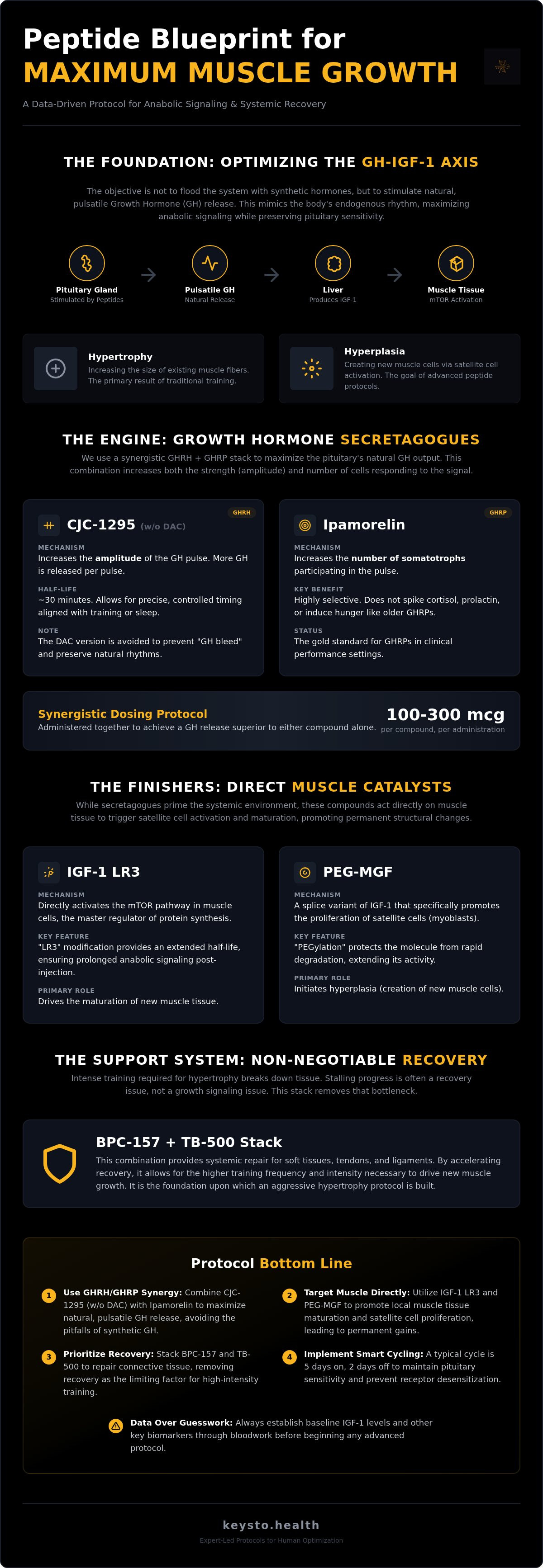
The GH-IGF-1 axis is the primary endocrine driver of skeletal muscle development. While exogenous Growth Hormone (GH) provides a steady, non-physiological elevation, using the best peptides for muscle growth focuses on stimulating the pituitary gland to release GH in natural pulses. This pulsatile rhythm is crucial because it mimics the body's endogenous secretion patterns. It helps maintain receptor sensitivity and avoids the "GH bleed" associated with synthetic administration. Once released, GH stimulates the liver to produce Insulin-like Growth Factor 1 (IGF-1), which then activates the mTOR pathway, the central controller of muscle protein synthesis.
Understanding The Science of Hypertrophy requires distinguishing between increasing the size of existing fibers and hyperplasia, the creation of new muscle cells. Most traditional training only achieves hypertrophy. However, advanced peptide research suggests that certain compounds can trigger satellite cell activation, potentially leading to hyperplasia. While much of the hyperplasia data stems from animal models, 2026 human clinical trials are beginning to validate these pathways through localized IGF-1 expression. This is the difference between a temporary pump and permanent structural changes in the muscle tissue.
Anabolic Signaling vs. Direct Administration
I've found that secretagogues are almost always superior to direct GH administration for long-term endocrine health. These compounds target the Somatotrophs in the anterior pituitary, forcing them to work rather than shutting them down. To prevent pituitary desensitization, we utilize strategic cycles, typically five days on and two days off. Typical research doses for GHRH/GHRP combinations range from 100mcg to 300mcg per administration. You can find detailed breakdowns of these schedules in our Compound Encyclopedia.
Myostatin Inhibition and Growth Potential
Myostatin is a protein that acts as a biological brake on muscle growth. Modulating this pathway via Follistatin derivatives represents the final frontier for elite athletes who've maxed out their genetic potential. In current 2026 research, we're seeing that inhibiting Myostatin doesn't just increase size; it fundamentally alters the body's anabolic limit. Utilizing these compounds alongside the best peptides for muscle growth creates a synergistic environment for extreme tissue accrual. Before starting, use the AI Bloodwork Analyzer to establish baseline IGF-1 levels. Guessing with high-level signaling molecules is a recipe for wasted capital and suboptimal results.
Growth Hormone Secretagogues: CJC-1295, Ipamorelin, and Tesamorelin
Secretagogues represent the most sustainable approach to growth hormone elevation. We use a combination of GHRH and GHRP because they act synergistically at the pituitary level. GHRH compounds like CJC-1295 increase the amplitude of the signal, while GHRPs like Ipamorelin ensure more somatotroph cells participate in the pulse. This dual action approach makes them some of the best peptides for muscle growth because it maximizes natural output without the "bleeding" effect of exogenous GH. I've found that this synergy is essential for breaking through plateaus where single compounds fail.
CJC-1295 comes in two primary forms. CJC-1295 with DAC (Drug Affinity Complex) has a half-life of roughly 6 to 8 days, which creates a constant GH elevation. I generally advise against this for muscle growth because it ignores natural circadian rhythms. Instead, we use CJC-1295 without DAC, often called Mod GRF 1-29, which has a half-life of about 30 minutes. This allows for precise control over the timing of GH pulses, usually synchronized with training or sleep. For those interested in a foundational understanding of these molecules, Peptides: What they are provides a useful clinical overview of their biological functions.
Ipamorelin is my gold standard for GHRPs. Unlike its predecessors, GHRP-2 and GHRP-6, it doesn't stimulate the ghrelin receptor to cause intense hunger. It's highly selective for the growth hormone receptor. This means you avoid the unwanted spikes in cortisol and prolactin that can occur with less refined compounds. We prioritize Ipamorelin because it allows for high-dose protocols without the metabolic side effects that can ruin a lean bulk.
The CJC-1295 + Ipamorelin Protocol
We typically utilize a 1:1 ratio for this stack to mimic the body's natural signaling. I recommend 100mcg of CJC-1295 (No DAC) and 100mcg of Ipamorelin per administration. You should administer this subcutaneously 1 to 2 times daily on an empty stomach. You must remain fasted for at least 2 hours before and 30 minutes after injection to prevent insulin from blunting the GH pulse. This protocol significantly improves nitrogen retention and accelerates fat oxidation during recovery phases.
Tesamorelin: The Elite Muscle Density Compound
Tesamorelin is a 44-amino acid GHRH analog that I reserve for the final stages of a physique protocol. While CJC-1295 is a generalist, Tesamorelin is highly effective at reducing visceral adipose tissue and increasing muscle area density. Clinical data originally focused on HIV-associated lipodystrophy showed that 2mg daily doses significantly reduced trunk fat while increasing lean mass. In an athletic context, we use 1 to 2mg daily during 8 to 12 week blast phases to sharpen muscle definition and density. You can view our full range of optimization protocols to see how we integrate these into a larger performance strategy.
Direct Muscle Catalysts: IGF-1 LR3 and PEG-MGF
While secretagogues focus on signaling the pituitary gland, direct muscle catalysts provide the downstream effector molecules required for immediate tissue expansion. I categorize IGF-1 LR3 and PEG-MGF as "direct" because they bypass the endocrine feedback loops discussed in the previous section. These compounds represent some of the best peptides for muscle growth when your goal is to force a physiological shift toward systemic anabolism. However, direct administration requires a higher degree of precision and monitoring to avoid metabolic desensitization.
IGF-1 LR3 is an 83-amino acid analog of human IGF-1. The "LR3" modification involves the substitution of Glutamic Acid for Arginine at position 3 and a 13-amino acid extension. This structural change prevents the peptide from binding to IGF-binding proteins (IGFBPs), which normally neutralize IGF-1 in the bloodstream. Consequently, the half-life increases from roughly 10 to 20 minutes to approximately 20 to 30 hours. While these results are potent, Harvard Health on peptide safety highlights the necessity of understanding the difference between clinical-grade protocols and unverified research chemicals.
IGF-1 LR3: Systemic Anabolism and Nutrient Partitioning
The primary mechanism of IGF-1 LR3 is its ability to inhibit glucose uptake into adipocytes while simultaneously forcing it into muscle cells. This creates a powerful nutrient partitioning effect where calories are prioritized for repair rather than fat storage. We typically utilize a dosing range of 20 to 50 mcg per day. Administering this post-workout maximizes the anabolic window by capitalizing on increased insulin sensitivity following resistance training. I restrict these cycles to 4 weeks because chronic exposure can lead to receptor downregulation and systemic insulin resistance.
- Mechanism: Downregulates glucose transport in fat tissue.
- Dosing: 20 to 50 mcg daily.
- Cycle Length: Max 4 weeks on, followed by 4 weeks off.
PEG-MGF: Triggering Satellite Cell Recruitment
PEG-MGF is a splice variant of IGF-1 that specifically targets muscle tissue repair through hyperplasia. While standard MGF is produced locally in response to mechanical stress, it's extremely unstable and degrades within minutes. PEGylation adds a polyethylene glycol molecule to the peptide, extending its stability and allowing it to remain active in the body for several days. This allows for the recruitment of satellite cells, which donate their nuclei to damaged muscle fibers to create new tissue.
I recommend a dosing protocol of 200 to 400 mcg administered 2 to 3 times per week. We find the greatest results when PEG-MGF is used on training days to facilitate the repair of micro-tears. The synergy between these two compounds is clear: MGF recruits the new cells, while IGF-1 LR3 drives their growth. You can deep-dive into the specific chemical structures of these catalysts in our Compound Encyclopedia. Before initiating a high-affinity IGF-1 protocol, ensure your baseline glucose and IGF-1 levels are verified via the HRT Bloodwork Analyzer to prevent metabolic drift.
The Recovery Foundation: Why BPC-157 and TB-500 are Non-Negotiable
Recovery is the absolute bottleneck of hypertrophy. If your systemic repair capacity lags behind your anabolic signaling, you'll inevitably hit a wall or suffer a connective tissue failure. While most athletes look for the best peptides for muscle growth in the GH-secretagogue category, the elite understand that chronic, low-level inflammation is the primary progress killer. We use a synergistic pairing of BPC-157 and TB-500 to ensure the physical architecture can support the increased workload.
BPC-157 drives Angiogenesis, the formation of new blood vessels. This is critical for delivering oxygen and nutrients to rapidly expanding muscle tissue that often outpaces its existing blood supply. TB-500 complements this through Actin sequestering, which facilitates cellular migration to micro-trauma sites. This isn't just about "healing an injury"; it's about accelerating the standard repair cycle of every high-intensity training session. I've found that this combination allows for higher frequency and intensity without the typical accumulation of systemic fatigue.
BPC-157: Systemic Repair and Gut-Muscle Axis
BPC-157 works by up-regulating growth factor receptors in tendons and ligaments. This is vital when using the best peptides for muscle growth because muscle tissue often grows faster than its connective support structure. We call this the "tendon-muscle mismatch," and it's a leading cause of injury in enhanced athletes. I recommend a systemic dose of 250 to 500 mcg daily, administered subcutaneously. It also maintains the integrity of the gut lining, ensuring optimal nutrient absorption which is the fuel for your anabolic signaling.
TB-500 (Thymosin Beta-4): The Flexibility and Repair Molecule
TB-500 is a synthetic version of the naturally occurring Thymosin Beta-4. Its primary role is promoting cellular migration and preventing the formation of restrictive scar tissue and adhesions. For maximum efficacy, I use a loading phase of 5 to 10 mg per week for the first 14 days, followed by a 2.5 mg weekly maintenance dose. This protocol maintains tissue flexibility and ensures that new muscle fibers are integrated correctly into the existing fascia. See our full Regenerative Protocol for advanced stacking strategies.
Precision Implementation: Protocol Building and Bloodwork Analysis
I've seen countless athletes waste thousands on the best peptides for muscle growth without ever looking at a single blood marker. This is high-stakes biology, not a guessing game. If you don't establish a baseline, you can't quantify your ROI or identify metabolic drift before it becomes a clinical issue. Data beats guesswork every time in elite performance. We require a comprehensive blood panel before any compound is reconstituted.
A standard "Elite Hypertrophy" stack for a 12-week cycle often combines a GHRH/GHRP secretagogue pair with a regenerative foundation. For example, a protocol might include CJC-1295 (No DAC) and Ipamorelin at 100mcg each, twice daily, alongside BPC-157 at 250mcg twice daily. This addresses both the anabolic signaling and the recovery bottleneck simultaneously. You must track your response to ensure these dosages align with your specific physiological needs.
Step 1: The Biohacking Baseline
We prioritize four critical markers: IGF-1, HbA1c, Fasting Insulin, and Total Testosterone. IGF-1 tells us your current growth ceiling, while HbA1c and Fasting Insulin monitor the metabolic impact of increased growth hormone signaling. I recommend using the AI Bloodwork Analyzer to interpret these results through a clinical-grade lens. This tool allows us to adjust peptide dosages based on your biological age markers rather than just chronological age.
Step 2: Reconstitution and Dosing Accuracy
Precision mixing is where most protocols fail. Shaking a vial or using the wrong volume of bacteriostatic water can denature fragile peptide chains, rendering them useless. We use the Peptide Reconstitution Calculator to ensure every "tick" on the insulin syringe delivers the exact microgram dosage required. Maintaining the cold chain is equally vital. Peptides must remain refrigerated at 2 to 8 degrees Celsius after reconstitution to prevent degradation and maintain potency throughout the cycle.
Step 3: Monitoring and Pivoting
Identifying non-responders early saves time and resources. We perform follow-up bloodwork at the 6-week mark to check for IGF-1 elevation. If the delta is insufficient, we pivot. This might involve moving from a standard Ipamorelin protocol to Tesamorelin for more aggressive body composition refinement. I've found that hyper-responders may need to scale back dosages to avoid peripheral edema or carpal tunnel symptoms. For a fully customized framework, utilize the AI Peptide Protocol Builder to align your stack with your specific 2026 performance goals. Identifying the best peptides for muscle growth is only half the battle; the other half is the precision of your implementation.
Mastering the 2026 Anabolic Architecture
Transitioning from generic hypertrophy routines to clinical-grade protocols marks the difference between hitting a plateau and achieving consistent tissue accrual. We've established that the best peptides for muscle growth work by optimizing the GH-IGF-1 axis while simultaneously removing the recovery bottleneck through BPC-157 and TB-500. This dual-action approach ensures your biological architecture can actually support the increased anabolic signaling.
Success hinges on moving beyond guesswork. Our framework utilizes clinical-grade bloodwork analysis and access to over 112 research compounds in our Encyclopedia to ensure every microgram is accounted for. By leveraging data-driven dosing and precision reconstitution, you maintain long-term endocrine health while maximizing your genetic potential.
It's time to stop guessing and start architecting your performance with the certainty of 25 years of expert-led science.
Frequently Asked Questions
What is the single best peptide for muscle growth?
No single peptide serves as a magic bullet for hypertrophy. Muscle accrual requires a multi-pathway approach that addresses both signaling and recovery. If forced to prioritize, Tesamorelin is arguably the most potent for increasing muscle area and reducing visceral fat. However, the best peptides for muscle growth usually involve a combination of GHRH and GHRP to maximize pulsatile growth hormone release while utilizing repair agents like BPC-157 to prevent connective tissue failure.
Are peptides safer than anabolic steroids for bodybuilding?
Peptides and anabolic steroids operate through different biological mechanisms. Steroids provide exogenous hormones that typically shut down natural production. Peptides like Ipamorelin signal your own pituitary gland to increase output, maintaining endocrine balance. While they avoid the liver toxicity and severe HPTA suppression of oral steroids, they still require precise dosing and monitoring. You must use data-driven protocols to avoid metabolic side effects like insulin resistance or peripheral edema.
How quickly can I expect to see results from a peptide stack?
You'll notice systemic recovery and improved sleep quality within the first 7 to 10 days. Measurable lean muscle accrual and fat oxidation typically become visible between weeks 4 and 8 of a consistent protocol. Peptides aren't as fast as synthetic androgens for weight gain, but the tissue added is often higher quality and easier to maintain post-cycle. Consistency in fasted administration and training intensity is the primary variable for speed.
Do I need PCT (Post Cycle Therapy) after using peptides?
Standard Post Cycle Therapy is unnecessary for most peptide protocols. Unlike anabolic steroids, growth hormone secretagogues don't suppress the Hypothalamic-Pituitary-Gonadal axis or natural testosterone production. Your pituitary continues to function, and natural GH pulses return to baseline shortly after cessation. I recommend a washout period of 4 weeks after a 12-week cycle. This allows receptor sensitivity to reset and prevents long-term desensitization of somatotroph cells.
Can peptides for muscle growth cause insulin resistance?
High-dose protocols, particularly those involving IGF-1 LR3 or chronic GH elevation, can negatively impact insulin sensitivity. Growth hormone naturally blunts glucose uptake in peripheral tissues to prioritize fat oxidation. We monitor HbA1c and fasting insulin levels closely during any 12-week protocol. Utilizing the best peptides for muscle growth safely requires periodic off days and strategic carbohydrate timing. This ensures you don't develop metabolic drift or glucose intolerance during your cycle.
Is it better to inject peptides intramuscularly or subcutaneously for muscle growth?
Subcutaneous injection is the clinical standard for systemic peptides like CJC-1295 and Ipamorelin. The slow absorption rate from adipose tissue provides a steady release into the bloodstream. While some athletes use intramuscular injections for localized repair with BPC-157, the systemic effect remains identical. Subcutaneous administration is less invasive and reduces the risk of scar tissue formation in the muscle belly. This is vital because scar tissue can eventually limit hypertrophy.
What is the best peptide stack for a 'lean bulk'?
An elite lean bulk stack focuses on maximizing nitrogen retention without excessive water weight. I recommend a foundation of CJC-1295 (No DAC) and Ipamorelin at 100mcg each, twice daily. You can add IGF-1 LR3 at 40mcg post-workout for four weeks to drive nutrients directly into the muscle. This combination targets both the GH-IGF-1 signaling axis and nutrient partitioning. It ensures that caloric surpluses are prioritized for new tissue rather than fat storage.
Do peptides affect natural testosterone production?
Peptides in the GH-secretagogue and repair categories don't suppress natural testosterone production. They target the somatotrophs in the pituitary gland rather than the Leydig cells in the testes. This makes them an excellent tool for those who want to optimize performance without committing to lifelong hormone replacement therapy. If you're concerned about your baseline, we use our AI Bloodwork Analyzer to verify that your HPG axis remains fully functional throughout your protocol.

Article by
Samir Levin
Samir Levin is a biohacker and longevity researcher with 25 years of personal experimentation across peptides, hormonal optimization, and regenerative medicine. He is the founder of Keys to Health — a platform combining a 112-compound research encyclopedia, AI-powered bloodwork analyzer, peptide protocol builder, and evidence-based PDF protocols used by thousands of biohackers worldwide.
Samir's work is grounded in first-person experimentation, not theory. He personally reversed 10+ years of AAS-induced gynecomastia without surgery using an enzymatic stack he developed and documented. His protocols are built from clinical literature, N=1 data, and feedback from the Keys to Health community.
He covers peptides, TRT/HRT, GLP-1 agents, senolytics, longevity stacks, cognitive enhancement, and animal longevity protocols for dogs, cats, and horses.
peptidesmuscle growthbodybuildingbiohackingGHRHIGF-1BPC-157peptide protocol