Research
Athlete Bloodwork Markers: The Elite Performance Optimization Checklist
By Samir Levin · August 24, 2026 · 16 min read
Disclaimer
This article is for informational and educational purposes only. It does not constitute medical advice, diagnosis, or treatment. Always consult a qualified healthcare provider before starting any new supplement, peptide, or protocol. Keys to Health and Samir Levin are not responsible for any actions taken based on this content.
A "normal" lab result is often the first sign that your athletic performance is about to crater. Most clinical reference ranges are designed to detect disease in a sedentary population, not to optimize an elite engine. If you're feeling under-recovered despite having labs that "look fine," you're likely falling victim to the fallacy of clinical averages. I've spent 25 years at the intersection of high-stakes performance and biological science, and I can tell you that the gap between baseline health and elite output is found in the nuances of specific athlete bloodwork markers.
You shouldn't have to guess why your PRs are stalling or why your morning grip strength is down. We're going to bridge the gap between raw data and actionable protocols. In this guide, I'll identify the specific biomarkers that differentiate elite performance from mere survival. You'll learn the mechanism of action behind each marker, from iron saturation thresholds to the cortisol-to-testosterone ratio. I'll also provide a structured framework for using tools like our HRT Bloodwork Analyzer to interpret your data and build precise recovery stacks. We're moving past general wellness and into the realm of biological architecture.
Key Takeaways
- Learn why clinical reference ranges fail high-output individuals and how to identify the specific athlete bloodwork markers that signal peak biological readiness.
- Shift your focus from Total Testosterone to Free Testosterone and SHBG to accurately measure the hormones actually available for tissue repair and protein synthesis.
- Master the use of Creatine Kinase and hs-CRP to differentiate between necessary acute training stimulus and dangerous systemic inflammation.
- Establish precision targets for micronutrients like Vitamin D and Magnesium to ensure enzymatic efficiency and maximal force production.
- Implement a data-driven framework using the HRT Bloodwork Analyzer to move from raw lab results to actionable peptide and supplement protocols.
Table of Contents
The Fallacy of Normal: Why Clinical Lab Ranges Fail Athletes
Standard standard laboratory reference ranges are statistically derived from the 95th percentile of the general population. This cohort is largely sedentary, metabolically compromised, and aging. If you're an elite performer, comparing your physiology to this average is a recipe for mediocrity. Optimization requires moving beyond these broad buckets into Optimal Tiers that reflect peak biological output.
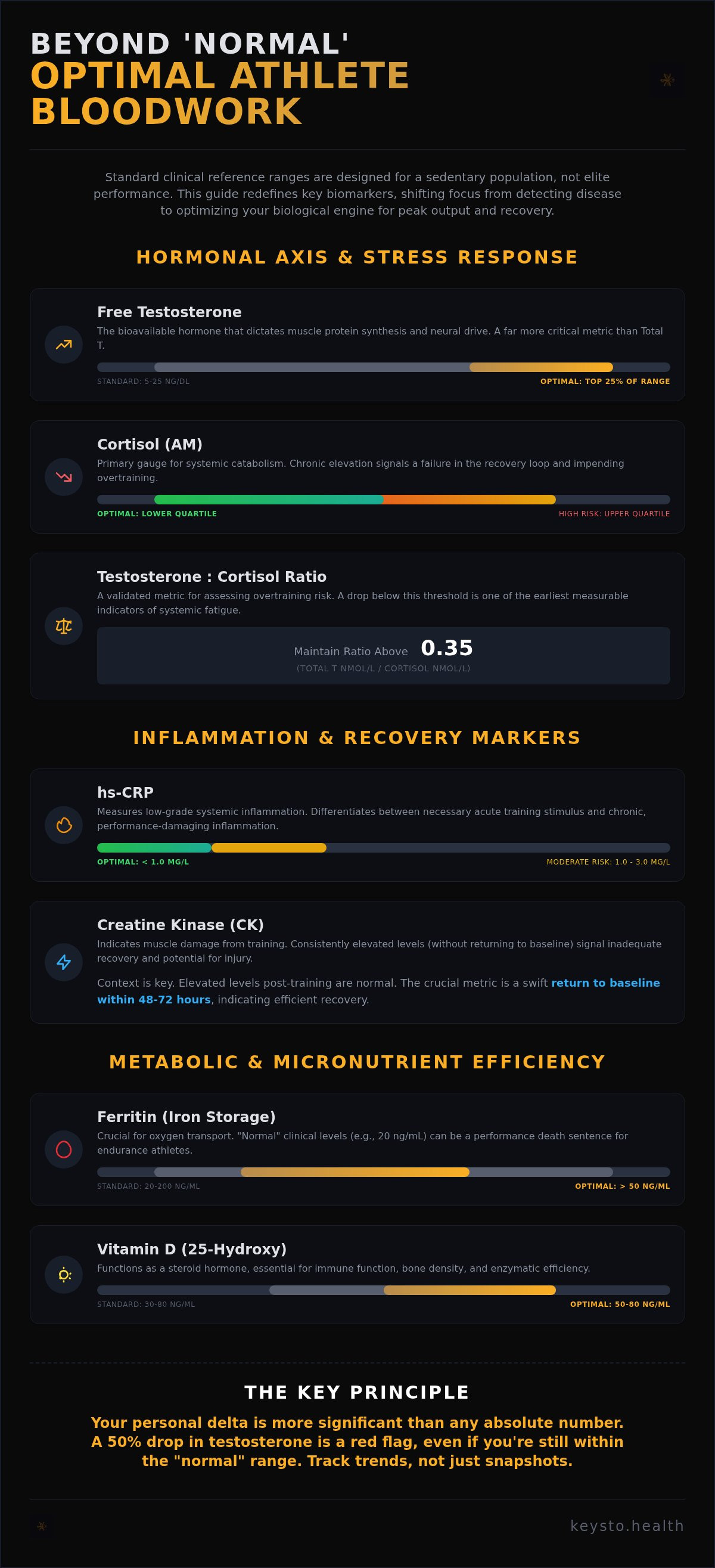
Consider iron status. A clinician might see a ferritin level of 20 ng/mL and label it "normal" because it falls within the standard bell curve. For a marathoner or a high-volume CrossFit athlete, that level is a performance death sentence. Research indicates endurance athletes need ferritin levels above 30 or 50 ng/mL to maintain oxygen transport efficiency. Using standard athlete bloodwork markers without this context leads to unexplained fatigue and stalled progress.
Your personal delta is often more significant than the absolute number. If your baseline testosterone is 900 ng/dL and you drop to 500 ng/dL, you're still "normal" by clinical standards. However, you've lost nearly 50% of your primary anabolic driver. We track these shifts to identify systemic fatigue before it manifests as a physical injury.
Defining the Optimized Athlete Range
Standard ranges for testosterone typically span 300 to 800 ng/dL. For elite performance, we target a much tighter and higher window, often aiming for the top 10% of the natural range to maximize recovery. Vascular Health markers like ApoB and LDL-P also require stricter control in athletes, especially those using performance-enhancing compounds that can stress the lipid profile.
I define Biological Redlining as a state where your markers remain at the extreme limits of clinical ranges during high-volume training blocks. It is a signal that your system is functioning, but it lacks the reserve capacity for further adaptation. If you stay in the redline for too long, systemic failure is inevitable.
The AI Advantage in Data Interpretation
Standard practitioners are trained to look for pathology, not performance. Our AI Bloodwork Analyzer identifies subtle hormonal and inflammatory patterns that indicate overreaching. It moves your data from a static snapshot to a predictive model of your physical readiness.
High-stakes athletes should monitor their athlete bloodwork markers at least four times per year. This frequency allows us to catch seasonal fluctuations and adjust protocols in real-time. Frequent testing turns raw data into a tactical roadmap for your next training cycle.
The Redline Hormonal Checklist: HPG Axis and Stress Response
Total Testosterone is a vanity metric. If your Sex Hormone Binding Globulin (SHBG) is elevated, your bioavailable hormone is locked away; it cannot interact with androgen receptors. Free Testosterone is the only value that dictates muscle protein synthesis and neural drive. When reviewing comprehensive biomarker panels, I prioritize the relationship between these three values over any single absolute number.
Cortisol serves as the primary gauge for systemic catabolism. While acute spikes are necessary for training adaptations, chronic elevation signals a failure in the recovery loop. The T:C Ratio (Testosterone to Cortisol) is a validated metric for assessing overtraining risk. Research identifies a ratio exceeding 0.35 as one of the earliest measurable indicators of overtraining syndrome, often appearing before physical performance begins to drop.
Monitoring these athlete bloodwork markers allows us to adjust training volume before a systemic crash occurs. If your Free Testosterone is trending down while Cortisol climbs, you are burning through your biological capital. This is the moment to pivot from accumulation to intensification or recovery.
Optimizing the Androgenic Profile
High-intensity training blocks place significant strain on the HPG Axis. To maintain output, we utilize targeted interventions to prevent signal dampening between the hypothalamus and the gonads. For support, I've seen success with specific peptide or secretagogue stacks using 250,500 mcg/day ranges to maintain baseline signaling. You can find detailed intervention strategies in our Testosterone Optimization Protocol.
Thyroid and Growth Hormone Markers
TSH and Free T3 are often the first victims of calorie restriction or extreme volume. High stress suppresses the peripheral conversion of T4 to T3, leading to "unexplained" fatigue despite high caloric intake. We also monitor IGF-1 to gauge systemic growth hormone response and tissue repair capacity. If your IGF-1 is suppressed alongside high cortisol, your physiology is no longer in an adaptive state.
Explore our optimization protocols to align your training volume with your current biological capacity and prevent hormonal burnout.
Inflammation and Recovery Biomarkers: Tracking Systemic Load
Creatine Kinase (CK) is perhaps the most misinterpreted value in a performance panel. While an acute spike is a necessary byproduct of training stimulus, a failure to clear that spike identifies a "Recovery Gap." If your CK levels remain elevated 72 hours post-exertion, your training volume has exceeded your physiological clearance rate. I monitor these athlete bloodwork markers to determine if an athlete is actually adapting or merely accumulating damage.
We use High-Sensitivity C-Reactive Protein (hs-CRP) as the definitive window into systemic, non-specific inflammation. Unlike standard CRP, the high-sensitivity assay detects the low-grade inflammation that derails performance without triggering a full clinical illness. I also track Ferritin as more than just an iron storage metric. In overtrained athletes, ferritin acts as an acute-phase reactant; it can skyrocket during systemic stress, often masking a functional iron deficiency that impairs oxygen transport.
Acute vs. Chronic Inflammation Profiles
Interpreting CK spikes requires baseline context. A reading of 800 U/L might be a normal physiological adaptation after a heavy eccentric session, but that same number during a deload week signals a systemic failure to recover. We use hs-CRP to screen for low-grade infections or gut permeability issues that drain adaptive reserves. If your baseline inflammatory load remains high, we transition to our Immune Protocol to modulate the cytokine response and reset the system.
Regenerative Recovery Markers
When inflammatory athlete bloodwork markers stay chronically high, bloodwork informs the tactical use of regenerative compounds. We frequently pair BPC-157 with TB-500 for their synergistic mechanism of action. BPC-157 upregulates growth factor receptors and promotes angiogenesis, while TB-500 facilitates cell migration through actin sequestration. This combination addresses the root of tissue damage rather than just suppressing the inflammatory signal.
A study by Chang et al. (2011) involving 20+ subjects demonstrated that BPC-157 significantly accelerated tendon-to-bone healing by promoting the formation of granulation tissue and increasing collagen expression. For athletes stuck in a chronic inflammatory loop, I typically suggest a dosing range of 250 to 500 mcg/day for BPC-157. This is often paired with TB-500 at 2.5 to 5 mg twice weekly. You can find specific application details in our Regenerative Recovery strategies.
Metabolic and Micronutrient Efficiency Checklist
Clinical sufficiency is not performance optimization. The "normal" range for Vitamin D starts at 30 ng/mL, which is barely enough to prevent bone demineralization in a sedentary population. For elite force production and immune resilience, I target 60 to 80 ng/mL. Maintaining these levels ensures proper calcium signaling in muscle fibers and optimal nuclear receptor activation, preventing the common "winter slump" in training output.
Magnesium and Zinc are the non-negotiables of enzymatic efficiency. Zinc acts as a co-factor for over 300 enzymes, including those governing testosterone synthesis and immune cell proliferation. Magnesium stabilizes ATP molecules; without sufficient levels, your cellular energy currency is effectively bankrupt. I also track the Omega-3 Index to establish a high cellular inflammatory threshold, protecting the cardiovascular system during high-intensity intervals and improving membrane fluidity.
Monitoring these athlete bloodwork markers allows us to identify metabolic friction before it manifests as a performance plateau. If your micronutrient status is sub-optimal, no amount of exogenous stimulus will produce the desired adaptation. We prioritize the foundational chemistry that allows higher-level protocols to function efficiently.
Hematology and Oxygen Transport
Hemoglobin and Hematocrit dictate your aerobic ceiling. However, high-volume training often triggers "sports anemia," where plasma volume expands and dilutes these athlete bloodwork markers. While a clinician might see a 13.5 g/dL hemoglobin and ignore it, I look at Ferritin status. For endurance athletes, Ferritin should stay above 50 ng/mL to ensure iron availability for mitochondrial function and oxygen transport, regardless of what the "normal" range suggests.
Optimize your oxygen transport capacity
Glucose Management for Performance
Nutrient partitioning is the difference between adding lean mass and fueling systemic inflammation. I look for a Fasting Insulin level below 5 uIU/mL to ensure maximal fat oxidation and metabolic flexibility. Even in high-carbohydrate fueling environments, chronic insulin elevation leads to receptor desensitization and impaired recovery. We use this metric to gauge how well your body handles the fuel you provide.
HbA1c provides a 90-day average of glucose management. High-performance athletes often see "pre-diabetic" HbA1c levels due to constant high-glycemic fueling during training blocks. We use our Metabolic Protocol to restore insulin sensitivity during the off-season. This ensures that when you return to high-volume work, your cells are primed to drive glucose into the muscle rather than storing it as visceral fat.
The Protocol: From Raw Data to Optimization Stacks
Raw data is just biological noise without a structured framework for implementation. I've spent two decades refining a four-step process to transform a lab report into a performance blueprint. This protocol ensures you aren't just chasing athlete bloodwork markers but are actually driving physiological adaptations.
- Conduct a baseline "Elite Panel" during a deload week. Testing during a high-volume block provides "dirty" data, as acute muscle damage and systemic fatigue will skew your androgenic and inflammatory markers.
- Utilize the AI Bloodwork Analyzer to identify performance outliers. Our algorithm cross-references your results against elite performance tiers rather than the standard bell curve of the general population.
- Match marker deficiencies to specific Compound Encyclopedia entries. Once you identify a bottleneck, such as suppressed IGF-1 or elevated SHBG, you can select the precise compound designed to modulate that pathway.
- Implement a 12-week protocol with mid-point "Redline" checks. You don't need a full panel every month, but you must monitor your 3,5 most volatile markers at week six to ensure the stack is working without causing secondary stress.
Pre-Analytic Rigor: Standardizing Your Draw
Your results are only as good as your preparation. You must fast for 12 hours and avoid all strenuous exercise for 48 hours before the draw. Intense training causes acute spikes in Creatine Kinase and Lactate Dehydrogenase that can trigger false positives for liver or kidney stress. Hydration status is equally critical; dehydration artificially inflates Hematocrit and Albumin, giving you a false sense of aerobic capacity.
I follow the "Samir Levin Rule" for all high-stakes testing: never pull blood during acute illness or an extreme caloric deficit. These states create a temporary hormonal "emergency mode" that doesn't reflect your true physiological baseline. If you're coming off a heavy weight-cut or fighting a respiratory infection, wait 14 days before heading to the lab.
Building the Optimization Stack
If your IGF-1 markers are chronically low, we often look at a synergistic pairing of Ipamorelin and CJC-1295. CJC-1295 acts as a GHRH (Growth Hormone Releasing Hormone) analog, while Ipamorelin is a selective ghrelin receptor agonist. Together, they amplify the amplitude of your natural growth hormone pulses without the desensitization common in older secretagogues.
Precision is mandatory when moving from data to dosing. Use our Peptide Calculator to ensure your reconstitution math is flawless before beginning any recovery stack. The bottom line is that data is useless without a structured protocol for implementation. We don't guess; we measure, analyze, and then execute.
Mastering Your Biological Blueprint
Optimizing athlete bloodwork markers isn't about avoiding disease; it's about engineering a physiological environment that supports maximal adaptation. Clinical reference ranges fail to account for the metabolic and hormonal demands of high-volume training. By shifting your focus to bioavailable hormones, inflammatory clearance rates, and micronutrient efficiency, you move from guessing to precise biological architecture. You've now got the framework to identify systemic bottlenecks before they manifest as physical injury.
I've spent 25 years at the intersection of performance and science to build these frameworks. We've compiled a database of 112 research compounds to ensure your interventions are evidence-based and effective. Our AI-driven interpretation removes the bias of standard medical diagnostics, providing you with the exact data points needed to adjust your training and recovery in real-time. This level of precision is what separates elite performers from the general population.
Stop leaving your progress to chance. Use the data to build your next intensification cycle with confidence. Your physiology is the ultimate competitive advantage when it's managed with clinical precision and data-driven protocols.
Frequently Asked Questions
What are the most important blood markers for athletes to track?
Athletes must prioritize Free Testosterone, Cortisol, Creatine Kinase, and hs-CRP. These cover the anabolic catabolic balance and systemic inflammatory load. Tracking micronutrients like Vitamin D (25-OH) and Ferritin is also essential for force production and oxygen transport. I focus on these athlete bloodwork markers because they provide a comprehensive view of physiological readiness rather than just checking for clinical disease or deficiency.
How often should a professional athlete get bloodwork done?
High stakes athletes should test quarterly, roughly every 12 weeks. This frequency allows you to capture data during different phases, such as a high volume accumulation block versus a deload week. Frequent monitoring ensures that you identify subtle shifts in hormonal or inflammatory trends before they manifest as a performance plateau. Testing once a year is insufficient for driving real time adjustments to your optimization protocols.
Can bloodwork detect overtraining before performance drops?
Yes, bloodwork identifies overreaching before physical symptoms occur. Specifically, a Cortisol to Testosterone ratio exceeding 0.35 is a primary indicator of systemic stress. If your Creatine Kinase levels fail to return to baseline within 72 hours of a heavy session, you've identified a "Recovery Gap." These objective metrics allow you to adjust training volume and intensity proactively, preventing the onset of full blown overtraining syndrome.
What is the difference between clinical and optimal testosterone levels?
Clinical ranges detect pathology, while optimal ranges target peak performance. A clinical testosterone range might span 300 to 800 ng/dL, but an athlete at 350 ng/dL will likely experience impaired recovery and drive. We target the top 10% of the natural range for Free Testosterone to maximize protein synthesis. Optimal tiers are narrow and performance focused, whereas clinical "normal" is a broad average of a largely sedentary population.
How does dehydration affect athlete blood test results?
Dehydration causes hemoconcentration, which artificially inflates several key metrics. Your hematocrit, hemoglobin, and albumin levels will appear higher than they actually are, potentially masking anemia or overstating aerobic capacity. This makes it difficult to accurately assess your biological redline. I always require athletes to be fully hydrated before a draw to ensure the data reflects their true physiological state rather than a temporary state of fluid loss.
Should I take my supplements on the morning of a blood draw?
You should avoid all supplements on the morning of your draw. Certain compounds, like Biotin, can interfere with immunoassay results for thyroid and hormonal markers, leading to false readings. Taking minerals like magnesium or zinc right before testing will only show your recent intake rather than your systemic status. For the most accurate baseline, fast for 12 hours and hold all non essential supplements until after the draw.
How can AI help in interpreting athlete bloodwork markers?
AI technology excels at identifying complex patterns across multiple athlete bloodwork markers that a human eye might miss. Our HRT Bloodwork Analyzer cross references your results against elite level benchmarks and predictive performance models. This moves interpretation beyond simple high low flags and into actionable strategy. It allows us to build precise stacks based on how your individual markers interact under systemic training stress.
What blood markers indicate a need for BPC-157 or TB-500?
Chronically elevated Creatine Kinase and hs-CRP indicate a need for regenerative support. If muscle damage markers remain high despite deloading, or if you have persistent soft tissue issues, we look at pairing BPC-157 with TB-500. These compounds address the root of the inflammatory loop by promoting angiogenesis and cell migration. You can find specific dosing and synergy details in our Compound Encyclopedia to fix these imbalances.

Article by
Samir Levin
Samir Levin is a biohacker and longevity researcher with 25 years of personal experimentation across peptides, hormonal optimization, and regenerative medicine. He is the founder of Keys to Health — a platform combining a 112-compound research encyclopedia, AI-powered bloodwork analyzer, peptide protocol builder, and evidence-based PDF protocols used by thousands of biohackers worldwide.
Samir's work is grounded in first-person experimentation, not theory. He personally reversed 10+ years of AAS-induced gynecomastia without surgery using an enzymatic stack he developed and documented. His protocols are built from clinical literature, N=1 data, and feedback from the Keys to Health community.
He covers peptides, TRT/HRT, GLP-1 agents, senolytics, longevity stacks, cognitive enhancement, and animal longevity protocols for dogs, cats, and horses.
bloodworkbiohackingathletic performancebiomarkersperformance optimizationrecoverylab testingtestosteroneinflammation