Longevity
Animal Longevity and Recovery Protocols: The Clinical Framework for Biological Optimization
By Samir Levin · August 31, 2026 · 16 min read
Disclaimer
This article is for informational and educational purposes only. It does not constitute medical advice, diagnosis, or treatment. Always consult a qualified healthcare provider before starting any new supplement, peptide, or protocol. Keys to Health and Samir Levin are not responsible for any actions taken based on this content.
Most veterinary practices are designed to manage decline rather than architecting peak performance. If you are waiting for a clinical diagnosis before intervening in your animal’s biology, you have already lost the window for optimization. I have spent 25 years refining high-stakes performance protocols. The reality is that extending healthspan requires moving beyond reactive care. We must utilize specific research compounds for animal health to modulate tissue repair at the cellular level.
You likely realize that standard senior diets and basic supplements are insufficient for the biological demands of a performance horse or an aging canine. This article provides the clinical framework you need to master advanced bioregulatory protocols. I will detail the mechanisms of action for key peptides like BPC-157 and TB-500. We will also establish precise dosing ranges for different species and outline the exact recovery strategies I use to slash downtime in elite animals.
Key Takeaways
- Shift from reactive veterinary maintenance to proactive biological optimization by managing micro-damage accumulation before clinical symptoms emerge.
- Identify the mechanisms of specific research compounds for animal health, such as the ability of BPC-157 to upregulate growth factor receptors for accelerated tissue repair.
- Develop species-specific recovery frameworks that prioritize equine structural integrity, canine mobility, and feline renal longevity through targeted bioregulation.
- Establish a data-driven recovery floor by utilizing inflammatory biomarkers and AI tools to quantify biological stress and eliminate protocol guesswork.
- Execute precise protocol implementation by leveraging the Peptide Reconstitution Calculator to ensure accurate dosing based on individual animal weight and compound concentration.
Table of Contents
Beyond Maintenance: The Science of Animal Longevity
Standard veterinary medicine is a triage system. It excels at fixing broken bones and treating acute infections, but it fails at extending the biological prime. We define longevity as the systematic management of micro-damage accumulation over time. By targeting mitochondrial health, proteostasis, and cellular senescence, we can interrupt the degradation cycle before it manifests as clinical disease. Performance animals, unlike sedentary domestic pets, operate at their metabolic limits. They require higher-leverage research compounds for animal health to sustain tissue integrity and prevent premature structural failure.
The Molecular Mechanisms of Aging in Companion Animals
Aging isn't a single event; it's a series of molecular failures. In dogs and cats, oxidative stress drives metabolic decline by damaging mitochondrial DNA and impairing ATP production. This leads to chronic inflammation, or "inflammaging," which systematically degrades joint cartilage and vascular elasticity. I often utilize the Longevity Protocol as a baseline for my clients to stabilize these markers. Understanding The Science of Animal Longevity requires us to look at negligible senescence and how certain organisms maintain cellular function indefinitely. We also focus on proteostasis, the process of maintaining protein quality within the cell. When proteostasis fails, misfolded proteins accumulate, leading to the cognitive and physical decline we see in senior animals.
Establishing the Recovery Floor
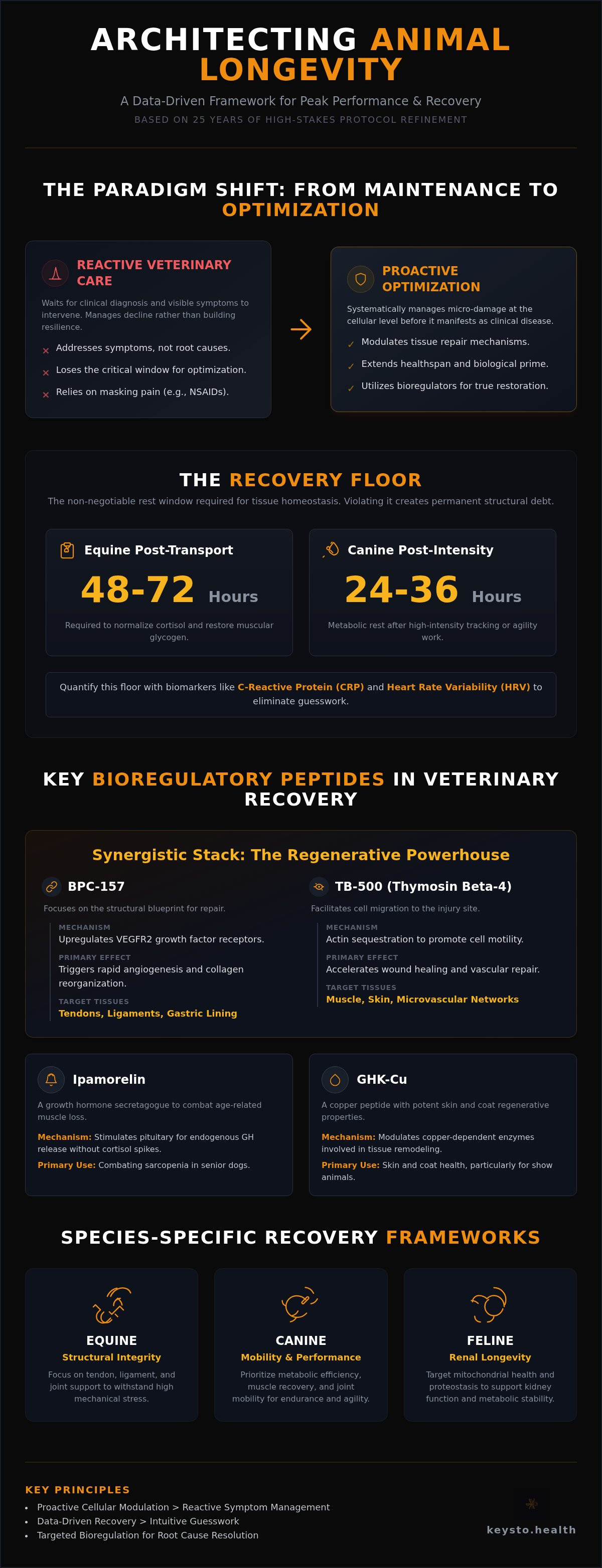
The recovery floor is the non-negotiable rest window required for tissue homeostasis. If you violate this window, micro-damage becomes permanent structural debt. For instance, horses typically require 48 to 72 hours of recovery post-transport to normalize cortisol and restore muscular glycogen. Performance dogs often need 24 to 36 hours of metabolic rest after high-intensity tracking or agility work. Bioregulatory signaling is the process of using exogenous compounds to trigger endogenous cellular repair mechanisms and restore systemic balance. We use these signals to ensure the animal returns to its baseline before the next stressor is applied. My experience shows that quantifying this floor with biomarkers like C-reactive protein (CRP) or heart rate variability (HRV) removes the guesswork from training schedules. This data-driven approach allows us to push performance limits without crossing into biological bankruptcy.
Bioregulatory Peptides in Veterinary Recovery
Bioregulatory peptides represent the frontier of regenerative medicine. While traditional NSAIDs merely mask pain, these research compounds for animal health actively signal the body to repair damaged tissue. I have integrated these molecules into high-performance protocols for over two decades because they address the root cause of structural failure. The primary objective is to move beyond symptom management toward true biological restoration.
BPC-157 is a pentadecapeptide that upregulates growth factor receptors, particularly VEGFR2. This mechanism triggers rapid angiogenesis and collagen reorganization in tendons and ligaments. In my experience, pairing it with TB-500 (Thymosin Beta-4) creates a powerful synergy. While BPC-157 focuses on the structural blueprint, TB-500 facilitates cell migration and vascular repair through actin sequestration. This stack is essential for post-surgical recovery. It addresses both the primary incision site and the surrounding microvascular network simultaneously.
Tissue-Specific Regenerative Compounds
Beyond structural repair, we use growth hormone secretagogues like Ipamorelin to combat sarcopenia in senior dogs. It stimulates the pituitary gland to release endogenous GH without the cortisol spikes associated with older compounds. For show animals, GHK-Cu provides a targeted solution for skin and coat regeneration by modulating copper-dependent enzymes. You can find detailed mechanisms for over 100 molecules in our Compound Encyclopedia. If you are looking for a structured approach to implementation, I recommend exploring our performance protocols.
The Clinical Evidence for Animal Peptide Use
The data supporting these interventions is compelling. Canine studies have demonstrated that BPC-157 significantly accelerates the healing of gastric ulcers and Achilles tendon ruptures. It is vital to distinguish between human clinical data and established veterinary research. While many human trials are larger, animal-specific studies show consistent outcomes in tissue tensile strength and recovery speed. We have analyzed the BPC-157 Peptide mechanisms extensively, noting its role in stabilizing the gut-brain axis and repairing mucosal linings. This technical depth ensures your protocol is based on physiological reality rather than marketing hype.
Species-Specific Recovery Frameworks: Canine, Feline, and Equine
Biological optimization isn't a "one size fits all" endeavor. We must categorize interventions based on whether the species' primary limitation is metabolic or structural. For horses and large dogs, structural integrity is the ceiling. For cats, longevity is almost entirely a function of metabolic and renal maintenance. Applying research compounds for animal health requires understanding these divergent physiological priorities to avoid protocol mismatch.
Canine Joint and Mobility Optimization
Dogs, particularly large breeds, face accelerated mechanical wear that often leads to early euthanasia. I prioritize protocols that manage hip dysplasia and cruciate ligament recovery by stimulating localized collagen synthesis. For a mid-sized dog, typically between 50 and 70 lbs, a baseline dose of 250 mcg/day of BPC-157 is the effective floor for tissue signaling. Integrating the Dog Joint Mobility Protocol allows us to stabilize the joint capsule and reduce the inflammatory cascade before it becomes irreversible. We focus on the synovial fluid environment to ensure the "lubrication" of the joint is maintained alongside structural repair.
Equine Performance and Structural Repair
Performance horses operate under extreme physiological pressure that most owners underestimate. Transport stress alone causes massive cortisol spikes that can suppress the immune system for up to 72 hours. I use the Equine Joint Tendon Protocol to counteract the structural damage from high-impact training and frequent hauling. One critical oversight in equine recovery is sleep hygiene. Horses require recumbent rest to achieve full REM cycles. Without at least 30 to 60 minutes of daily recumbency, they suffer from neural fatigue that leads to poor coordination and increased injury risk during competition.
Feline Longevity and Metabolic Support
Feline health is synonymous with kidney health. Renal failure remains the primary driver of feline mortality, often triggered by chronic low-grade dehydration and protein processing stress. We use specific bioregulators to support nephron function and maintain glomerular filtration rates. The Feline Longevity Protocol focuses on these metabolic levers to extend the healthy lifespan of domestic cats. Utilizing research compounds for animal health in felines requires micro-dosing precision to avoid overwhelming their sensitive metabolic pathways. We treat the cat as a metabolic specialist, focusing on mitochondrial efficiency rather than just structural load.
Quantifying Biological Stress: The Data-Driven Recovery Floor
Subjective observation is the enemy of biological optimization. If you wait until your animal shows visible signs of fatigue, you have already allowed micro-damage to exceed the recovery floor. We rely on objective data, specifically heart rate variability (HRV) and inflammatory biomarkers, to determine when to push and when to pull back. This quantitative approach ensures that research compounds for animal health are administered when the biological terrain is most receptive to signaling.
AI tools now allow us to interpret complex trends in animal health data that remain invisible to the naked eye. Behavioral baseline deviation, such as subtle changes in gait, sleep patterns, or appetite, often serves as the first indicator of systemic stress. We use the HRT Bloodwork Analyzer to monitor hormonal shifts and ensure that recovery protocols are keeping pace with metabolic demands. This eliminates the guesswork that often plagues standard veterinary care.
Biomarker Tracking for Animal Optimization
Precision monitoring requires a specific panel of markers. We look for elevations in C-reactive protein (CRP) to gauge systemic inflammation and Creatinine to monitor renal clearance. Cortisol ratios provide a window into the sympathetic nervous system's state. When these markers show a significant trend away from the baseline, I recommend a deload week. This typically involves a 40 to 60% reduction in physical volume to allow the endocrine system to reset. We use the AI Peptide Protocol Builder to adjust the intensity of bioregulatory stacks during these periods.
Sleep Architecture as a Recovery Metric
Recovery is not just the absence of work; it is a neurological requirement. Species-specific sleep requirements must be met to ensure neural preservation and motor skill retention. For horses, this means providing a secure environment that allows for at least 30 minutes of recumbent rest per day. Dogs and cats require dark, quiet spaces to facilitate deep REM cycles. We use wearable technology to track these metrics, identifying deviations in sleep quality before they manifest as physical injuries or cognitive decline.
Implementing the Keys to Health Animal Protocols
Transitioning from theoretical knowledge to tactical execution is where most optimization efforts fail. I treat every animal protocol with the same clinical rigor I apply to high-stakes human performance stacks. We avoid the "spray and pray" approach by following a highly structured lifecycle that ensures every milligram of research compounds for animal health serves a specific biological purpose. My experience shows that a methodical implementation prevents the metabolic waste often seen in amateur biohacking.
- Define the primary objective: structural repair, cognitive preservation, or metabolic longevity.
- Establish a clear baseline through biomarker analysis or behavioral logging.
- Calculate the dosage using the mcg/kg model to account for species-specific metabolism.
- Execute the 4 to 6 week block with daily subcutaneous administration.
- Re-evaluate biomarkers after a 7 to 10 day washout period to assess progress.
Precision Dosing and Reconstitution
Calculating the correct dosage is non-negotiable. I use a mcg/kg formula to ensure the compound reaches therapeutic thresholds without taxing the animal's liver or kidneys. For example, large dogs typically require 250 to 500 mcg/day of BPC-157 for effective ligament repair. You must use the Peptide Calculator to determine the exact volume of bacteriostatic water needed for reconstitution. Errors in math are the leading cause of protocol failure. A 0.1ml mistake can significantly alter the signal strength of the compound and lead to inconsistent results.
Stacking and Synergistic Combinations
We rarely use compounds in isolation because biological systems are redundant. For acute structural injuries, I always stack BPC-157 with TB-500 to address both the structural collagen blueprint and the vascular repair needed for nutrient transport. We also integrate the Regenerative Protocol to maintain systemic homeostasis during the repair phase. This ensures the whole organism supports the localized repair site. You must monitor for localized irritation or changes in lethargy, though side effects are statistically rare when protocols are followed precisely.
Subcutaneous administration is the standard for systemic bioregulation. Ensure you rotate injection sites daily to prevent tissue scarring and maximize absorption. Most research compounds for animal health are stable at room temperature for short periods, but I recommend refrigerated storage once reconstituted to maintain peptide integrity. We prioritize safety by adhering to strict hygiene standards and using high-quality needles for every administration. Real-time data remains your best tool for ensuring long-term success and biological optimization.
Architecting the Future of Animal Performance
Biological optimization is a deliberate choice. By applying the clinical frameworks we have discussed, you move beyond the limitations of reactive veterinary care. We've established that utilizing research compounds for animal health requires a commitment to data and precision dosing. You now possess the blueprint for systemic regeneration and structural preservation across canine, feline, and equine species.
Between our Compound Encyclopedia and the reconstitution tools provided, the barrier to elite-level animal care has been removed. I have spent 25 years refining these protocols to eliminate the guesswork that often leads to biological decline. It is time to treat your animal's health with the same rigor you apply to your own performance. Your animal’s biological healthspan is the ultimate metric of your strategy.
The tools are ready for implementation. Architect a future where your animals thrive in their prime for years to come.
Frequently Asked Questions
Are peptides like BPC-157 safe for long-term use in dogs and cats?
BPC-157 is safe for dogs and cats when administered in structured cycles. We typically utilize 4 to 6 week blocks to trigger growth factor receptors without causing receptor desensitization. I've observed that continuous use without a washout period can diminish the compound's efficacy. Long-term safety is maximized by monitoring renal and hepatic markers during the protocol. This approach ensures these research compounds for animal health remain an effective signaling tool.
How do I calculate the correct peptide dosage for a senior horse?
Calculating the correct dosage for a senior horse requires a precise mcg/kg calculation based on the animal’s current weight. You should never guess these numbers because equine metabolic demands are highly specific. I always recommend using our Peptide Reconstitution Calculator to ensure the concentration of bacteriostatic water matches the desired dose. For structural maintenance in horses, we often start at the lower end of the therapeutic range.
What is the best protocol for a dog recovering from ACL surgery?
The gold standard for canine ACL recovery is a synergistic stack of BPC-157 and TB-500. BPC-157 upregulates the VEGFR2 receptor to accelerate collagen reorganization; while TB-500 facilitates the migration of satellite cells to the injury site. I’ve found this combination significantly reduces the standard 12 week recovery window in working breeds. We prioritize localized tissue repair while maintaining systemic homeostasis to prevent secondary compensatory injuries in the opposite limb.
Can bioregulatory compounds help with chronic feline kidney disease?
Bioregulatory compounds can support feline kidney health by modulating the inflammatory pathways that degrade nephron function. Chronic feline kidney disease is a metabolic failure; so we focus on peptides that support glomerular filtration and reduce vascular stress. I use the Feline Kidney Support Protocol to stabilize these markers. Early intervention is critical because renal tissue has limited regenerative capacity compared to muscle or skin.
How long does it take to see results from an animal longevity protocol?
Biological markers typically show measurable shifts within 14 to 21 days of starting a protocol. Structural improvements in mobility or coat quality usually take 4 to 8 weeks to become visible. I’ve seen that the timeline depends heavily on the animal’s baseline metabolic state and the severity of the micro-damage. We use objective data from our bloodwork analyzer to confirm that the research compounds for animal health are successfully modulating the target pathways.
Do I need to cycle peptides for my pet, or can they be used continuously?
I mandate cycling for all animal protocols to maintain receptor sensitivity and prevent biological adaptation. A standard cycle consists of 4 to 6 weeks of active administration followed by a 10 to 14 day washout period. Continuous use can lead to diminished returns as the body’s signaling pathways become saturated. This structured approach allows us to assess the animal’s "new normal" during the off-cycle and adjust the next block accordingly for better optimization.
What biomarkers should I track to monitor my animal’s recovery progress?
You should track C-reactive protein (CRP) for systemic inflammation and Creatinine to ensure renal clearance remains optimal. I also prioritize heart rate variability (HRV) as a non-invasive metric for central nervous system recovery. These data points provide a clear picture of whether the animal is adapting to the stress of training or surgery. We interpret these trends using the HRT Bloodwork Analyzer to eliminate the errors inherent in subjective visual observation.
Is there a specific protocol for equine performance endurance?
Our Equine Performance Endurance Protocol is specifically designed for high-output horses. It focuses on mitochondrial efficiency and structural load management to prevent the micro-damage accumulation common in endurance events. I’ve integrated specific compounds that support ATP production and muscular oxygenation during prolonged exertion. This framework ensures the horse can maintain a higher work capacity while significantly lowering the risk of metabolic exhaustion or structural failure.

Article by
Samir Levin
Samir Levin is a biohacker and longevity researcher with 25 years of personal experimentation across peptides, hormonal optimization, and regenerative medicine. He is the founder of Keys to Health — a platform combining a 112-compound research encyclopedia, AI-powered bloodwork analyzer, peptide protocol builder, and evidence-based PDF protocols used by thousands of biohackers worldwide.
Samir's work is grounded in first-person experimentation, not theory. He personally reversed 10+ years of AAS-induced gynecomastia without surgery using an enzymatic stack he developed and documented. His protocols are built from clinical literature, N=1 data, and feedback from the Keys to Health community.
He covers peptides, TRT/HRT, GLP-1 agents, senolytics, longevity stacks, cognitive enhancement, and animal longevity protocols for dogs, cats, and horses.
animal longevitypeptidesBPC-157TB-500equine recoverycanine mobilityresearch compoundsbioregulationveterinary protocols