Peptides
AI Peptide Protocol Builder: The Clinical Framework for Precision Stacking
By Samir Levin · August 25, 2026 · 17 min read
Disclaimer
This article is for informational and educational purposes only. It does not constitute medical advice, diagnosis, or treatment. Always consult a qualified healthcare provider before starting any new supplement, peptide, or protocol. Keys to Health and Samir Levin are not responsible for any actions taken based on this content.
Most generic AI tools are nothing more than glorified search engines that ignore your specific biological data. If you're relying on a standard chatbot to design your recovery or longevity strategy, you're likely following a sub-optimal plan that misses the nuances of your unique biomarkers. Using an AI peptide protocol builder requires more than just a list of goals. It demands a clinical framework that respects the biological synergy between compounds.
I understand the frustration of staring at a vial of BPC-157, questioning your reconstitution math or wondering if your dosing schedule is backed by human data. You want precision, not a guess. We've spent 25 years refining these protocols to move beyond maintenance into the realm of elite performance optimization. Generic advice often fails because it ignores the specific mechanisms of action required for systemic repair.
This article provides the blueprint to master the biological logic behind AI-driven protocols for recovery, fat loss, and longevity. You'll learn how to integrate your bloodwork with technical insights to create a daily dosing schedule that delivers measurable results. We'll examine exactly how to leverage specific compounds like TB-500 to ensure your stack is optimized for your individual needs.
Key Takeaways
- Transition from anecdotal guesswork to a clinical framework that uses biological logic for precise stacking and optimization.
- Integrate your specific biomarkers from the HRT Bloodwork Analyzer into an AI peptide protocol builder to generate data-driven dosing schedules.
- Prioritize mechanism-based synergy over generic goals to improve outcomes, such as combining BPC-157 and TB-500 for targeted vascular repair.
- Utilize the Peptide Calculator for precision reconstitution and establish cycling schedules based on compound half-lives and biological feedback.
Table of Contents
- The Evolution of Peptide Protocols: From Reddit Guesswork to AI Logic
- Decoding the Algorithm: How an AI Peptide Protocol Builder Processes Bio-Data
- Synergistic Stacking: Why Mechanism of Action Beats Goal-Based Selection
- Implementation and Safety: Reconstitution, Dosing, and Cycling via AI
- The Keys to Health Advantage: Integrating AI with Elite Practitioner Experience
The Evolution of Peptide Protocols: From Reddit Guesswork to AI Logic
I have seen thousands of protocols fail because they lacked a cohesive biological arc. For decades, the community relied on anecdotal evidence from internet forums, a period often called the "bro-science" era. Practitioners would copy-paste dosing schedules without understanding how these compounds interact with specific cellular pathways. This haphazard approach ignores the fundamental scientific definition of peptides as signaling molecules that require precise timing to be effective.
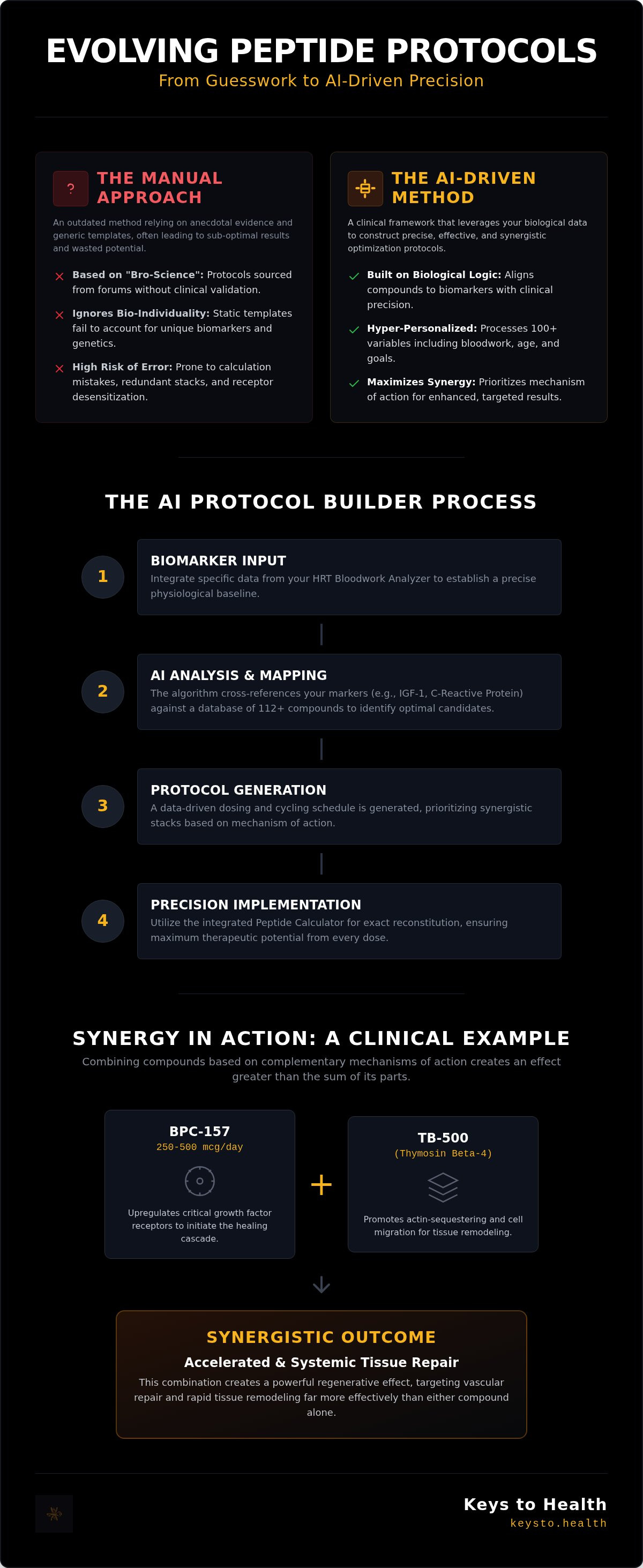
Static templates fail because they don't account for individual pharmacokinetics or the saturation points of your receptors. Optimization isn't about taking every available compound; it's about aligning the right molecule with your current biomarkers. An AI peptide protocol builder solves this by processing over 100 variables simultaneously, ensuring that each compound serves a specific purpose in your biological architecture. We've moved from "guessing" to "calculating," using data to drive outcomes rather than hope.
The Limitations of Manual Protocol Design
Human error is the most common cause of ineffective cycles. Manually calculating the half-lives of multiple compounds while trying to avoid receptor desensitization is a complex task. For example, overusing Growth Hormone Releasing Peptides (GHRPs) without proper pulsing can lead to a rapid decline in pituitary sensitivity. Most users struggle to track the nuances of the 112+ research compounds listed in our Compound Reference, leading to stacks that are redundant or even antagonistic.
Generic templates often ignore the specific mechanism of action required for your goal. A stack designed for systemic recovery might include BPC-157 at 250,500 mcg/day to upregulate growth factor receptors. However, without the actin-sequestering properties of TB-500, the protocol lacks the synergy needed for rapid tissue remodeling. Manual tracking rarely captures these synergistic nuances with the precision required for elite results.
How AI Standardizes Clinical Excellence
The AI peptide protocol builder removes emotional bias from your selection process. It doesn't care about the latest trend on social media; it only cares about the biological logic of the stack. By integrating real-time research updates, the tool ensures that your dosing reflects the most current clinical data. This allows us to scale elite practitioner logic to anyone with a set of bloodwork results.
Precision starts with accurate preparation. We integrate the Peptide Calculator directly into the workflow to eliminate reconstitution math errors. This ensures that every milligram of a compound like Ipamorelin is utilized at its maximum therapeutic potential. By using the AI Protocol Builder, you transition from a consumer of compounds to a strategist of your own biology.
Decoding the Algorithm: How an AI Peptide Protocol Builder Processes Bio-Data
An AI peptide protocol builder is a computational engine designed to align specific biomarkers with the mechanisms of action found in research compounds. It replaces subjective goal descriptions with objective data points. We prioritize hard numbers from your HRT Bloodwork Analyzer because biological reality exists in your serum, not your intentions.
The algorithm weights critical variables such as age, biological sex, and current hormonal baselines to determine the appropriate intervention. This methodology mirrors how AI processes complex bio-data to predict disease risk and optimize therapeutic outcomes. By analyzing these inputs, the system identifies where your physiology deviates from the elite performance standard.
The Biomarker-to-Compound Mapping Process
The mapping process begins by identifying deficiencies in the GH/IGF-1 axis. If your IGF-1 levels fall below the 200 ng/mL threshold, the AI flags growth hormone secretagogues as potential candidates. It also aligns inflammatory markers like C-Reactive Protein (CRP) with regenerative peptides to address systemic or localized tissue damage. This predictive scaling allows the system to anticipate how your body will respond to a specific dosing range based on your unique history.
We use this data to build a biological arc that evolves as your markers improve. For those looking to refine their recovery strategy, reviewing our Regenerative Recovery protocol provides a baseline for how these markers influence compound selection.
The Role of the Research Compound Encyclopedia
The engine constantly queries our Compound Reference, which contains technical data on 112+ research compounds. It cross-references these substances for potential contraindications and synergistic overlaps. This ensures that a protocol doesn't just stack compounds randomly but instead creates a cohesive biological effect. Every recommendation is backed by a minimum of three clinical studies to maintain high standards of evidence-based optimization.
The AI distinguishes between human clinical trials and animal data to ensure safety and efficacy. For instance, while BPC-157 shows remarkable results in animal models for tendon repair, the AI adjusts human dosing ranges to 250,500 mcg/day based on established practitioner data. You can access these data-driven insights through our AI Protocol Builder to start your optimization journey.
Synergistic Stacking: Why Mechanism of Action Beats Goal-Based Selection
Goal-based stacking is a hallmark of amateur biohacking. I focus on the "why" before the "how" to ensure long-term receptor health and metabolic stability. An AI peptide protocol builder prioritizes biological logic over generic labels like "Fat Loss," which often lead to redundant or conflicting pathways. For instance, pairing a GLP-1 agonist with a GHRH (Growth Hormone Releasing Hormone) provides a more sophisticated approach to metabolic health than a single-compound strategy.
Mechanism-based stacking ensures that each compound addresses a different aspect of the same biological goal. We look for cross-talk between pathways that amplifies results without increasing the side-effect profile. This precision is what separates elite practitioners from forum-based hobbyists. By aligning compounds with specific cellular targets, we maximize the efficiency of every microgram administered.
The Secretagogues and the GH Axis
Maximizing the GH axis requires understanding the difference between steady-state and pulsatile release. CJC-1295 with DAC (Drug Affinity Complex) has a half-life of approximately 8 days, providing a continuous bleed of growth hormone. In contrast, CJC-1295 without DAC mimics the body's natural pulsatile rhythm. I typically recommend a dosing range of 250,500 mcg/day for GHRHs to maintain receptor sensitivity while maximizing endogenous production.
Stacking Ipamorelin with CJC-1295 is the gold standard for amplifying GH pulse amplitude. Ipamorelin acts as a ghrelin mimetic, agonizing the growth hormone secretagogue receptor without the cortisol or prolactin spikes associated with older compounds. This combination targets two distinct receptors on the pituitary gland. The result is a synergistic output that far exceeds the sum of its parts, optimizing recovery and body composition simultaneously.
Regenerative Recovery Mechanisms
True tissue repair requires more than just systemic growth factors. BPC-157 functions by up-regulating growth factor receptors and promoting angiogenesis, the formation of new blood vessels. This is particularly effective for gastric and tendon repair where blood flow is traditionally poor. In human contexts, we often see successful outcomes with a daily dose of 250,500 mcg, though individual response varies based on injury severity.
We pair BPC-157 with TB-500 to address the cellular migration phase of healing. TB-500's mechanism involves actin sequestration via the Thymosin Beta-4 protein, which allows cells to move more freely to the site of injury. This clinical synergy is a cornerstone of our Regenerative Recovery protocol, providing a comprehensive framework for vascular and musculoskeletal repair. Using an AI peptide protocol builder allows you to synchronize these mechanisms with your specific recovery timeline.
Implementation and Safety: Reconstitution, Dosing, and Cycling via AI
I've seen countless "perfect" protocols ruined by a simple math error during reconstitution. A 10% error in your diluent volume results in a 10% error in the biological signal your cells receive. Precision is non-negotiable for an Elite Performance Architect. My AI peptide protocol builder integrates safety checks to ensure your implementation matches the clinical intent of the stack.
Reconstitution Math for Research Accuracy
Precision begins with the Peptide Calculator. You must account for the mass of the lyophilized powder in milligrams against the volume of bacteriostatic water in milliliters. Calculating the exact "mcg per tick" on a 100-unit insulin syringe prevents the common mistake of over-saturating receptors. If you are reconstituting 5mg of BPC-157 with 2ml of water, each 1-unit mark (tick) represents 25mcg of the compound.
We also distinguish between human and animal metabolic rates. While a human might use 250,500 mcg/day for tissue repair, a horse requires a significantly different dosing scale. Our Equine Joint and Tendon protocol accounts for these physiological differences. This ensures that animal recovery is as data-driven as human optimization.
Cycling Strategies to Maintain Sensitivity
To prevent pituitary fatigue, you must implement mandatory washout periods. The 8,12 week standard for GH secretagogues like Ipamorelin exists to prevent the downregulation of the ghrelin receptor. Continuous administration without a break leads to a diminishing return as the body attempts to maintain homeostasis by reducing receptor density. The AI peptide protocol builder automates these schedules based on the half-life of each compound.
- Step 1: Use the calculator for exact dilution based on vial mass.
- Step 2: Establish a 5-on/2-off schedule to allow for natural recovery.
- Step 3: Monitor IGF-1 levels and glucose sensitivity every 90 days.
- Step 4: Execute a 4-week washout after every 12-week cycle.
Monitoring is essential when using secretagogues. Elevated IGF-1 is the goal, but you must watch for a decrease in glucose sensitivity. If fasting blood glucose begins to creep upward, the system suggests a transition from a loading phase to a maintenance phase. This ensures your longevity efforts don't accidentally create metabolic friction.
The Keys to Health Advantage: Integrating AI with Elite Practitioner Experience
I've spent 25 years at the intersection of biological science and high-stakes performance. Our AI peptide protocol builder isn't just a software tool; it's the digital manifestation of two decades spent refining stacks for elite athletes and longevity seekers. We provide the technical blueprint for your biological architecture, but the ultimate success of the protocol depends on your discipline in execution. We've moved beyond the era of generic advice into a period of calculated, data-driven mastery.
The "Elite Performance Architect" perspective recognizes that every milligram must serve a purpose. We don't believe in "shotgun" stacking where you hope something works. Instead, we use our proprietary logic to ensure that every compound in your protocol addresses a specific deficiency or optimization goal. This approach has delivered high-stakes results for those who demand more than mere maintenance from their bodies.
Beyond Human Optimization: Animal Longevity
We distinguish our framework by applying the same rigorous clinical logic to animal recovery and longevity. Applying BPC-157 logic to Canine Joint Mobility requires a deep understanding of species-specific metabolic pathways. For example, equine performance protocols demand precise scaling of dosages for high-mass recovery, often using concentrations that would overwhelm human systems. While the mechanism of action remains the same, the pharmacokinetic profile varies significantly across species.
Animal metabolic pathways often process secretagogues at different rates than humans. A 500kg horse requires a dosing strategy that accounts for plasma volume and receptor density differences. We've successfully adapted human regenerative logic to create high-performance equine protocols that prioritize long-term soundness over temporary relief. This cross-species expertise ensures that our Compound Reference is the most comprehensive resource available for both human and animal optimization.
Next Steps for Biological Mastery
Mastery begins with objective data, not subjective feelings. Start with the AI Bloodwork Analyzer to establish your biological baseline and identify current hormonal or inflammatory gaps. From there, you can generate a multi-goal protocol using our proprietary logic via the AI Protocol Builder. We've built a community that values clinical data over marketing hype, focusing on measurable outcomes rather than anecdotal trends.
Our system doesn't just suggest a list of peptides; it creates a chronological arc for your optimization. This includes specific cycling durations and synergistic pairings that we've vetted through thousands of real-world applications. Use this intelligence to move beyond maintenance and into true optimization. Your biology is a complex system that requires a strategist, not a spectator.
Mastering Biological Architecture through Data
Precision stacking is no longer a matter of anecdotal guesswork or forum based experimentation. By leveraging an AI peptide protocol builder, you replace subjective intentions with objective biological logic. We've integrated 25 years of practitioner expertise and clinical data on 112+ compounds to ensure your strategy respects cellular pathways and receptor sensitivity.
Success in human or animal optimization requires the right tools to bridge the gap between bloodwork results and daily administration. You now have the clinical framework to align your biomarkers with specific mechanisms of action, such as the synergistic pairing of BPC-157 and TB-500. This data-driven approach ensures that every microgram serves a distinct purpose in your recovery, fat loss, or longevity arc. Precision tools like the integrated bloodwork analyzer and reconstitution calculator eliminate the margin for error that plagues generic protocols.
Take control of your biological trajectory with the same rigor used by elite performance architects. Your journey toward mastery starts with a commitment to clinical precision and measurable outcomes. We provide the blueprint; you provide the discipline.
Frequently Asked Questions
How accurate is an AI peptide protocol builder compared to a doctor?
An AI peptide protocol builder functions as a computational engine that processes 100+ variables, providing a level of data-driven precision that manual oversight often misses. While a physician provides clinical diagnosis, the AI excels at calculating biological synergy and pharmacokinetic overlaps. We've built our system on 25 years of practitioner experience to ensure the logic aligns with elite performance standards. It serves as a sophisticated blueprint to be reviewed alongside your medical provider.
Can I stack more than three peptides in a single protocol?
Stacking more than three compounds is viable if each serves a unique biological mechanism without creating redundant pathway saturation. We often see superior results when combining a GHRH, a GHRP, and regenerative compounds like BPC-157 and TB-500. The key is avoiding antagonistic interactions that could lead to receptor desensitization. Our proprietary logic ensures that every added peptide contributes to a cohesive biological arc rather than just increasing systemic load.
What is the best peptide protocol for fat loss and muscle preservation?
The most effective strategy involves pairing a GLP-1 agonist for metabolic control with a GHRH/GHRP pulse for muscle preservation. Ipamorelin and CJC-1295 (No DAC) at 250,500 mcg/day maximize endogenous growth hormone without the cortisol spikes seen in older GHRPs. This combination agonizes the pituitary while simultaneously improving insulin sensitivity. By targeting different pathways, you maintain lean tissue while the GLP-1 mechanism optimizes glucose disposal and satiety for efficient fat loss.
How does the AI handle peptide reconstitution math?
The system utilizes our integrated Peptide Calculator to eliminate human error in dilution. It requires the precise mass of the lyophilized powder in milligrams and the volume of bacteriostatic water in milliliters. This ensures you know exactly how many micrograms are delivered in every unit of an insulin syringe. Precision is critical because a 10% calculation error directly translates to a 10% deviation from the intended clinical signal.
Is it safe to use a protocol builder for animal longevity?
Safety in animal longevity depends on species-specific dosing and metabolic logic. We offer dedicated Canine Longevity and equine protocols that account for the distinct metabolic rates of different animals. A horse requires different concentrations than a dog or a human to achieve tissue repair. Our builder distinguishes between these pathways to ensure that compounds like BPC-157 are administered at levels that reflect established veterinary and practitioner data.
What happens if I miss a dose in my AI-generated protocol?
If you miss a dose, resume your next scheduled administration rather than doubling the amount. Peptides like CJC-1295 rely on maintaining a steady-state concentration or specific pulsatile rhythms. Doubling a dose can over-saturate receptors and increase the risk of side effects like water retention or lethargy. The goal is consistent signaling over time. Our AI peptide protocol builder designs schedules that prioritize long-term receptor sensitivity over short-term fluctuations in serum levels.
How often should I update my protocol based on new bloodwork?
I recommend updating your protocol every 90 days based on fresh data from our HRT Bloodwork Analyzer. This interval allows enough time to see changes in IGF-1, inflammatory markers like CRP, and glucose sensitivity. If your biomarkers have shifted into the optimal range, the AI may suggest a transition from a loading phase to a maintenance schedule. Regular monitoring ensures your protocol evolves alongside your changing biological needs.
Does the protocol builder account for oral vs. injectable bioavailability?
Our system accounts for the significant differences in bioavailability between administration routes. Oral peptides like BPC-157 Arginate are formulated for gastric stability, whereas most secretagogues require subcutaneous injection to avoid enzymatic degradation in the digestive tract. We query our Compound Reference to ensure that the dosing ranges reflect the specific delivery method. This prevents the common mistake of using injectable dosing for oral compounds which have lower systemic absorption.

Article by
Samir Levin
Samir Levin is a biohacker and longevity researcher with 25 years of personal experimentation across peptides, hormonal optimization, and regenerative medicine. He is the founder of Keys to Health — a platform combining a 112-compound research encyclopedia, AI-powered bloodwork analyzer, peptide protocol builder, and evidence-based PDF protocols used by thousands of biohackers worldwide.
Samir's work is grounded in first-person experimentation, not theory. He personally reversed 10+ years of AAS-induced gynecomastia without surgery using an enzymatic stack he developed and documented. His protocols are built from clinical literature, N=1 data, and feedback from the Keys to Health community.
He covers peptides, TRT/HRT, GLP-1 agents, senolytics, longevity stacks, cognitive enhancement, and animal longevity protocols for dogs, cats, and horses.
peptidesbiohackingAI toolslongevitypeptide stackingBPC-157TB-500performance optimizationrecovery protocols