Research
AI Bloodwork Analyzer: Precision Data for Elite Performance Optimization
By Samir Levin · August 20, 2026 · 16 min read
Disclaimer
This article is for informational and educational purposes only. It does not constitute medical advice, diagnosis, or treatment. Always consult a qualified healthcare provider before starting any new supplement, peptide, or protocol. Keys to Health and Samir Levin are not responsible for any actions taken based on this content.
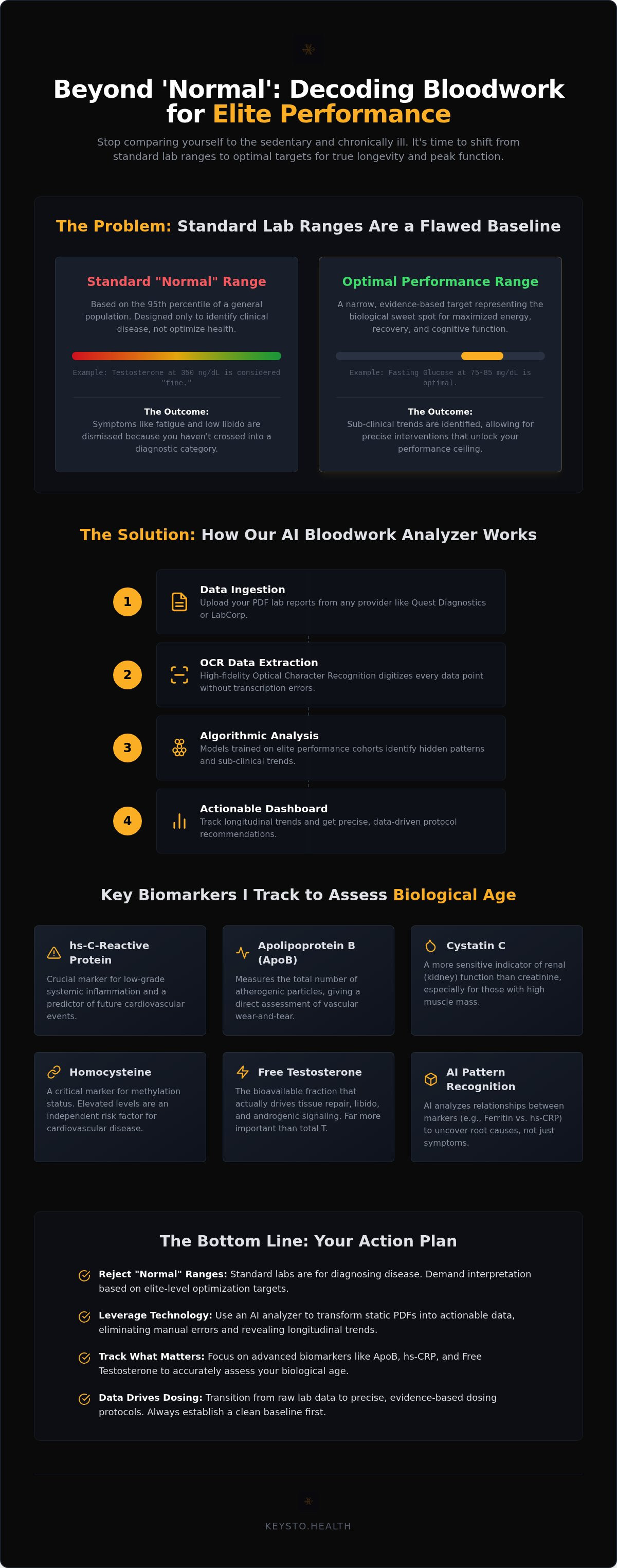
Standard lab reference ranges aren't designed for elite performance. They're designed to identify failing organs and clinical disease in a population that's statistically sedentary and chronically ill. If your physician tells you your biomarkers are "normal," they're often dismissing your symptoms because you haven't yet crossed into a diagnostic category. To achieve true longevity, you need an AI bloodwork analyzer that interprets data through the lens of biological optimization rather than pathology.
I understand the frustration of tracking 50+ biomarkers across fragmented spreadsheets while looking for patterns your doctor ignores. After 25 years in elite performance, I've seen how manual tracking fails most high-performers. You'll learn how to stop reading results through the lens of disease and start decoding your biomarkers for peak performance. We'll cover the mechanics of longitudinal tracking, how to set aggressive optimization targets, and how to use data to drive specific protocol adjustments. This is the blueprint for moving from "within range" to biologically elite.
Key Takeaways
- Standard lab ranges identify disease while performance optimization requires narrow, elite-level targets for true biological mastery.
- An AI bloodwork analyzer leverages OCR technology and algorithmic comparisons to transform static PDF results into actionable performance data.
- Decode complex biomarkers to identify physiological needs and select synergistic compound stacks based on your unique metabolic profile.
- Transition from raw lab data to precise dosing protocols by establishing a clean baseline before introducing any research compounds.
- Streamline your strategy by using specialized tools to track longitudinal trends and reference evidence-based clinical data for hormone optimization.
Table of Contents
The Failure of Standard Lab Reference Ranges
Standard lab results are interpreted against a reference interval derived from the 95th percentile of the general population. This is a fundamentally flawed baseline. If you're comparing your biomarkers to a population that's 70% overweight and increasingly sedentary, "normal" is a dangerously low bar. Being "in range" simply means you aren't currently dying of an acute disease. It doesn't mean you're performing at your peak. This is why many men with testosterone levels at 350 ng/dL are told they're "fine" despite having zero libido and chronic fatigue. Standard medicine treats the average; we treat the individual.
The Pathological vs. Optimal Divide
Pathological ranges are designed for triage. They tell a physician when to prescribe a pharmaceutical or schedule a surgery. In contrast, optimal ranges represent the biological sweet spot where energy, recovery, and cognitive function are maximized. For example, a "normal" fasting glucose might be 99 mg/dL, but for longevity and metabolic efficiency, I look for 75–85 mg/dL. An AI bloodwork analyzer identifies these sub-clinical trends long before they manifest as chronic issues. While there are broad applications of AI in healthcare for diagnosing disease, our focus is on using these algorithms to find your performance ceiling.
Biological Age vs. Chronological Markers
Chronological age is a useless metric for high-performers. I care about your biological age, which we assess through markers of vascular aging and systemic inflammation. We track specific data points like High-Sensitivity C-Reactive Protein (hs-CRP) and Apolipoprotein B (ApoB) to determine the actual wear on your systems. We use these to build a clear picture of internal health that goes beyond the date on your birth certificate.
- Cystatin C: A more sensitive indicator of renal function than creatinine for those with high muscle mass.
- Homocysteine: A critical marker for methylation status and cardiovascular risk.
- Free Testosterone: The bioavailable fraction that actually drives tissue repair and androgenic signaling.
You can reference our Longevity Protocol for the specific baseline targets we aim for. If your thyroid or testosterone levels are technically "within range" but you're experiencing brain fog or poor recovery, your data is telling you that your current state is sub-optimal. We use an AI bloodwork analyzer to bridge that gap and move toward precision optimization.
Mechanisms of an AI Bloodwork Analyzer
Precision medicine requires high-fidelity data processing that exceeds human capacity for manual entry. An AI bloodwork analyzer utilizes advanced computational models to eliminate the interpretative lag between receiving a lab report and initiating a protocol. I've seen countless athletes compromise their progress by misreading units or failing to spot trends across multiple PDF reports. Automation solves this by standardizing data into a single, longitudinal dashboard.
OCR and Data Extraction Precision
The foundation of any reliable analysis is Optical Character Recognition (OCR). This technology handles the diverse formatting used by major providers like Quest Diagnostics and LabCorp, as well as specialized international labs. High-fidelity extraction ensures that every biomarker, from basic lipids to complex hormonal fractions, is captured without the risk of transcription error. We process this data through encrypted pipelines to maintain absolute privacy while building a historical record of your biological shifts.
Algorithmic Optimization Frameworks
Most software compares your data to hospital averages; we use models trained on elite performance cohorts. This framework establishes Green Zones, which are significantly tighter than standard clinical ranges. Our HRT Bloodwork Analyzer functions as the gold standard for this process, specifically tuned for those utilizing exogenous hormones or peptide stacks. Reviewing our full suite of optimization protocols provides the necessary context for these data points once they are extracted.
The real power of an AI bloodwork analyzer lies in pattern recognition across seemingly unrelated systems. For example, the relationship between Ferritin and High-Sensitivity C-Reactive Protein (HS-CRP) is a critical diagnostic tool. If Ferritin is elevated while HS-CRP remains low, we are likely looking at iron overload. If both are elevated, the data indicates systemic inflammation, necessitating a shift toward regenerative compounds. AI identifies these correlations instantly, whereas a manual review might miss the connection.
- Elimination of Human Error: Removes the risk of misinterpreting units (e.g., ng/dL vs. nmol/L).
- Longitudinal Tracking: Visualizes biomarker velocity to predict performance plateaus.
- Evidence-Based Benchmarking: Compares results against clinical studies rather than general population bell curves.
- Instant Protocol Suggestions: Bridges the gap between raw data and actionable dosing schedules.
I prioritize these algorithmic frameworks because they provide the clinical confidence required for high-stakes biohacking. When you move beyond simple "in-range" thinking, you require a tool that functions as a strategic architect for your biology. This methodical approach ensures that every compound introduced to your system is backed by a clear, data-driven necessity.
Identifying Synergistic Stacks and Performance Gaps
Raw data is useless without a translation layer that converts numbers into specific interventions. An AI bloodwork analyzer identifies the precise performance gaps that standard medical reviews overlook. For example, if I see elevated liver enzymes like Alanine Aminotransferase (ALT) or Aspartate Aminotransferase (AST) in an athlete using oral research compounds, we immediately adjust the dosing schedule or introduce hepatoprotective agents. This data-driven approach ensures you aren't guessing with your internal health.
Peptide Synergy: BPC-157 and TB-500
When lab markers like High-Sensitivity C-Reactive Protein (HS-CRP) or Erythrocyte Sedimentation Rate (ESR) remain chronically elevated, systemic inflammation is likely hindering your progress. This is where we deploy the Regenerative Protocol. The synergy between BPC-157 and TB-500 is unparalleled for tissue repair.
- BPC-157: Administered at 250–500 mcg/day, it works by upregulating growth factor receptors and accelerating the formation of new blood vessels, a process known as angiogenesis.
- TB-500: This compound promotes actin-sequestering, which is critical for cell migration and vascular repair.
Pairing these two compounds creates a synergistic effect that addresses both localized injury and systemic recovery needs identified by your bloodwork. While much of the foundational data for these peptides stems from animal models, the real-world application in elite human performance has established clear efficacy for rapid connective tissue recovery.
Hormone Optimization Markers
Optimization isn't just about high numbers; it's about the ratio and availability of hormones. I prioritize Free Testosterone over Total Testosterone because it represents the fraction actually available to bind to androgen receptors. High levels of Sex Hormone-Binding Globulin (SHBG) can effectively neuter even high Total Testosterone levels by binding them too tightly.
Management of Estradiol (E2) is equally critical for male performance. If your E2 is too low, you lose neuroprotection and joint health; if it's too high, you risk water retention and mood instability. We use the Testosterone Optimization Protocol to maintain these markers within the elite performance "Green Zones" identified by our AI bloodwork analyzer. This methodology allows us to justify dosing adjustments based on real-time physiological response rather than generic guidelines.
Implementation: From Lab Data to Dosing Protocols
Baseline testing is the non-negotiable first step in any performance regimen. You cannot track a physiological shift if you don't have a definitive starting point. I require a comprehensive panel before any research compound enters the system. Use the AI bloodwork analyzer to establish this baseline, ensuring every subsequent change is measured against a clean data set. We then schedule follow-up labs every 6 to 12 weeks to monitor biological response and stabilization.
Biohacking is a game of precision, and more is rarely better. If a compound doesn't move the needle on your target biomarkers within two testing cycles, we don't increase the dose; we reassess the mechanism. Flooding receptors with excessive dosages often leads to desensitization or side effects that muddy your data. We use longitudinal tracking to identify the minimum effective dose required to reach your elite performance targets.
Precision Dosing and Reconstitution
Once your AI bloodwork analyzer identifies specific gaps, you must translate those needs into exact milligram-to-microgram ratios. This is where most practitioners fail by eyeballing volumes or miscalculating dilutions. I utilize the Peptide Reconstitution Calculator to ensure every injection is mathematically sound. Incorrect dosing leads to biomarker volatility, making it impossible to establish a predictable dose-response relationship for compounds like Ipamorelin or CJC-1295.
Monitoring Metabolic and Vascular Health
We prioritize Hemoglobin A1c (HbA1c) and fasting insulin to gauge metabolic efficiency and glucose disposal. For vascular health, I look at Apolipoprotein B (ApoB) and LDL-P as the primary drivers of the Cardiovascular Protocol. Standard lipid panels are often misleading for athletes with high muscle mass; particle count and ApoB provide the granular data needed for true risk assessment.
A clinical study published in the Journal of the American College of Cardiology, which analyzed data from over 400,000 participants, confirmed that ApoB is a superior predictor of vascular events compared to standard LDL-C. By tracking these specific markers, we can adjust our protocols to ensure that performance gains don't come at the expense of long-term arterial health. This methodical monitoring allows for aggressive optimization while maintaining a defensive posture against metabolic decay.
The Keys to Health HRT Analyzer: The Architect’s Tool
The HRT Bloodwork Analyzer is the culmination of 25 years spent at the intersection of high-stakes sport and biological science. I built this tool because standard medical portals are incapable of providing the granular insights required for Hormone Replacement Therapy (HRT) or complex peptide stacks. This AI bloodwork analyzer functions as a strategic architect; it doesn't just report numbers but interprets them against elite-level benchmarks. By integrating directly with our Compound Encyclopedia, the system references clinical evidence for 112 research compounds to explain exactly how specific interventions affect your Metabolic Profile.
Protocol Builder Integration
Moving from analysis to action is a seamless process through our Protocol Builder. Once the AI identifies your performance gaps, you can construct a customized stack that addresses your specific biological signatures. This ensures that every compound in your regimen serves a documented purpose. I designed this AI bloodwork analyzer to serve as the foundation of our community, providing a level of technical depth that competitors simply cannot match.
- Refinement: Adjusting dosing based on real-time biomarker shifts.
- Customization: Selecting synergistic compounds like pairing Tesamorelin with Ipamorelin to maximize Growth Hormone (GH) secretion.
- Execution: Utilizing precise milligram-to-microgram ratios for consistent results.
This isn't a suggestion engine; it's a blueprint for biological mastery. We prioritize the removal of guesswork by ensuring that every protocol is backed by the data extracted from your most recent lab reports. You aren't just following a trend; you're executing a strategy based on the reality of your internal chemistry.
Animal Longevity Applications
Biological optimization isn't limited to human performance. We've expanded the analyzer to include Species-Specific reference ranges for horses, dogs, and cats. This allows you to apply the same level of scientific rigor to your animals as you do to yourself. For example, our Canine Longevity Protocol utilizes these data points to extend the healthspan of senior dogs through targeted cellular support.
- Vascular Health: Monitoring cardiac markers in performance horses.
- Renal Function: Tracking specific biomarkers in aging felines to prevent chronic decay.
- Mobility: Using inflammatory markers to justify the use of regenerative compounds in working dogs.
This cross-species capability ensures that the Keys to Health community has the tools to manage the longevity of every member of their household with clinical precision. Whether you're optimizing your own testosterone levels or managing the recovery of an equine athlete, the data remains the final authority.
Master Your Biological Blueprint
Standard medicine operates on a reactive model; elite performance requires a proactive architecture. After 25 years in the field, I've seen that the difference between being "within range" and truly optimized is often the difference between stagnation and biological mastery. An AI bloodwork analyzer provides the clinical confidence to move beyond guesswork by identifying sub-clinical trends before they manifest as performance plateaus. By referencing data on 112+ research compounds, we bridge the gap between raw lab results and actionable dosing strategies for peptides and hormones.
We've moved past the era of manual spreadsheets and broad population bell curves. You now have the technical tools to track biological velocity and adjust your protocols with mathematical certainty. Whether you're refining a testosterone stack, managing systemic inflammation, or extending the healthspan of a senior animal, the data remains the final authority. It is time to stop viewing your bloodwork as a checklist for disease and start using it as a blueprint for optimization. Start decoding your internal chemistry and take command of your performance ceiling today.
Frequently Asked Questions
Is an AI bloodwork analyzer as accurate as a doctor?
Accuracy is high for data extraction, but the focus differs from a general practitioner. While a doctor identifies disease, an AI bloodwork analyzer identifies sub-clinical trends for performance. It eliminates human error in unit conversion and historical tracking. I use it to find the biological sweet spot that standard medicine ignores. It's a tool for architects of their own biology rather than patients waiting for a diagnosis.
Can I upload results from any lab to the HRT analyzer?
Our OCR technology is designed to handle varied formats from Quest Diagnostics, LabCorp, and specialized international providers. It standardizes diverse units to ensure your longitudinal dashboard remains accurate. This prevents the confusion that often arises when comparing results from different labs over several years. You can upload any high-quality PDF report to the system for immediate data extraction and algorithmic comparison against our performance databases.
What specific markers are most important for TRT optimization?
We prioritize Free Testosterone, Sex Hormone-Binding Globulin (SHBG), and Estradiol (E2). Tracking the bioavailable fraction of testosterone is more useful than Total Testosterone alone. We also monitor Hematocrit and Hemoglobin to assess blood viscosity during TRT. These markers, along with LH and FSH, provide the data needed to adjust dosing schedules or introduce ancillary compounds for endocrine balance.
How often should I use the AI analyzer to track my progress?
You should establish a baseline before starting any new protocol and then re-test every 6 to 12 weeks. This interval provides enough time for biomarkers to stabilize after introducing research compounds or adjusting hormone dosages. Frequent tracking allows us to visualize the velocity of your biological shifts. It ensures that every protocol change is backed by a clear, data-driven necessity rather than subjective feeling or guesswork.
Does the analyzer suggest specific peptide dosages?
The analyzer identifies physiological needs and suggests evidence-based protocols from our database of 112 research compounds. While it points toward specific stacks, you must use the Peptide Reconstitution Calculator to determine exact milligram-to-microgram ratios. For instance, if the system identifies high systemic inflammation, it may suggest a stack of BPC-157 and TB-500 at practical ranges like 250-500 mcg per day for tissue repair.
Is my health data secure when using AI tools?
We utilize encrypted processing pipelines to ensure your biological signatures remain private and secure. Unlike many mainstream health portals, we don't sell your data to insurance brokers or third-party marketing firms. The AI bloodwork analyzer is built on a high-fidelity data extraction model that prioritizes user anonymity. Your historical lab data is used exclusively to build your longitudinal performance dashboard and optimize your specific biological protocols.
What happens if the AI identifies a marker outside of optimal ranges?
The system flags any marker falling outside our elite "Green Zones" and provides a technical breakdown of the mechanism involved. It references our Compound Encyclopedia to help you understand the potential performance impact. If a marker indicates acute pathology rather than a sub-clinical performance gap, the tool will signal that a medical consultation is necessary. It bridges the gap between raw data and actionable biological strategy.
Can the tool analyze bloodwork for pets or horses?
Yes, we've integrated species-specific reference ranges to accommodate canine, feline, and equine health markers. This allows owners to track the longevity of their animals with the same precision used for human athletes. You can monitor markers for renal function in cats or joint inflammation in working dogs. Reference our Canine Longevity Protocol for specific baseline targets for senior animals and performance breeds.

Article by
Samir Levin
Samir Levin is a biohacker and longevity researcher with 25 years of personal experimentation across peptides, hormonal optimization, and regenerative medicine. He is the founder of Keys to Health — a platform combining a 112-compound research encyclopedia, AI-powered bloodwork analyzer, peptide protocol builder, and evidence-based PDF protocols used by thousands of biohackers worldwide.
Samir's work is grounded in first-person experimentation, not theory. He personally reversed 10+ years of AAS-induced gynecomastia without surgery using an enzymatic stack he developed and documented. His protocols are built from clinical literature, N=1 data, and feedback from the Keys to Health community.
He covers peptides, TRT/HRT, GLP-1 agents, senolytics, longevity stacks, cognitive enhancement, and animal longevity protocols for dogs, cats, and horses.
AIbloodworkbiomarkersperformance optimizationbiohackinglongevitydata-driven healthHRT